Reading time
12 min
When I visited Atravesar el lago, a cycle of performances programmed at Casa del Lago, curated by Adonay Bermúdez, I was confronted with a certain unease that I could not fully understand at the time.¹ At first, I could not find a relationship between what the curator had anticipated and the performative experiences that had taken place, as the dialogue between each gesture seemed rather dissonant. The circumstances of this experience revealed to me a troubling symptom of the current cultural landscape: a curatorial politics that attempts to show "the indigenous" as artistic style-category and identity enunciation, but that does not manage to question the colonial logic such a criterion brings with it.
Through a reconstruction of the experience of the performances and their written accompaniment (the curatorial text), I will attempt to address three questions situated in Atravesar el lago: How do indigenous experiences and bodies enter the exhibition? What colonial drives persist in the discourse? And how is it that art produced by indigenous society smuggles a logic of dissent that dismantles the discursive operation that summons its body of work to the museum space?
Atravesar el lago was a performance curation proposal in which the indigenous experience was reduced to a rhetorical abstraction. A tacit link was established between indigeneity, spirituality, and ancestrality. In the curatorial text provided during the exhibition, the show was described as follows:
[The artists] immerse themselves in the memory and cosmovisions of their respective peoples, rescuing stories and traditions that resist cultural homogenization. Their works not only recover these forms of ancestral knowledge, but project them as tools for imagining futures in which indigenous peoples are protagonists of their own history, defending their territories, their spirituality, and their right to live in fullness.²
Under modern expository rhetoric, the curatorial text seeks to establish a general outline of what will be exhibited. However, the descriptive position adopted by the curator establishes semantic cuts that homogenize the particularities of each performance.
Drawing on a rereading of Gayatri Spivak's Can the Subaltern Speak?, Eve Tuck and K. Wayne Yang interrogate the ways in which the subaltern speaks and propose the following axiom: "the subaltern can speak, but is only invited to speak about her/our pain."³ While Atravesar el lago did not invite the artists to "speak of their pain," Bermúdez anticipated what they wanted to say about their territorial experiences, "inscribes" the body and retains it, through a series of expectations and hierarchies regarding what he finds most interesting about such subaltern experiences⁴.
Placed in areas near where each performance took place, a series of texts on orange-colored plaques attempted to inform (inscribe) what was about to occur (or had already occurred). The written word claimed for itself a certain hermeneutic competence⁵ over what was being shown, grounding its validity and its law in the figure of the author-curator. The text took precedence over the present body.
By deferring the experience between text and body in action, one of the theses put forward by Gayatri Spivak materialized before my eyes, when she reminds us that: "All speech, even the most apparently immediate, involves a distanced deciphering by another, which is, at best, a choice[6]." The enunciation of the subaltern is misinterpreted, but it is the misinterpretation that is erected as the condition of possibility for another type of enunciation[7]. It seems to me that in the descriptive poverty — that irreducibility of the act by the word — a gesture of dissent materialized, operating internally in favor of destabilizing the curator's colonial drive.
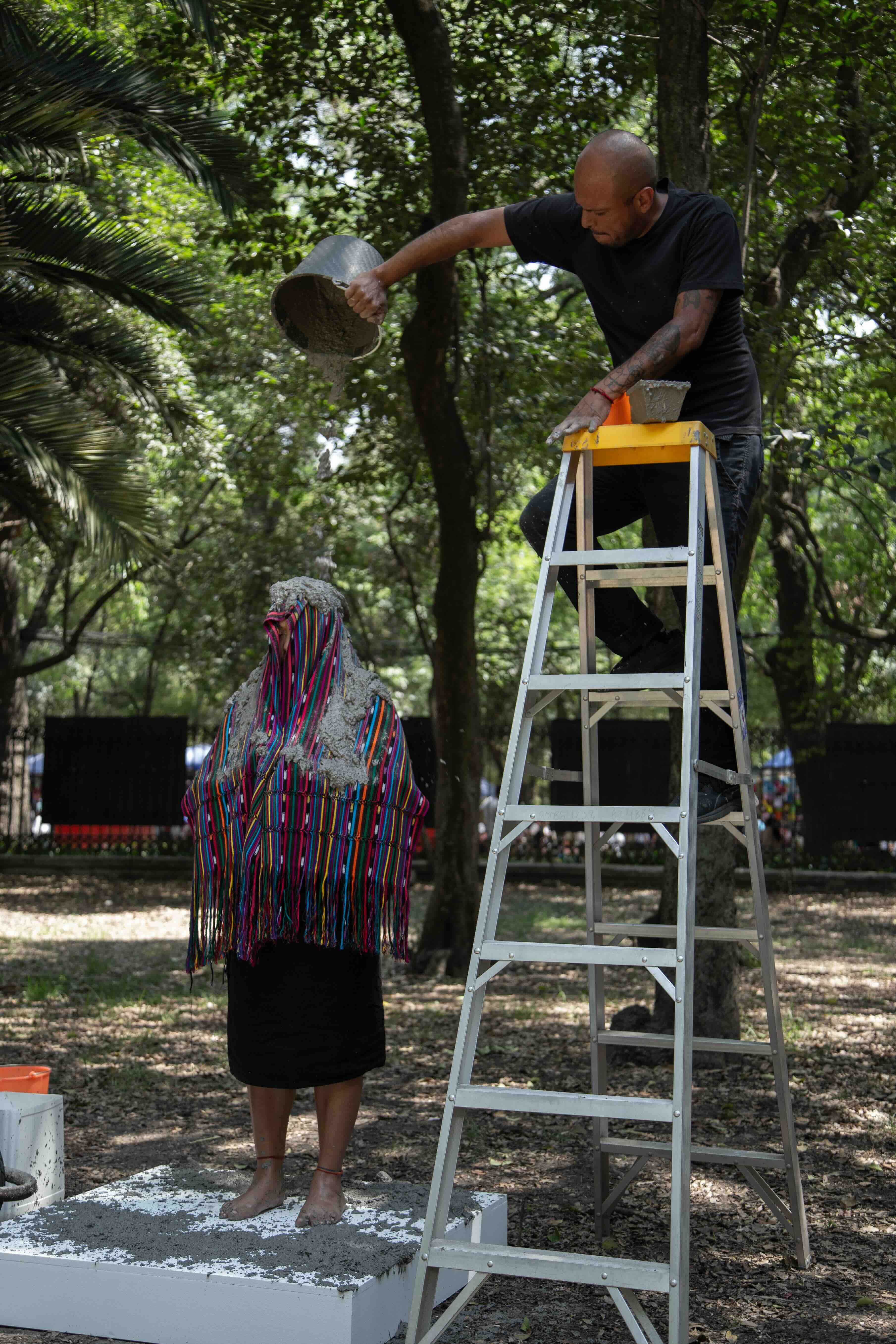
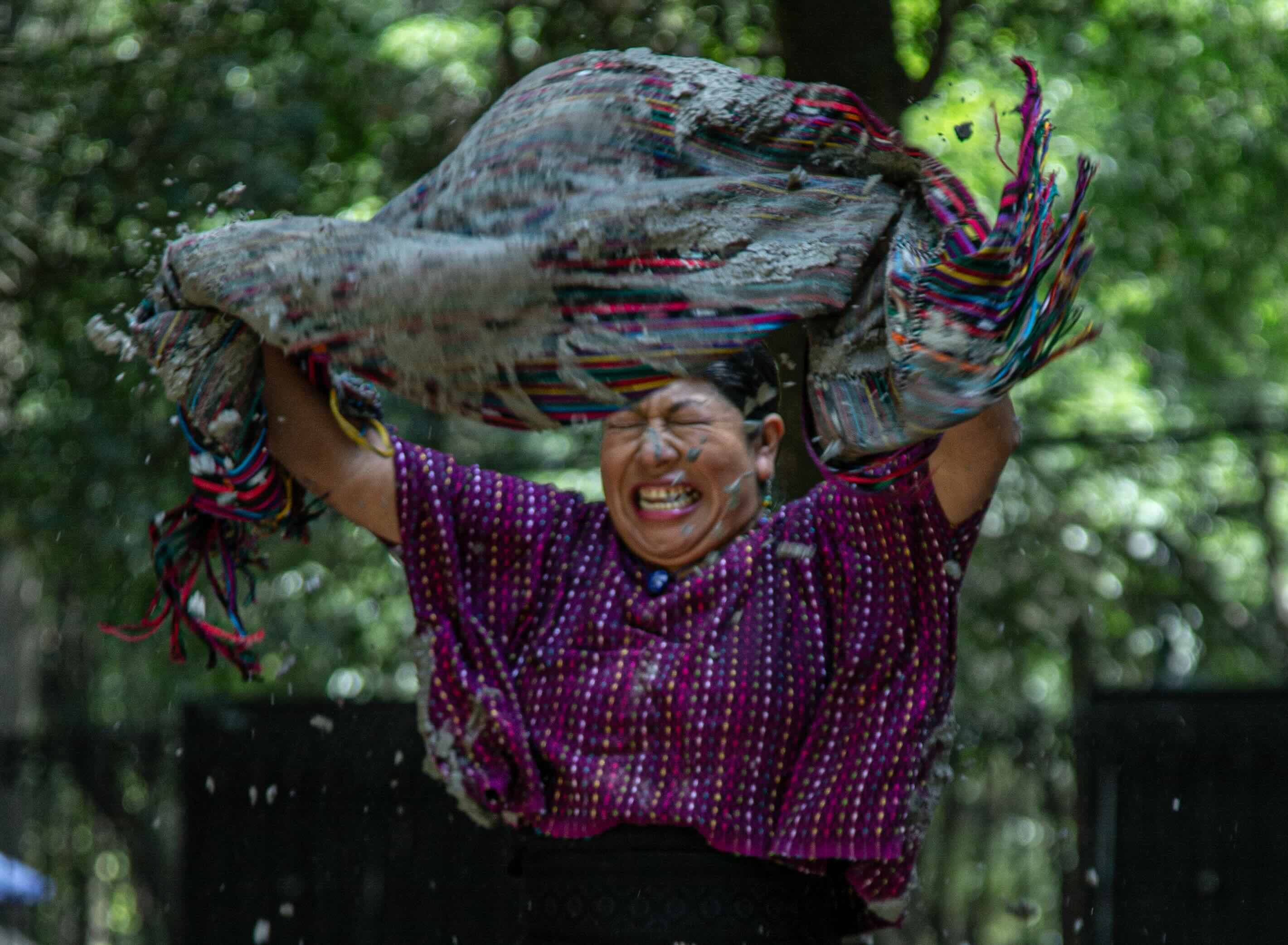
Marilyn Boror Bor, from Guatemala and belonging to the Maya-Kaqchikel people, presented "Lo que el cemento no puede cubrir" (What Cement Cannot Cover). With her face covered by a rebozo, she placed herself on a pedestal and commissioned a man to pour fresh cement over her. The gravity of the gesture, the material oppression of the concrete falling over her body, spoke to the problems her country faces in the face of the unchecked advance of cement companies. In interviews, the artist mentions that her work seeks to make visible the siege that Cementos Progreso de Guatemala has carried out against the community of San Juan Sacatepéquez, a Maya community dedicated primarily to the cultivation and sale of flowers, for the construction of the largest cement plant in Latin America⁸.
The current drama of the territory, shown through her performance, was dissolved in generic descriptions and the use of convenient tropes. In her respective plaque, Bermúdez describes: "the textile affirms itself as a book that the colony could not burn: a system of signs in which cosmovision, genealogy, and territorial knowledge are inscribed.⁹" It refers only to the clothing worn by Boror Bor, without paying attention to the denunciatory meaning her performance conveyed.
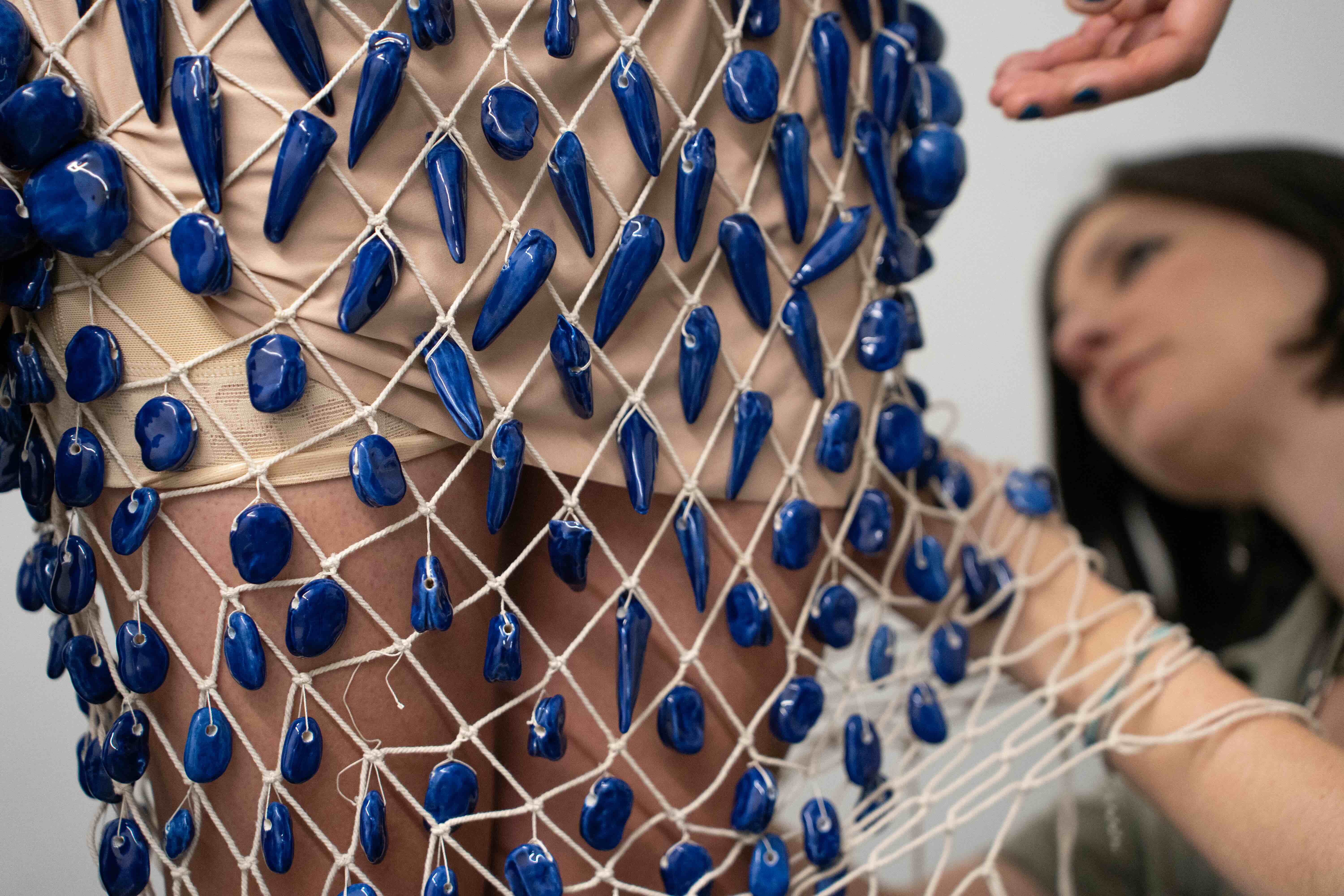
Seba Calfuqueo presented "Guardo mis semillas para el futuro" (I Keep My Seeds for the Future). While wearing a blue dress made of ceramic beads simulating seeds/raindrops, the artist moved through the audience to distribute loose pieces of it. In this way, certain intimacies were produced ephemerally between artist and audience: extending a hand, taking the seed, that brief contact of hands, that complicit glance shared for an instant.
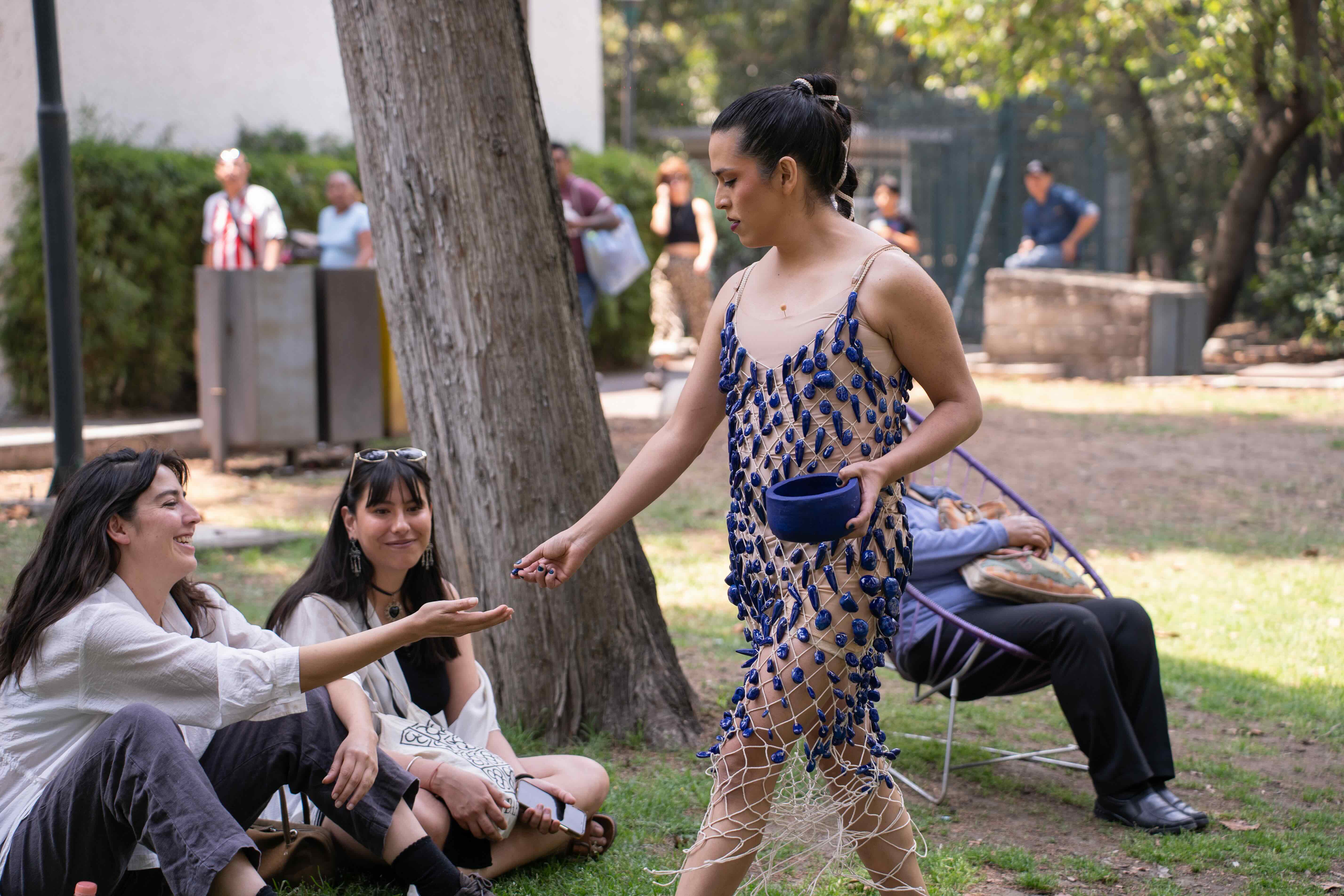
Her gesture recovered the Mapuche tradition of trafkintu, a seed exchange practice. This citation shifts Calfuqueo's address, from sensory experiences to the persistence of the Mapuche people in the present. The trafkintu was originally a commercial ritual in which livestock, textile, and ornamental goods were exchanged between different Mapuche communities. However, the relocation of the people and the colonial siege of their existence caused the practice to be modified. From the nineties onward, the trafkintu was taken up by Mapuche women to preserve the biodiversity of their creole seeds. Thus, an originally commercial practice became a territorial struggle against monocultures and in favor of biodiversity¹⁰. In Calfuqueo's practice — who also militates in an interest for Chile's water crisis¹¹ — giving away a seed also means promising a rain to come¹².
Bermúdez barely mentions these particularities in his description of the piece:
Performative action that situates the body as a territory of transit, memory, and safeguarding. The performance begins with the artist entering the space, while holding her dress as a threshold of contact with the audience: the direct gaze at each attendee establishes a relationship of presence and listening[13].
Finally, Julieth Morales presented "Enchumbarnos: Cuerpo, Norma y Territorio" (Enchumbarnos: Body, Norm, and Territory). Accompanied by another woman, Morales negotiated the tensions of two textile instruments: a blanket and a ribbon. Each woman took turns wrapping the other with the ribbon while vocalizing subtle lullabies. The piece recovers the knowledge of the chumbetradition, belonging to the Misak and Inga peoples of southern Colombia, which consists of swaddling newborn babies up to two years of age¹⁴. For Morales, recovering this gesture allows her to play with the ambivalence of swaddling: on one hand, the care of the newborn; on the other, motherhood as patriarchal mandate, the oppression of a ribbon that tightens around the body. The artist takes performance as a place to enunciate her disagreement with the heteropatriarchal configuration of her own indigenous community — it is an exercise in self-critique that tensions the redemptive imaginaries commonly associated with indigenous peoples.
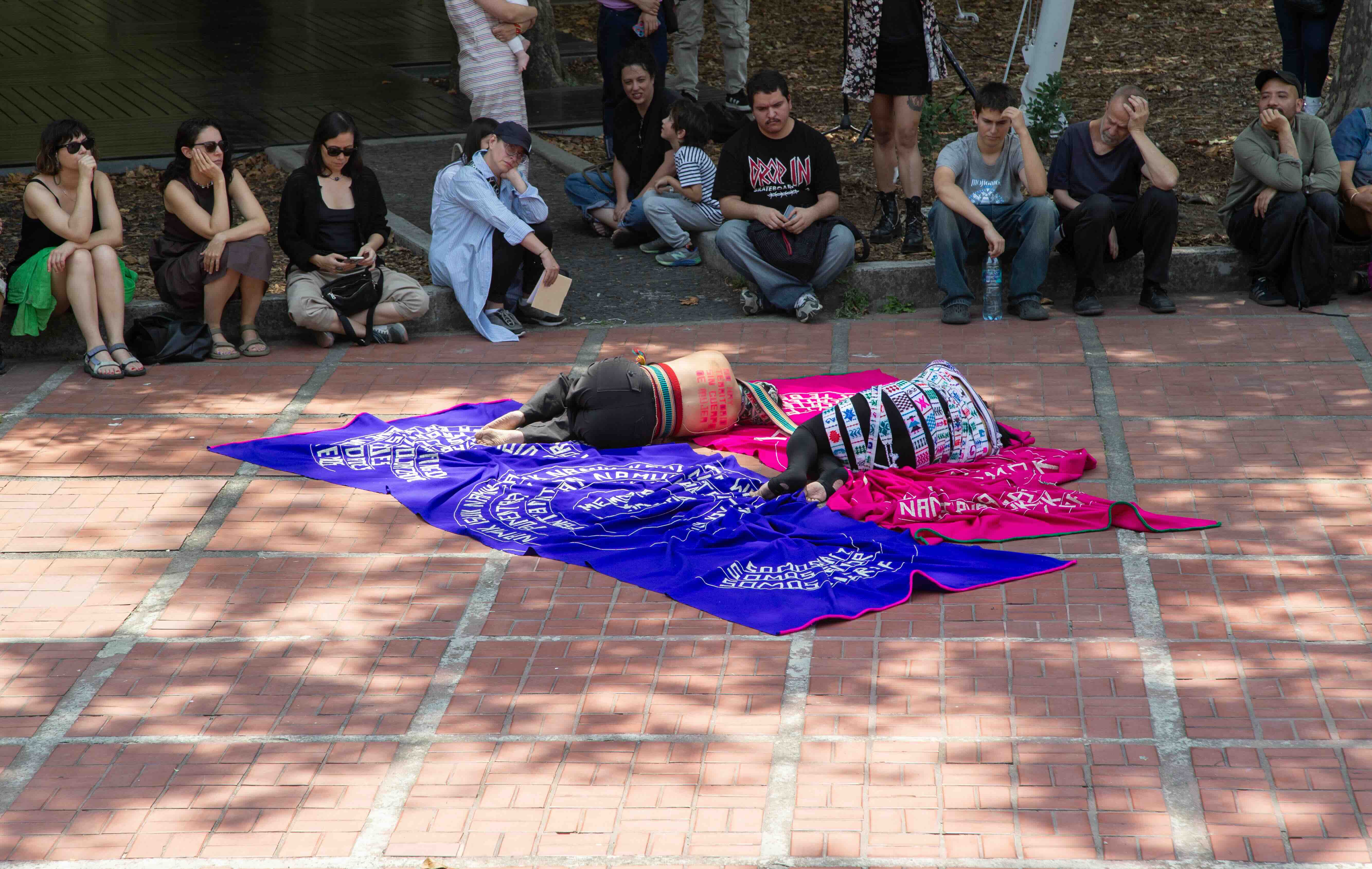
In his text Bermúdez refers to the chumbeand its central role in the rituals of the Misak people. He also describes how Morales's piece elaborates as a critique of "the forms of correction and discipline that traverse bodies from birth.¹⁵" The commentary she deploys inward toward her own community is omitted. However, this theme was central to the performance, as it began with Morales wearing a cape that proclaimed:
"THE VIOLENCES INFLICTED | BY THE COLONIZING PATRIARCHY | UPON OUR COMMUNITIES | FROM WITHIN OUR OWN COMMUNITIES | IS A TRAP WE WILL NOT FALL INTO."
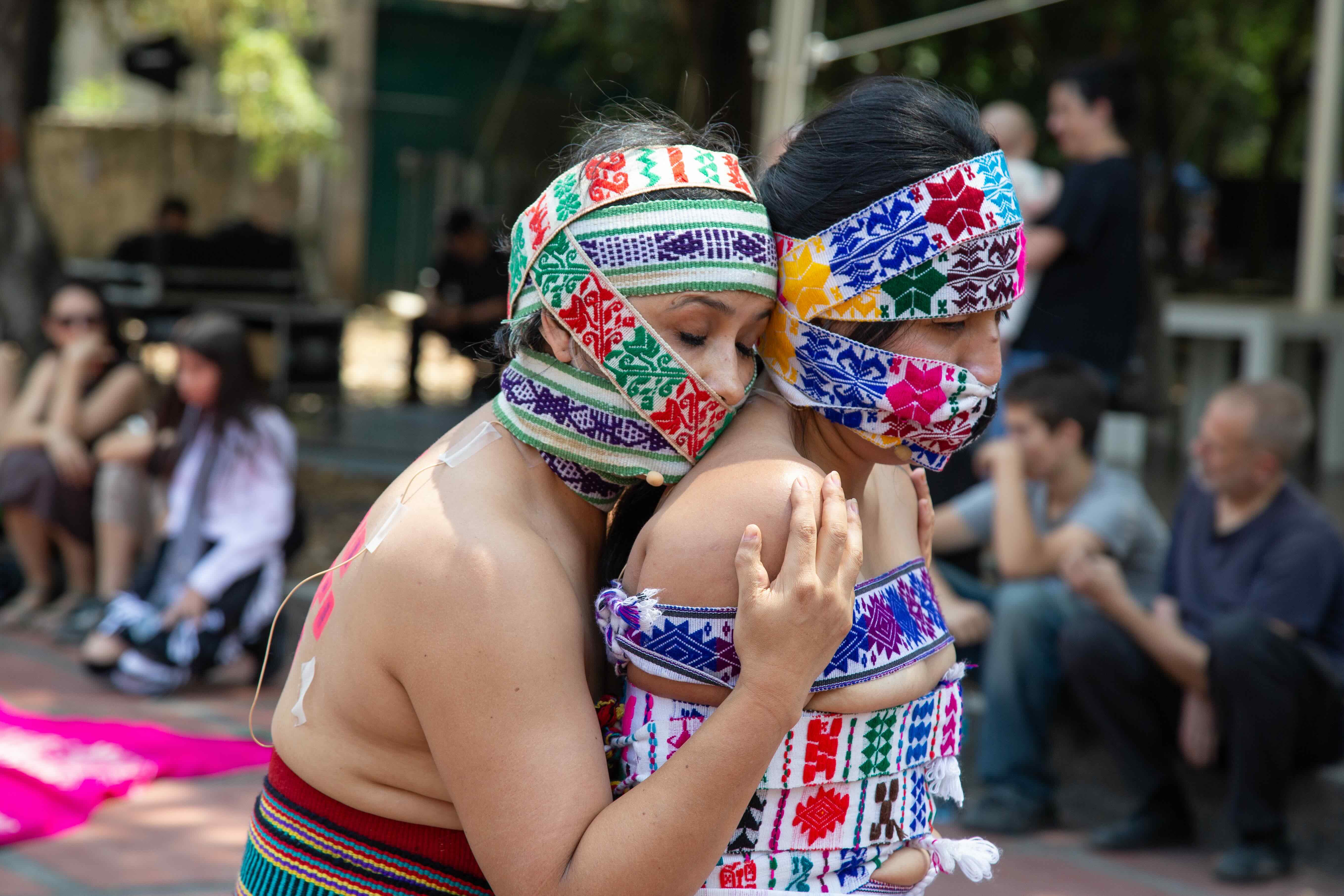
Bermúdez's curatorial mediation appears as a gap between body and word, action and text. It also reminds us of the risks involved in speaking for the other(s) and assuming before them a certain authority entrenched in a colonial inheritance. Paradoxically, my critique is sustained by another repertoire of textualities — mostly communications from the artists themselves — to demonstrate the depth of what was shown in their performances. Despite good intentions, it is necessary to note that this act of writing could also be yet another misinterpretation.
To close this text, I would like to return to the gesture that gives this piece its title: smuggling. Smuggling allows me to make sense of the dissonance that allowed itself to be shown in each performance. In opposition to what the curator anticipated, the gestural becomings and bodily presence of the artists enlivened another horizon of referentialities, significations, and discursivities. The sensory experience of the pieces, the intensity of their gestures, already insinuated to me what I confirmed in the documentation of this essay: that each artist operated from a series of her own poetic, political, and aesthetic coordinates. Rather than resonances, their gestures performed dissonances among themselves, evidencing the ways in which curatorial conceptualization falls short of what the performances were doing.
Smuggling is that which is introduced into a territory without going through the proper legal process. To pass over the law, or over the word — that text that inscribes an a priori order onto the event. Fred Moten and Stefano Harney will remind us of the smuggler as one who renders capitalist logistics unrealizable, for they bring with them that which lies outside the norm. Their becoming is an unlocalizable becoming, an unreachable point of view that thus establishes the sabotage of the capitalist structure and, therefore, of the colonial discursive structure¹⁶. The artist-smugglers of Atravesar el lago demonstrate in their gestures what Moten and Harney elaborate. There is something in the body that always smuggles the discourse, that introduces its contradiction and its inoperability.
Smuggling dissent becomes a crucial gesture in the face of the current landscape of curatorships interested in indigenous subjectivities¹⁷. Before the implacable logic of capture of the museum apparatus, the possibility of an internal dissent that appears unsuspected emerges as the last redoubt for producing deviations from the order of the foreseen and pre-established. The gap between Bermúdez's descriptions and the performative experiences is a reminder of the poverty of our descriptions and the need to assume textual commitments with the ethical, political, and aesthetic ramifications that appear when attempting to say something for "the other(s)." We need to orient our writings toward those moments where the unforeseeable and the unsayable takes on consistency. To weigh in them the possibility of accompanying the smuggling.
Translated into English by Luis Sokol
1: The performance cycle was presented on Saturday, April 13, 2026.
2: Adonay Bermúdez, "Atravesar el lago," wall text (2026). A modified version of the text can be found in: Adonay Bermúdez, "Marilyn Boror Bor, Seba Calfuqueo, Julieth Morales. Performance y disidencia," Artishock, May 5, 2026, https://artishockrevista.com/2026/05/05/marilyn-boror-bor-seba-calfuqueo-julieth-morales-performance-y-disidencias/.
3: Eve Tuck and K. Wayne Yang, "R-Words: Refusing Research," in Humanizing Research: Decolonizing Qualitative Inquiry with Youth and Communities, ed. D. Paris and M. T. Winn (SAGE Publications, 2014), 224.
4: Tuck and Yang use "conscription," a play on words between inscription and conscription. See: Tuck and Yang, "R-Words," 229.
5: Jacques Derrida, Mal de archivo. Una impresión freudiana (Trotta, 1997), 10.
6: Gayatri Chakravorty Spivak, ¿Pueden hablar los subalternos? (Museu d’Art Contemporani de Barcelona, 2009), 123. [No published English translation of this edition.]
7: Manuel Asensi Pérez, “La subalternidad borrosa. Un poco más de debate en torno a los subalternos,” in: Gayatri Chakravorty Spivak, ¿Pueden hablar los subalternos? (Museu d’Art Contemporani de Barcelona, 2009), 33.
8: Marilyn Boror Bor, "Poéticas de alfabetización hacia los mundos originarios," interview by Maya Juracán, La Escuela, October 23, 2024. https://laescuela.art/es/campus/library/conversaciones/poeticas-de-alfabetizacion-hacia-los-mundos-originarios-marilyn-boror-con-maya-juracan.
9: Adonay Bermúdez, "Marilyn Boror Bor. Lo que el cemento no puede cubrir," wall text (2026). NOTE: The wall texts displayed during the performance cycle are not published anywhere; for the writing of this essay I drew on photographs from my personal archive. These, as they contain an unpublished text, may be provided at the discretion of whoever requests them.
10: Rodrigo Cuevas Vargas y Valentina Vives Granella, “Del Trafkintu como práctica ancestral mapuche al intercambio de semillas y saberes. Experiencias y resistencias en el Wallmapu y la Ciudad: Valdivia, Chile,” VIII Simposio Internacional de Geografía Agraria, November, 2017, https://singa2017.wordpress.com/wp-content/uploads/2017/12/gt03_1506925330_arquivo_deltrafkintucomopracticaancestralmapuchealintercambiodesemillasysaberes_articulofinal_singa2017.pdf.
11: Seba Calfuqueo, "Las artistas mapuche somos invisibles cuando no les servimos como cuota a las instituciones culturales," interview by Denisse Espinoza A., Palabra Pública, November 3, 2020, https://palabrapublica.uchile.cl/sebastian-calfuqueo-los-artistas-mapuche-somos-invisibles-cuando-no-les-servimos-como-cuota-a-las-instituciones-culturales/.
12: Mentioned during the performance presentation.
13: Adonay Bermúdez, “Seba Cafulqueo (sic).Guardo mis semillas para el futuro,” wall text (2026).
14: Julieth Morales, “Las comunidades indígenas no somos vestigios que están en el museo del oro,” interview by Ana Luisa González Pinzón, Artishock, November 12, 2021, https://artishockrevista.com/2021/11/12/julieth-morales-entrevista/.
15: Adonay Bermúdez, “Julieth Morales. Cuerpo, Norma y Territorio. Ritual para dos cuerpos,” wall text (2026).
16: Stefano Harney y Fred Moten, Los abajocomunes. Planear fugitivo y estudio negro (La Campechana Mental / Rancho Electrónico, 2018), 138-143.
17: This year alone, at least three exhibitions dealing with indigenous artistic production have been presented: "Wayamou: Lenguas de lo común" (Museo Tamayo), "Disputar la mirada: Imaginarios visuales de las mujeres indígenas" (MUNAL), and "Amazônia" (MNA). Also worth mentioning is the forthcoming opening of the Museo Textil de los Pueblos Indígenas y Afromexicanos, which will open its doors in the second half of this year.
Published on Jun 14 2026