Review
There are many ways to name a city. On Ingrid Hernández at the Centro de la Imagen
Reading time
6 min
There are many ways to name the city where the homeland supposedly begins, and Ingrid Hernández has found a few of them. They are refreshing ways that inscribe themselves in and at the same time run against the grain of a certain documentary tradition in Mexican photography. "Tijuana, where my family's restaurant was. Tijuana, home to nearly 500 active maquiladoras. Tijuana, where my daughter was born. Tijuana, 300,000 daily crossings through the garita [border crossing]. Tijuana, with more homicides than most of the country. Tijuana, where I grew up alongside my grandmother. Tijuana, always peripheral, first city of Latin America."¹
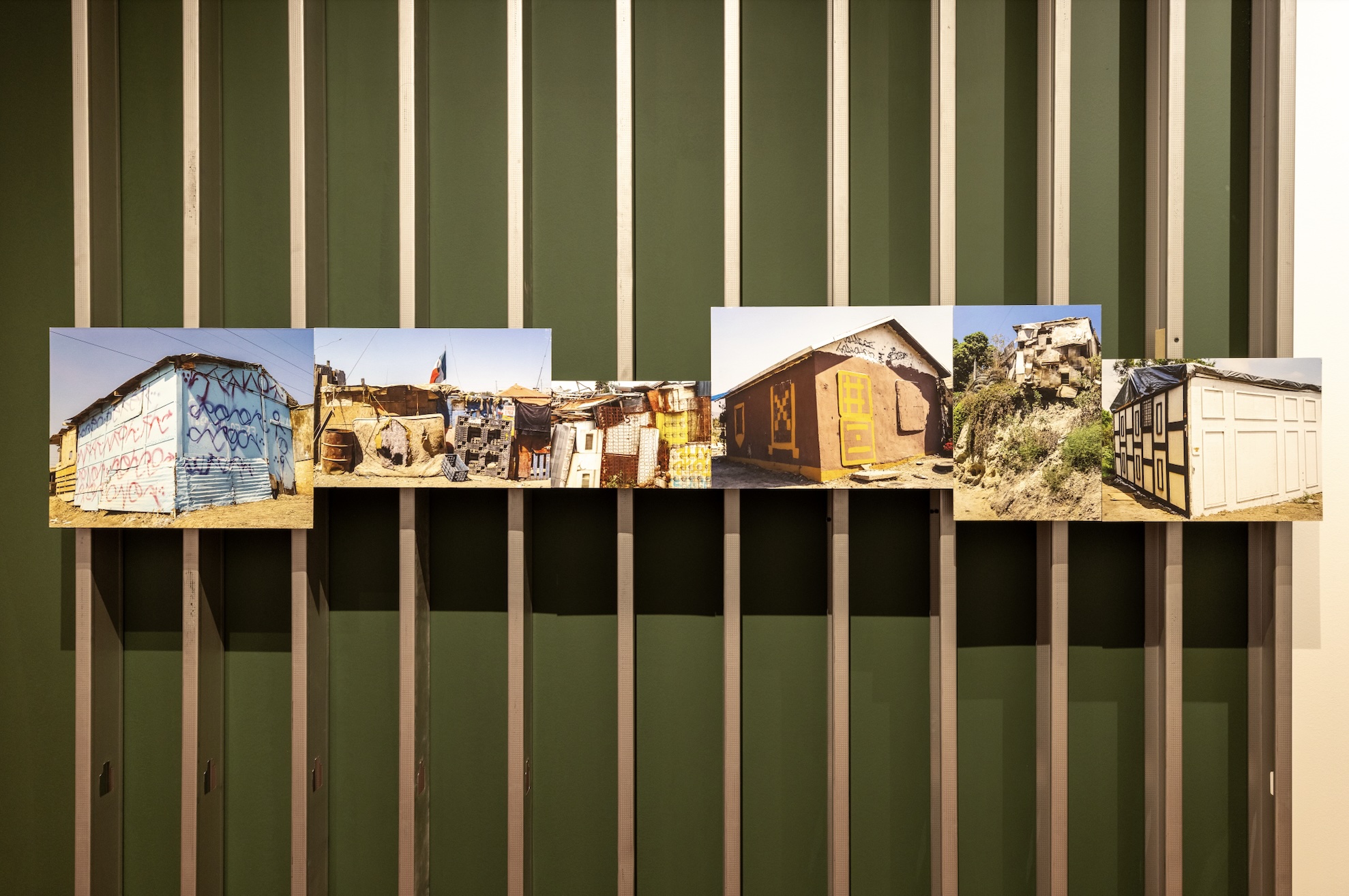
Ingrid Hernández: 20 años de arte_Under Construction_, on view at the Centro de la Imagen until August 9—after occupying the galleries of the Centro Cultural Tijuana (CECUT) last year—also speaks of another Tijuana. It refers to a permanent state of construction and transformation, a way of making in which materials that cross and inhabit the border are rescued and reused, accumulated in multiple layers: an intrinsically Tijuanense condition that the artist has been drawn to throughout her career.
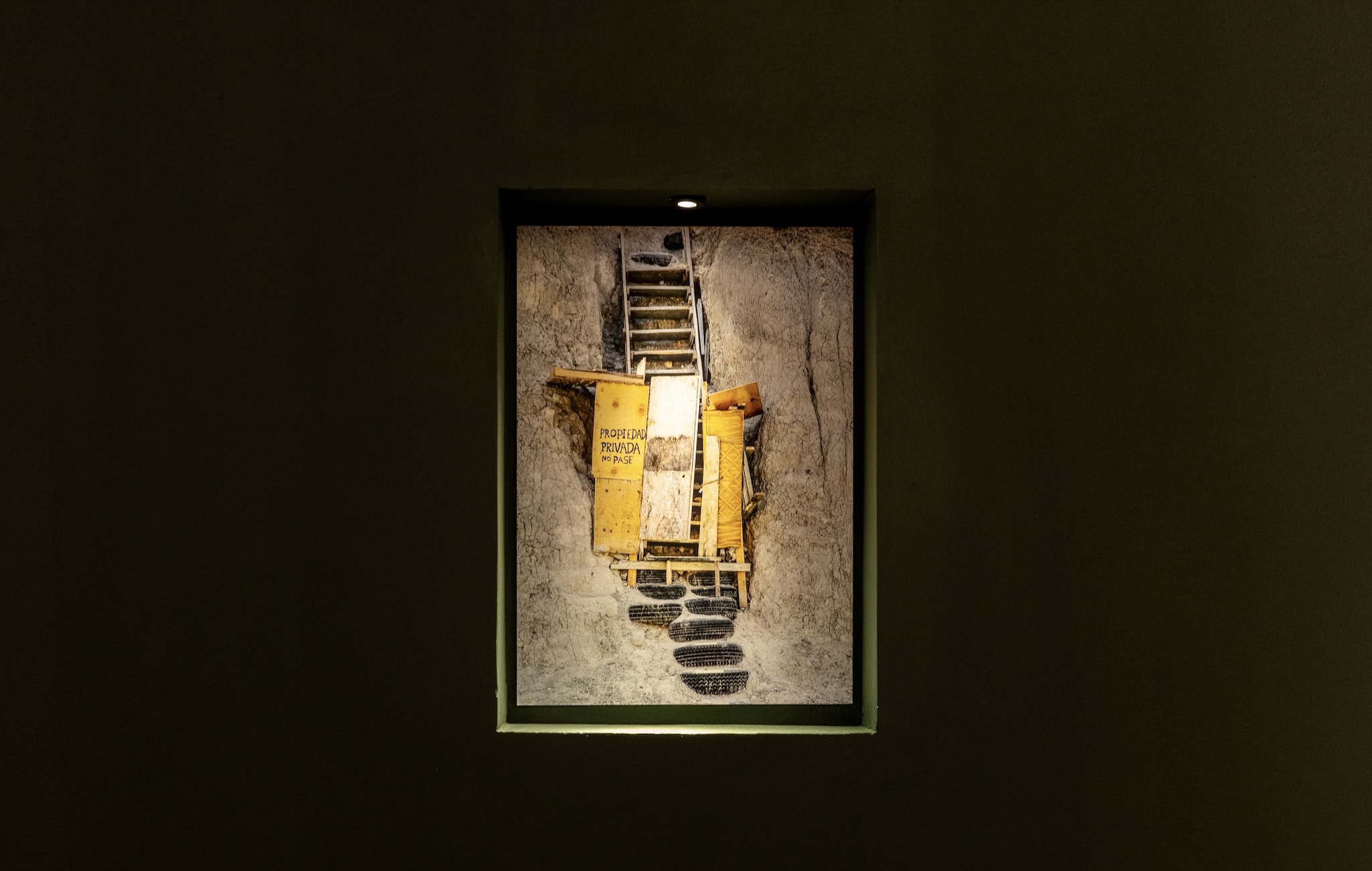
Just as garage doors and household appliances become house walls, trailer tires transform into beach stairs, and cardboard boxes turn into headboards, what seems like a momentary solution becomes a permanent way of life—like someone who ends up staying in a city they only passed through.
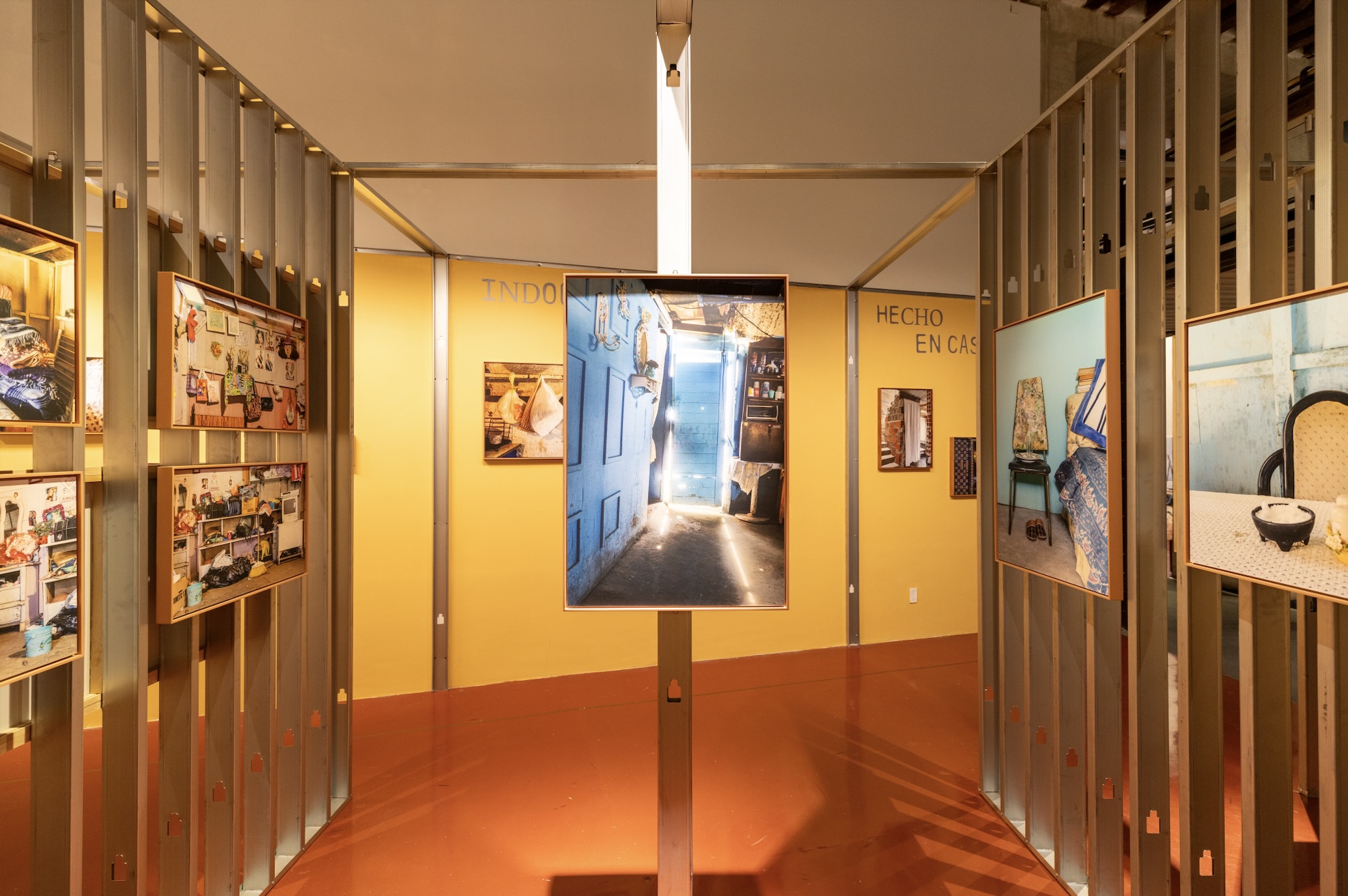
Under Construction demands more attention than other exhibitions because of the sheer quantity of images and texts it presents: thirteen nuclei packed into four museum galleries. They are presented chronologically: the path begins with Outdoor and Tijuana comprimida, the series with which the artist entered photography—after working in film production and studying sociology—and ends with Sedimentaciones, a project she completed last year. It is interesting how a chronology of personal work also speaks to the technical transformations of digital photography: the images increase in size progressively, starting with small prints that respond to the image quality available in 2003, and ending with vinyls that cover entire walls and photographs of houses that could well be printed at actual size, in keeping with the technological surplus of 2026.
In Ingrid Hernández's works there are no faces or human figures.² If we think of them as documentary photography, this is strange; but if we think of her work as a social practice rooted in listening and dialogue, it seems almost obvious. People appear in the narratives that accompany the images—the texts are as important as the photographs.
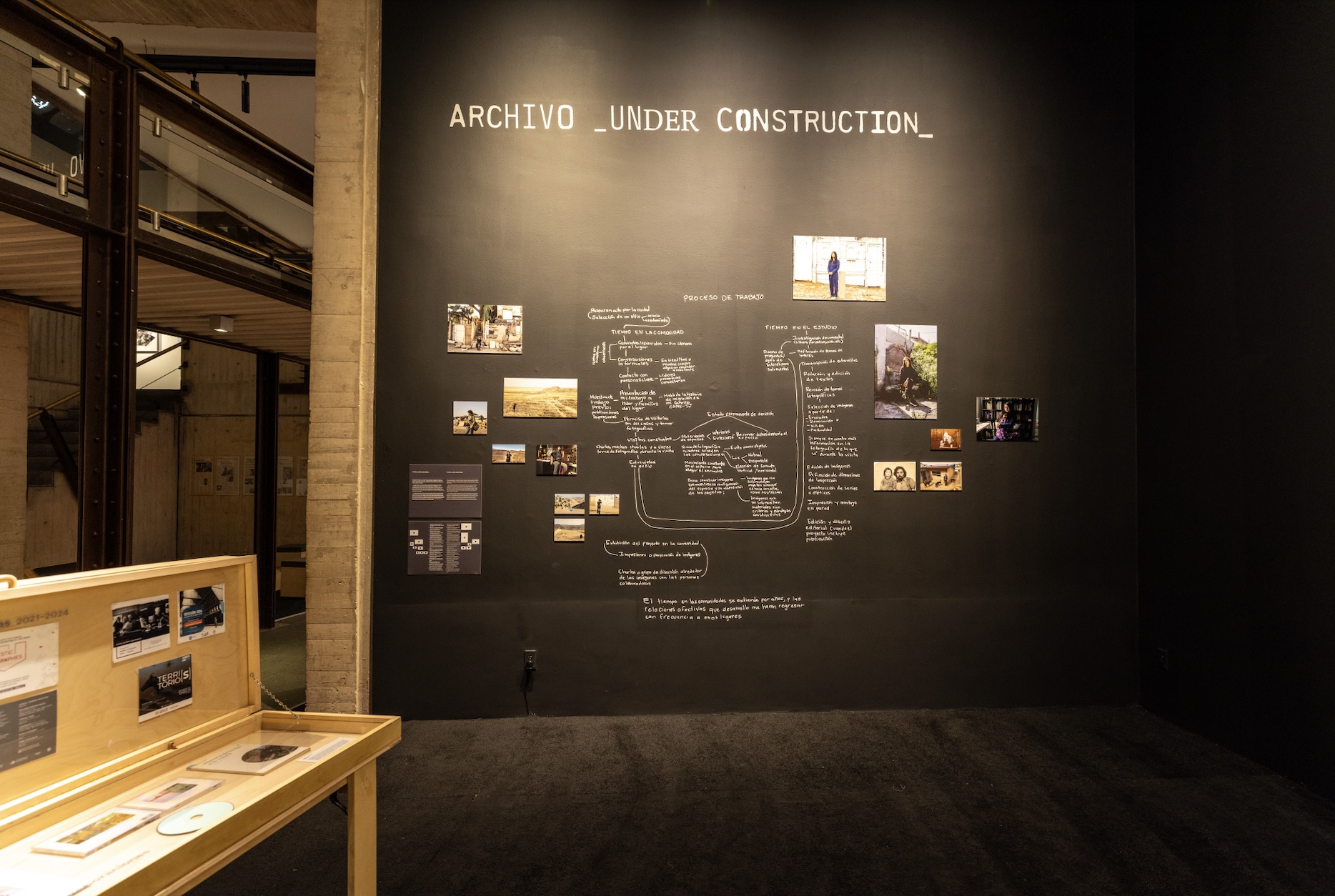
The decision—undeniably political—to avoid capturing portraits responds to a desire to shift attention away from people and toward the environment, the territory, and the spaces they inhabit. It is a way of avoiding the exoticization of those who live differently from oneself, of distancing from poverty porn and ethnography, of shielding their dignity. I think Ingrid's practice updates a documentary tradition that predominated in national photography for decades—and even defined the creation of the Centro de la Imagen itself—avoiding its most dangerous clichés by building from horizontal relationships, the care of collaborative networks, and accompaniment.
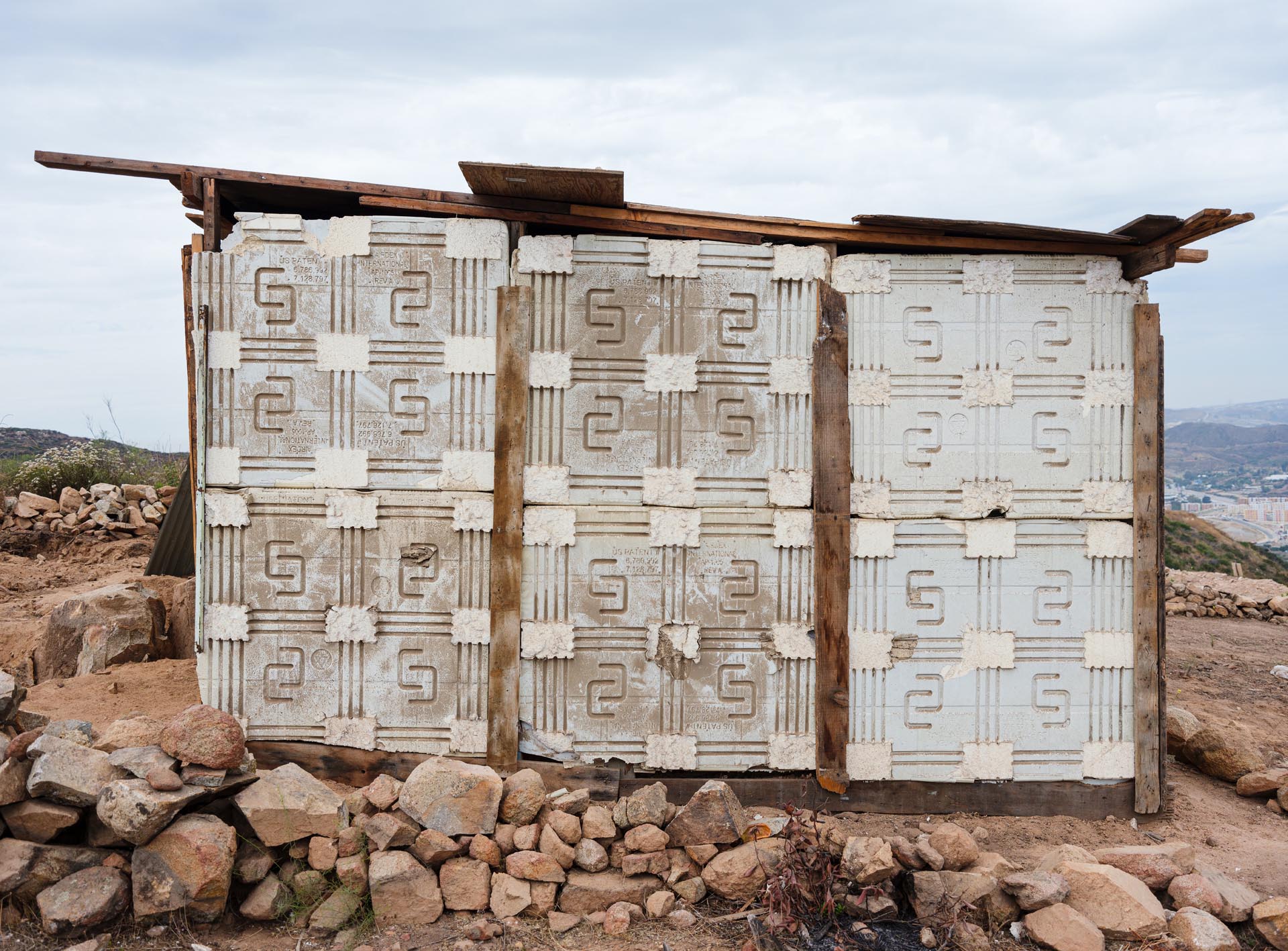
To accompany, according to the RAE, can mean "to be or go in the company of another person, to exist alongside another, to participate in someone's feelings." Although it is impossible to confirm whether all the series were generated this way, I believe the photographs of Under Construction have the capacity to situate you in the spaces they present, to make you participate in the lives of those Ingrid has visited.
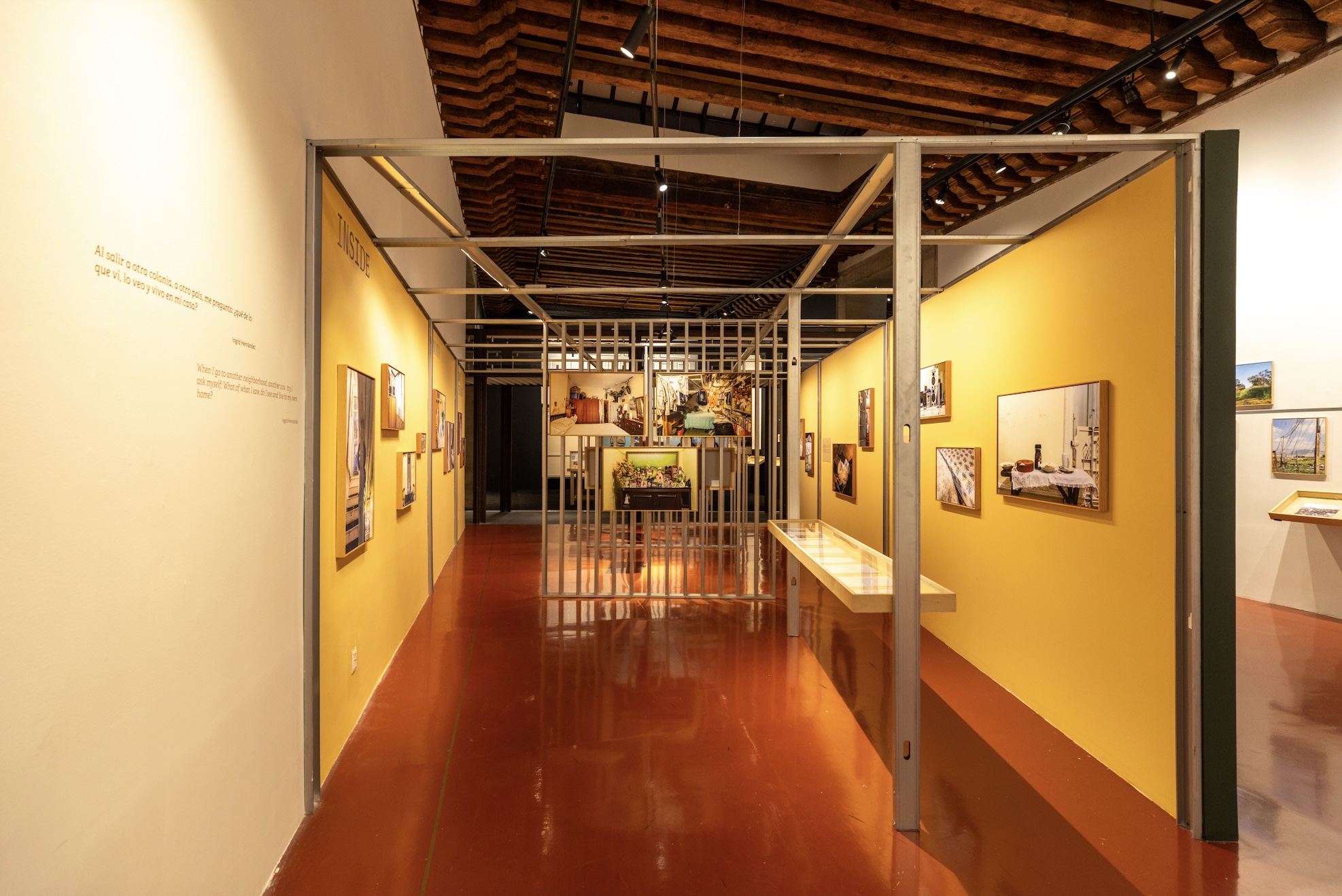
One of the artist's primary interests is the permeable border between interior and exterior, public and private, domestic and communal. In the museum's complicated corridor of galleries— which––forces you to walk through the exhibitions twice, there and back—we find a museographic exercise that redoubles that interest. The design, by Adalberto Charvel, suggests a house like those Ingrid photographs, with aluminum walls, narrow spaces, and works floated in the manner of windows. On the outside of the little house, we find the series of communities and neighborhoods in Tijuana; inside it, we see interior landscapes of houses on the border or in cities like New York and Bogotá. The little house is an astute solution that allows for a fluid transition between series while also resolving spatial restrictions. At times, however, it is difficult to distinguish the end of one series from the beginning of another, which makes some texts hard to read at the size to which they are reduced.
Across from the house, three Californian garage doors—brought to the capital so we can understand their scale—remind us that Tijuana is very far from Mexico City. I find it amusing to think of a work that simultaneously functions as a content adaptation for a decontextualized audience and a Duchampian gesture that flirts with installation.
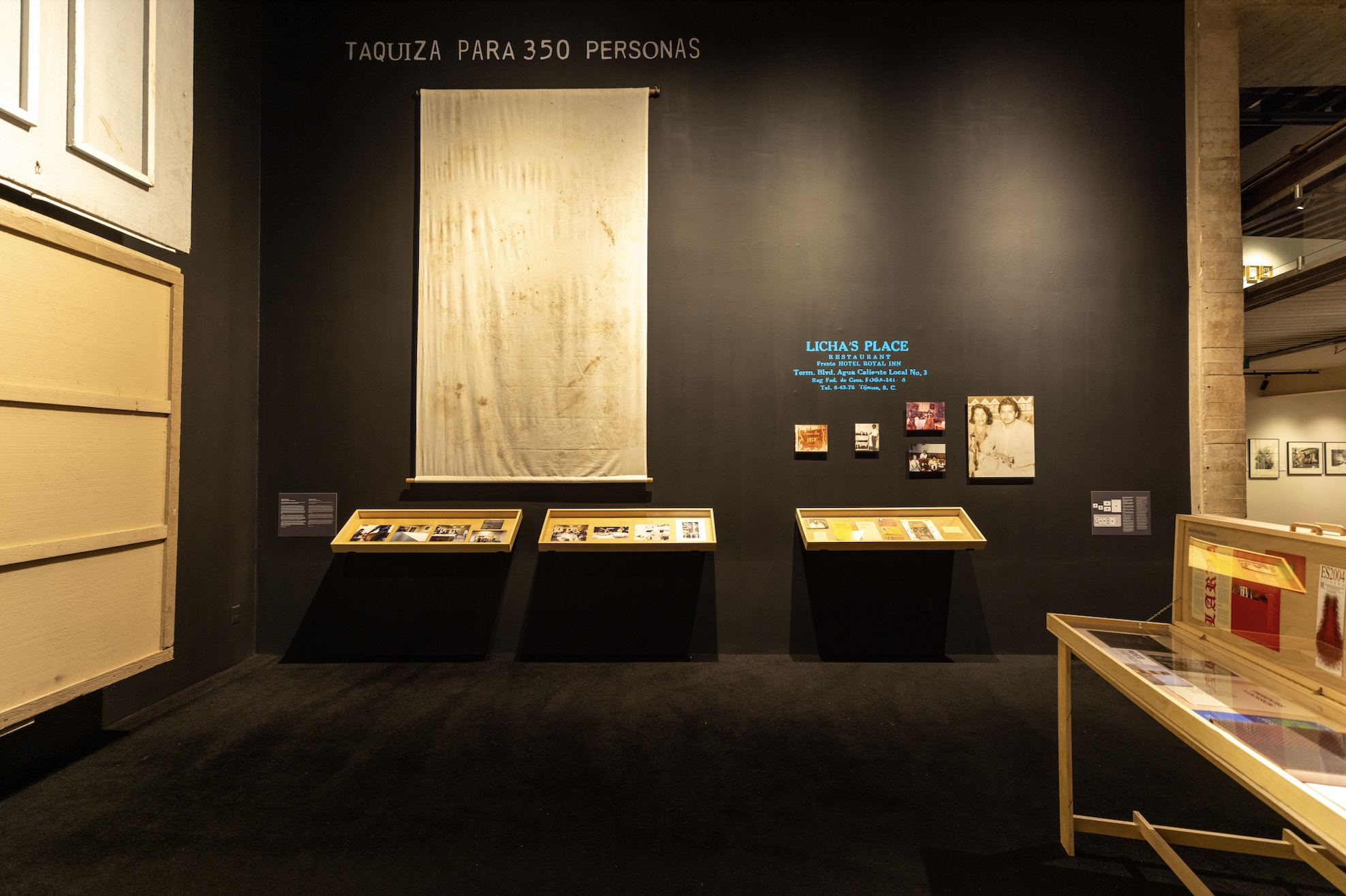
Another monumental piece stands out, one that leans toward relational practices. Taquiza para 350 personas is a tablecloth-banner large enough to seat that many people, originally commissioned by Marta Palau for the III Bienal Internacional de Estandartes in 2004. The menu included picadillo, birria, mole, and chicharrón, and the event lasted six hours. What 22 years ago was a pristine white and a vibrant red from hibiscus water is now a delicate cream and a work of stains bearing the mark of the memory of a long, good meal. It is curious to think how Rirkrit Tiravanija's dinners were mentioned to me every year of my Art History studies and no one thought to mention Ingrid Hernández as well.
In the curatorial text, signed by Daniela Lieja Quintanar and Rosela del Bosque, the exhibition is described as celebrating her practice as "one of the key figures in contemporary Mexican, international, and transborder art." Now I find myself wondering whether it would be better to include her in the photography class or the visual arts class—or to combine both curricula.
1: Some phrases in this paragraph arise from an interview I had with Ingrid Hernández while walking through her exhibition. I sincerely thank Ingrid for her openness and a stimulating conversation.
2: True, there are people in the records of performances, in the section dedicated to her archive as arts administrator, educator, artist, and curator, or in exhibition records — but we tend to overlook those images by categorizing them as "documentation" rather than "work."
Published on Jul 30 2026