Review
Percussion and Abrasion. On "Donde terminan las montañas" by Cynthia Gutiérrez en Galería CURRO
Reading time
10 min
This review draws from a conversation held with Cynthia Gutiérrez and is woven together with fragments of her own experimental writings. The subtitles come from that body of notes and function here as marks of a situated writing: not as explanatory quotations, but as surfaces of contact between her process, our friendship, and the shared reading of her latest exhibition: Donde terminan las montañas[1] [Where the Mountains End,] at Galería CURRO, Guadalajara.
Blows, voices, eroded marks
First it is heard. Not a melody, but a sequence of blows, scrapes, and abrasions. Stone against stone. The exhibition begins there: in the friction between two surfaces, in the moment when contact becomes a mark.
I have read Cynthia Gutiérrez's work through matter, history, resistance, and memory for years. This time I want to approach it from another side: through percussion and abrasion. Through that point prior to language where the sign is still pressure and rhythmic contact.
In Donde terminan las montañas, at Galería CURRO, stone does not appear solely as a body, ruin, or vestige. It appears as an active surface: something that can be touched, struck, scraped, perforated, listened to. The exhibition departs from a question about origin, but avoids turning it into a pure or distant image. Here, origin is not an intact foundational scene. It is a material operation. Before being symbol, the petroglyph was blow and impact. Before being archive, wear and erosion. Before being form, the sound of a sustained choreography.
Cynthia's work has long been articulated around a critical relationship with that which sustains, orders, legitimizes, or collapses. Her practice, as has been noted before, tests the vulnerability and stability of that which seems structural, whether physically, conceptually, or politically. In this exhibition, that concern shifts toward a more ancient, more elemental structure: the relationship between body, matter, and sign.
Messages revealed from the grooves
Gramática del origen [Grammar of Origin,] a sound piece made in collaboration with Diego Orendain, functions as the axis of this reading. The audio intervenes in the space with rhythmic knocks and scrapes that evoke the gesture of opening grooves in solid matter. The wall text describes it as "the echo of rock against rock" and as "an invisible engraving in the air." The phrase matters because it situates sound not as accompaniment, but as sculptural procedure. The stone may be absent, but the action remains: to strike, to scrape, to insist, to wear down.
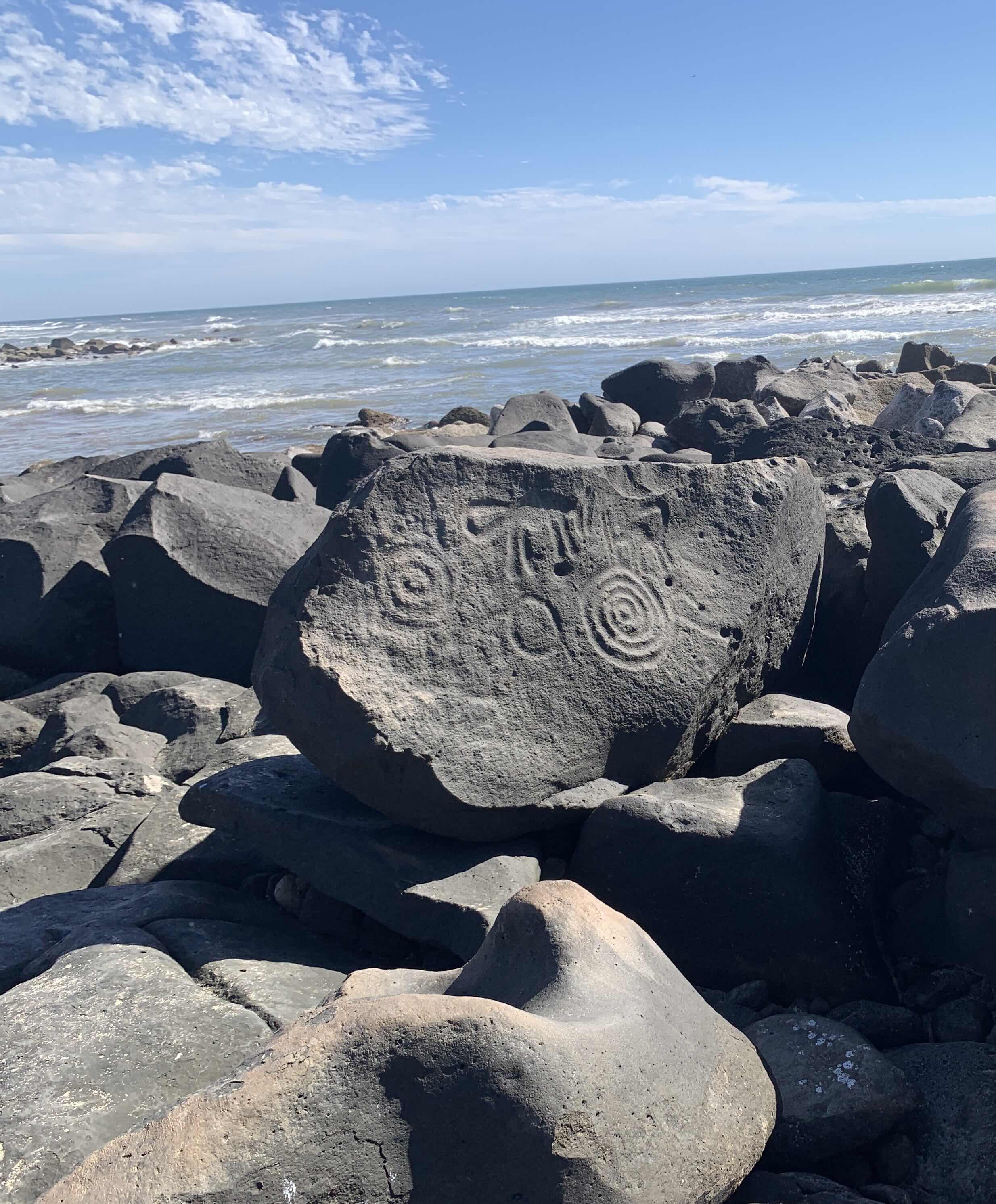
During our conversation, Cynthia spoke of her visit to Las Labradas, in Sinaloa, a site of petroglyphs by the sea. Looking at those carved rocks, she was not thinking only of the inscribed images, but of the physical moment of their production: bodies working on stone, water running through the grooves, a sequence of marks made at different times. What interested her was the possibility of a continuity between rock, water, and whoever carved it. That continuity is both a spiritual idea and a material scene: a chain of contacts.
Reading the exhibition through percussion and abrasion keeps it from being softened too much. There is something hard in these works, even when they work with glass, light, and transparency. Abrasion implies an uncomfortable closeness: one surface insists upon another, but neither allows itself to be modified without offering resistance. None remains intact: there is pressure, friction, wear. The sign appears because something was forced open.
The surface of the rock transfers onto my skin
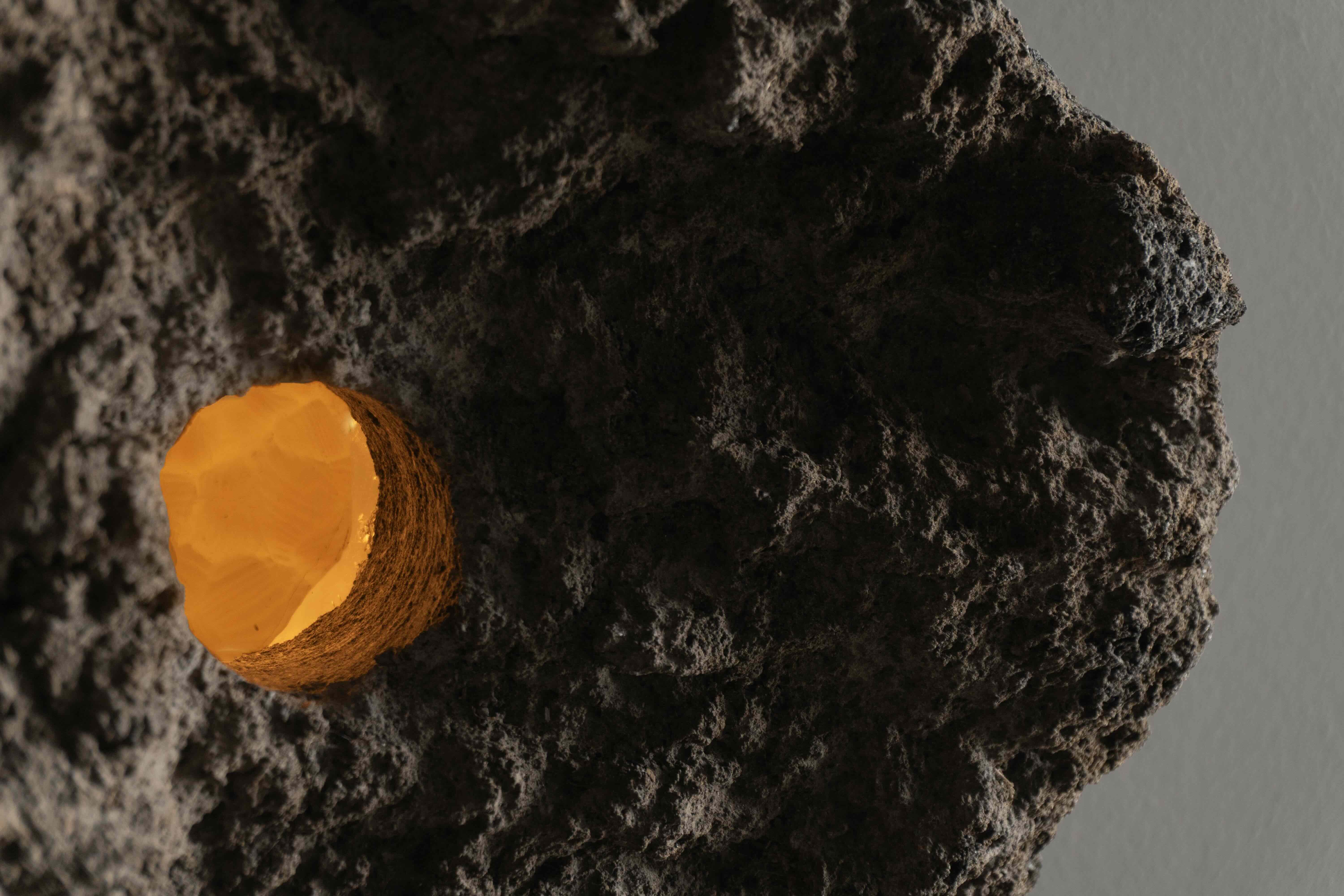
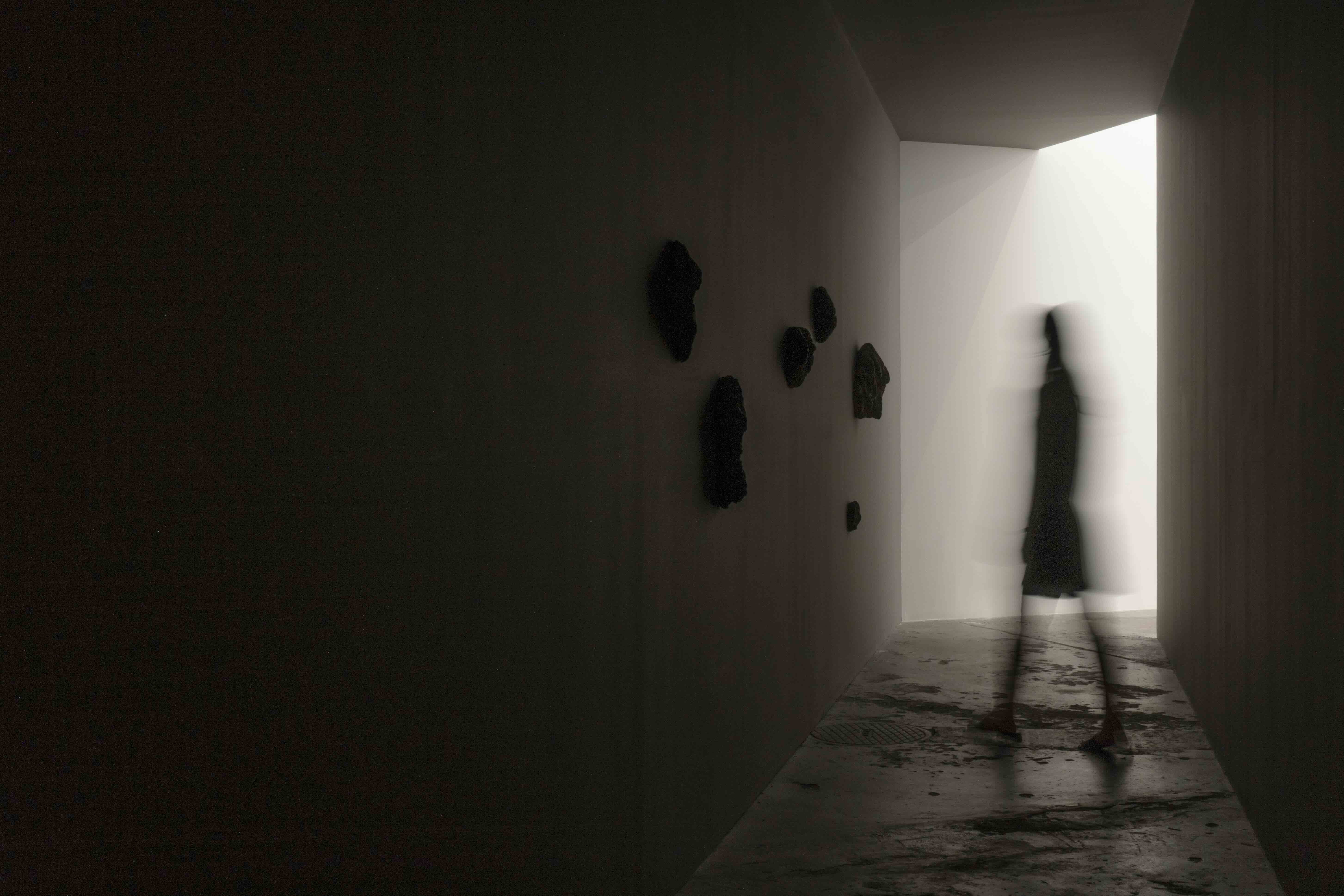
That logic of contact also runs through the Cartografías series. In a narrow, shadowy corridor, several volcanic rocks emerge from the walls, perforated and intervened with colored textured glass. Described as "sculptures that pass through the limit of the wall and produce a kind of luminous cartography," these pieces function as peepholes, but do not offer a transparent view. One has to approach, adjust one's body, press an eye close. The gaze becomes partial, conditioned, almost tactile.
The rock here does not give itself over as an object; it administers access. It allows seeing, but not entirely. The glass filters, distorts, and colors. The perforation opens a way through, but also establishes a limit. In our conversation, Cynthia said these pieces were a way of "peering inside the stone"; she also spoke of a kind of pact with the gaze: "I'll let you through, but only this far." That phrase could describe the show's most seductive tension: an approach without possession, a desire without transparency, contact regulated by matter, access without total surrender, and intimacy crossed by a limit.
A seed in my hand
In Cartografía de expansión, that tension concentrates into a small scene: through a perforated volcanic rock, one can make out a cluster of corn kernels cast in bronze. The seed is there, but it cannot be touched. The exhibition links the piece to the cave, the earliest rupestrian manifestations, and the beginnings of agriculture. It also underscores its paradox: by being made eternal through metal, the seeds become infertile, suspended between a remote past and a possible posthuman future. The piece avoids romanticizing the seed as an organic promise. It renders it hard and shining, but it remains arrested in time. An encapsulated origin that no longer germinates.
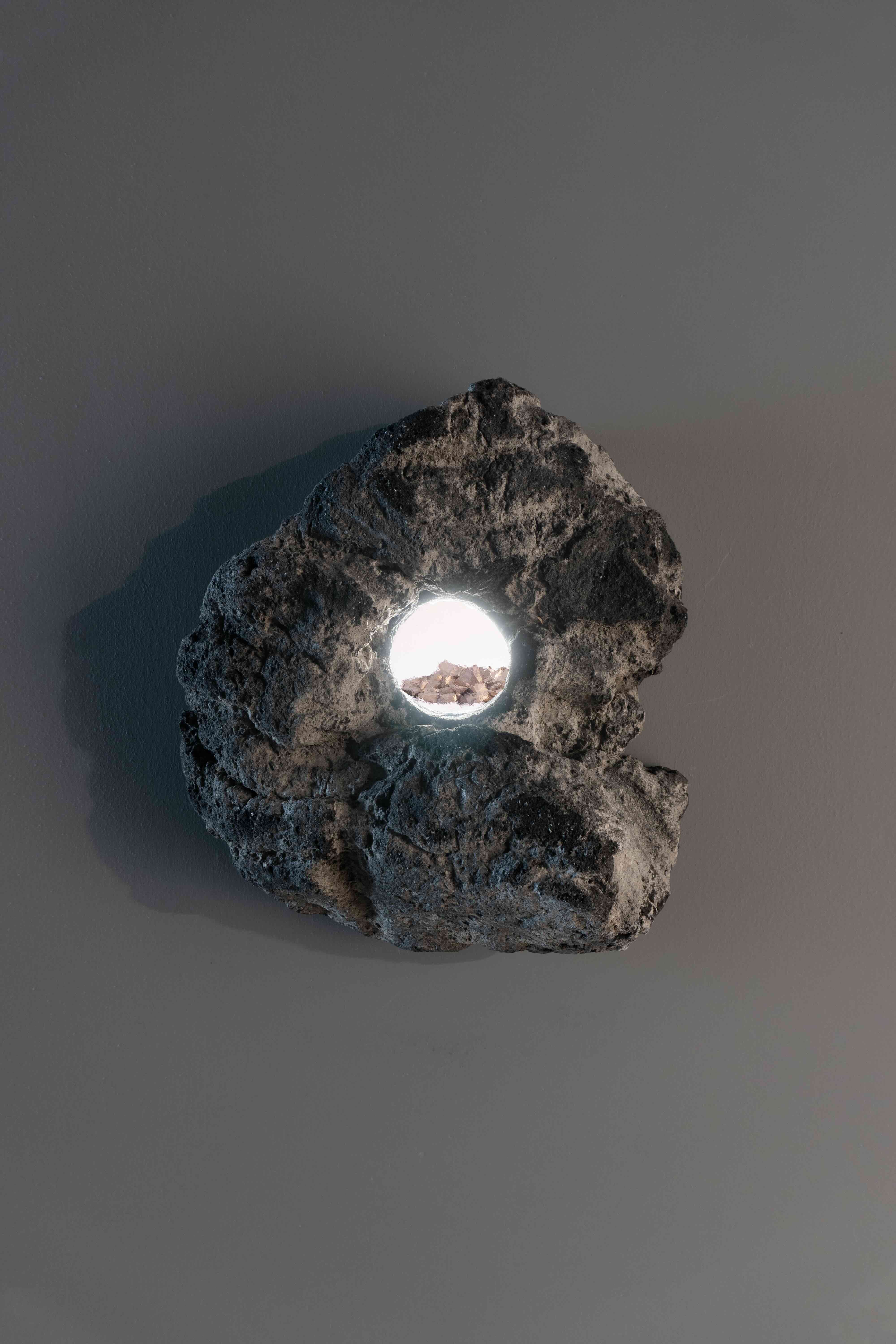
The presence of corn opens another reading of the exhibition: that of planting. Not only as a theme, but as the structure of the path through it. The show can be thought of as a passage between seed, furrow, sign, and apparition. The bronze seed, contained behind the wall, functions as a suspended capsule of potency: something that holds the possibility of growth, but that has been withdrawn from the living cycle. It is a seed without soil, without moisture, without germination or decomposition. A seed turned into sculpture.
From there, the rest of the pieces seem to unfold another phase of the same process. The grooves of the petroglyphs, evoked by the sound of Gramática del origen, can also be read as a form of tilling. To engrave and to sow share a basic action: opening a surface. In one case, stone; in another, earth. Both operations produce a furrow where something can take hold. Abrasion, then, is not only wear; it is also the preparation of ground.
Fine filaments of light connecting to the stars
This reading resonates if we think of the milpa — not as an identitarian image or folkloric motif, but as a system of relations. The milpa is not a single crop; it is an agricultural, social, and temporal technology in which different species grow together and sustain one another. Corn, beans, squash, chile, quelites: plant bodies that organize a space of coexistence. In the exhibition, the ochre, amber, olive-green, and brown glass pieces do not literally illustrate the milpa, but they do activate a chromatic palette of earth, fire, dry leaf, seed, moisture, and heat. They remain below, in the warm zone of the earth: close to the ground, to the trunk, to the sprout.
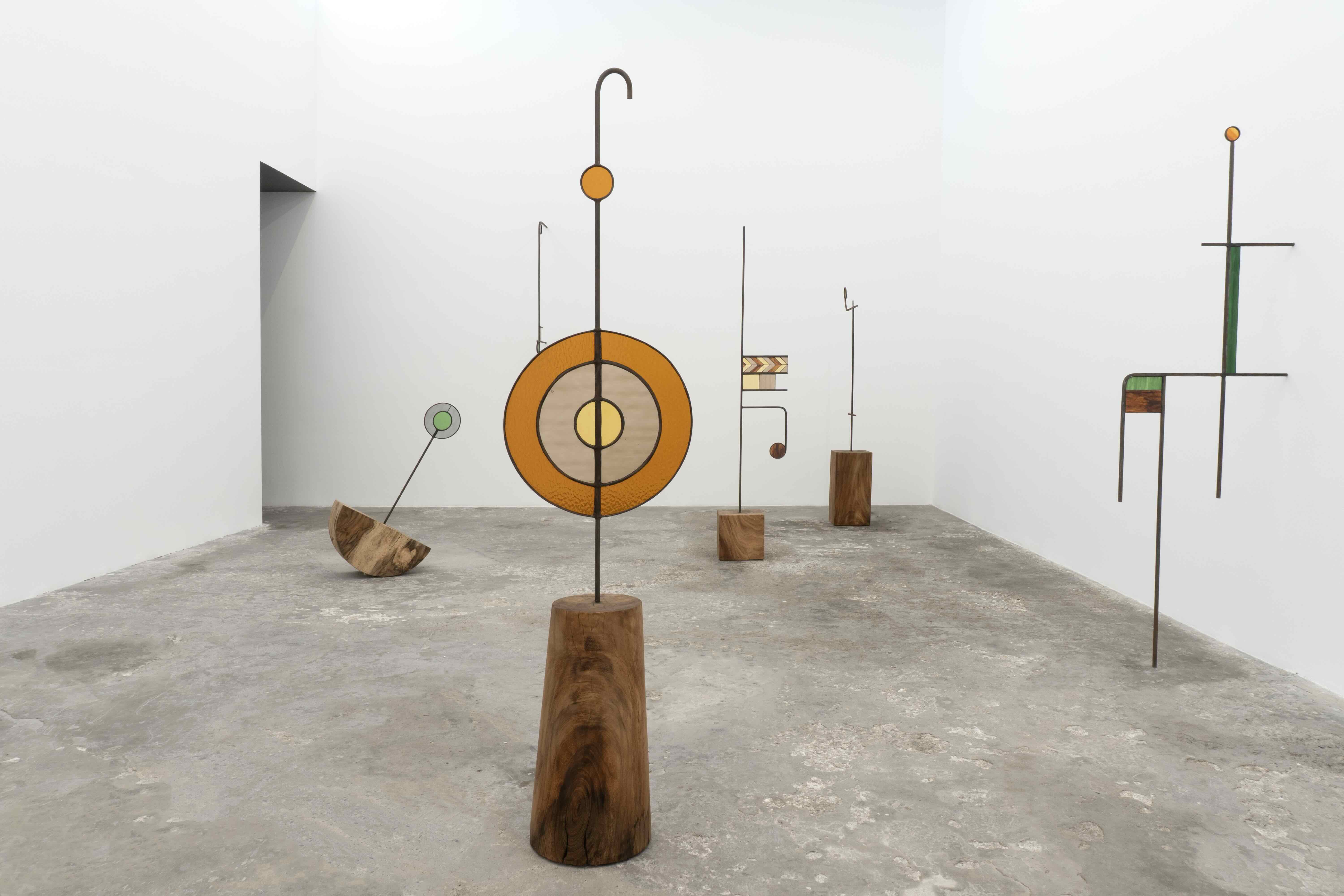
In our conversation, that very possibility came up: thinking of the path through the exhibition as a cycle in which first there is the sheltered seed, and then the forms that rise up, almost like sprouts or abstract plants. It was a reading that emerged from the exchange, activated by the path of the exhibition itself. It was not a predetermined interpretive key, but its openness matters: the show does not declare "this is a milpa," yet it allows one to think in terms of a logic of germination. Without representing plants as such, the pieces rehearse a rising.
A dotted line that records paths
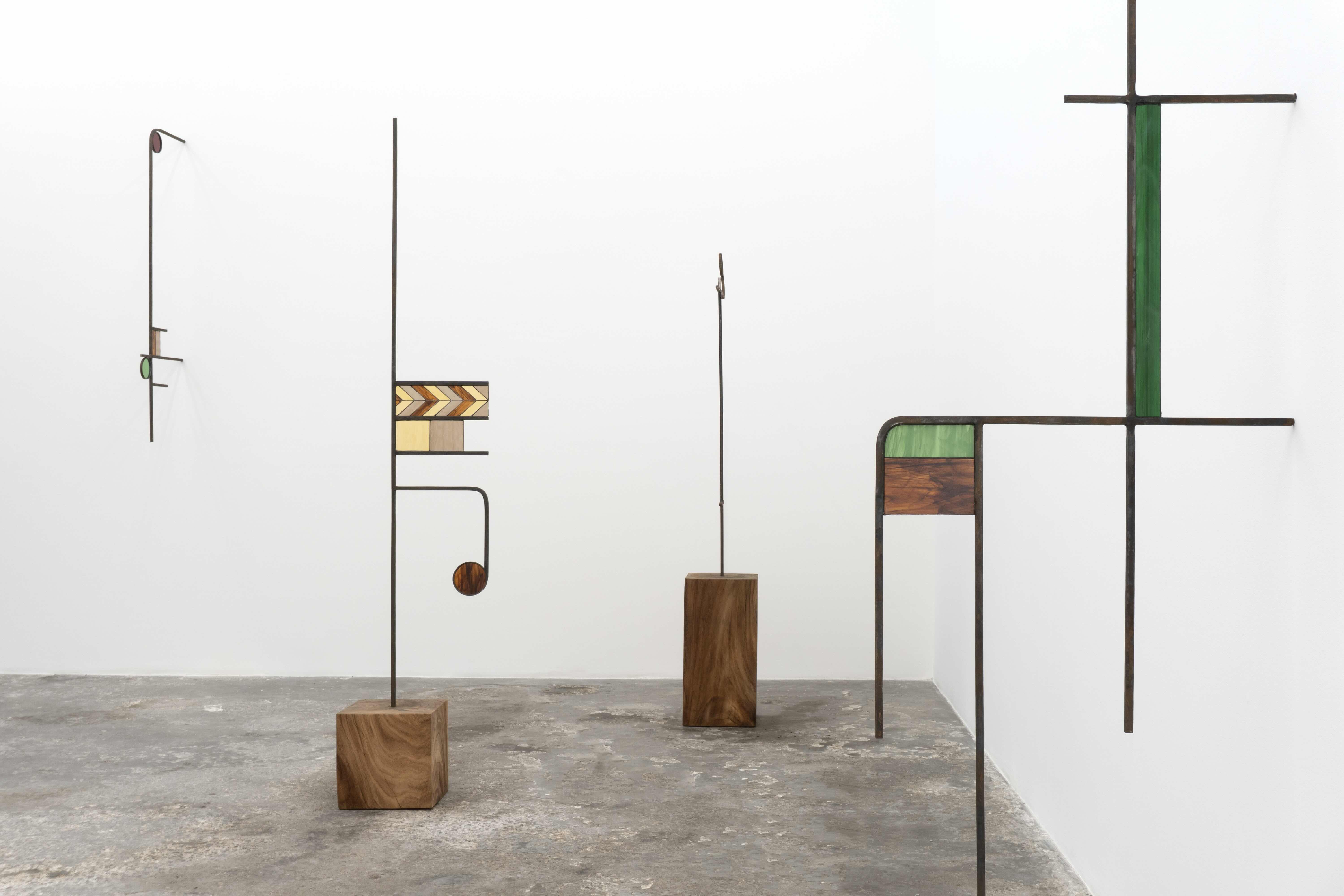
The Apariciones series takes that rising to another scale. The iron, glass, and wood sculptures draw from forms associated with petroglyphs, but do not present them as archaeological citations or decorative motifs. Cynthia describes these pieces as "glyphs and engravings that detach from the skin of the rock to reclaim their three-dimensionality." That image is key: the sign is no longer inscribed; it rises and occupies its own space at a distance from the stone.
In that rising, the logic of sowing also resonates. Something that was buried, encapsulated, or adhered to the surface now appears as a vertical line. Some pieces remain anchored to the floor through wooden bases; others appear on the wall, at eye level. They do not float entirely, but neither do they collapse. They are held in tension between rootedness and elevation: like stems and branches, like new messages, like remnants of a writing that decided to leave the stone.
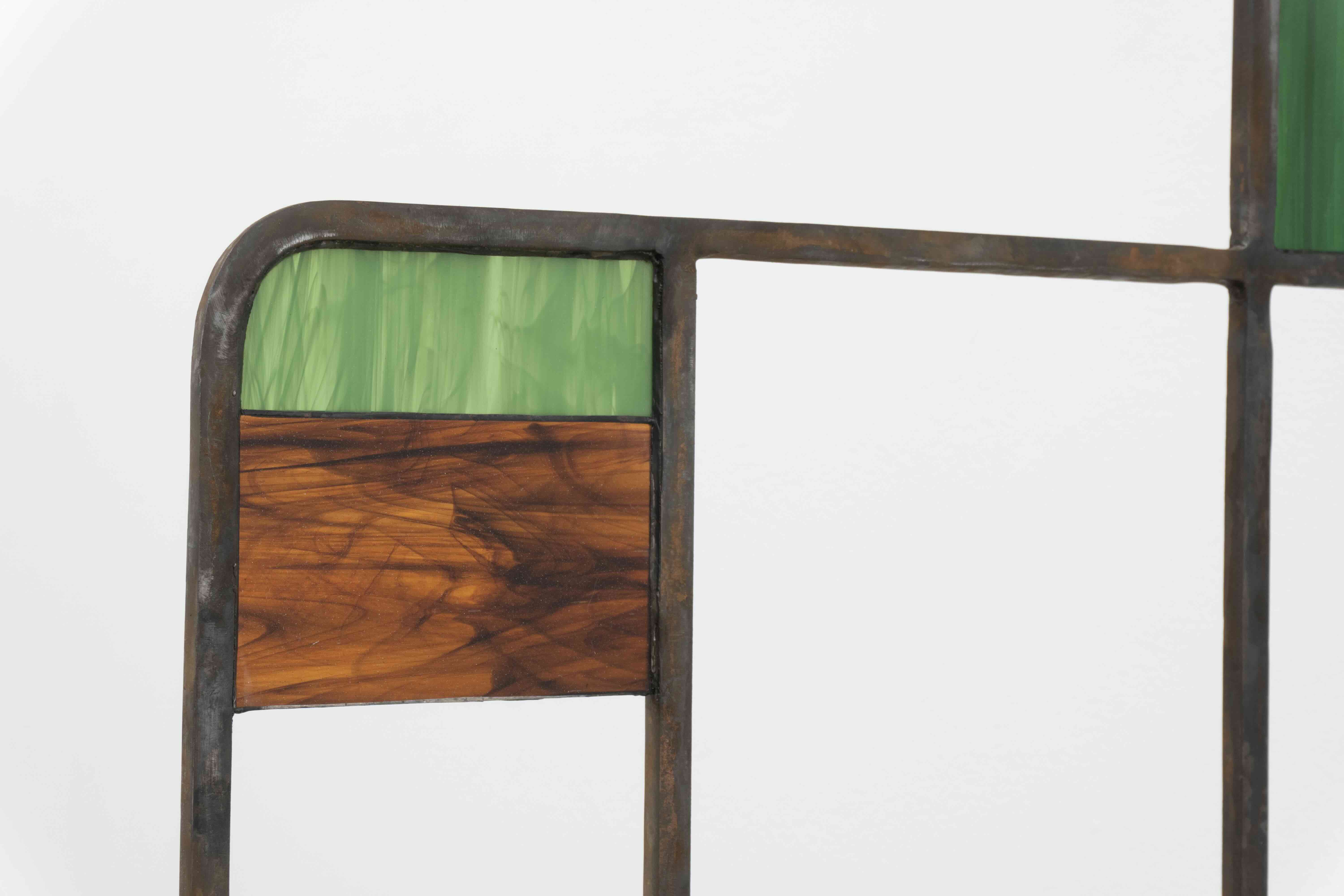
There is something important in that movement within Cynthia's practice. In many of her earlier works, gravity played a central role: forms and structures rendered vulnerable, materials bound to that force. Things fell under their own weight. In Apariciones, by contrast, the pieces seem to be in the process of detaching. It is not a clean or transcendent elevation; it is rather a strange, irregular growth that is still tethered to the ground. A verticality that does not deny the earth it comes from.
Codes shared among all the structures of the universe
The exhibition exceeds a reading of "the ancestral." Cynthia does not attempt to decipher the petroglyphs or translate them into a domesticated contemporary language. She works with them as opaque forces: signs we do not fully know how to read, but that continue to produce effects. In our conversation we agreed not to think of them as primitive, but as primordial. Not because they lie outside of history, but because they point to a zone where seeing, touching, marking, sowing, and knowing were not yet separate.
The exhibition insists on modifying the conditions of perception. There is darkness, sound, glass, tunnel, perforation, distortion. Nothing is offered from a clean frontality. The gaze has to move; the ear reconstructs an absent surface; the body understands that knowing does not always mean deciphering. Sometimes knowing is letting oneself be affected by an operation: the blow, the scrape, the vibration, the resistance of a material.
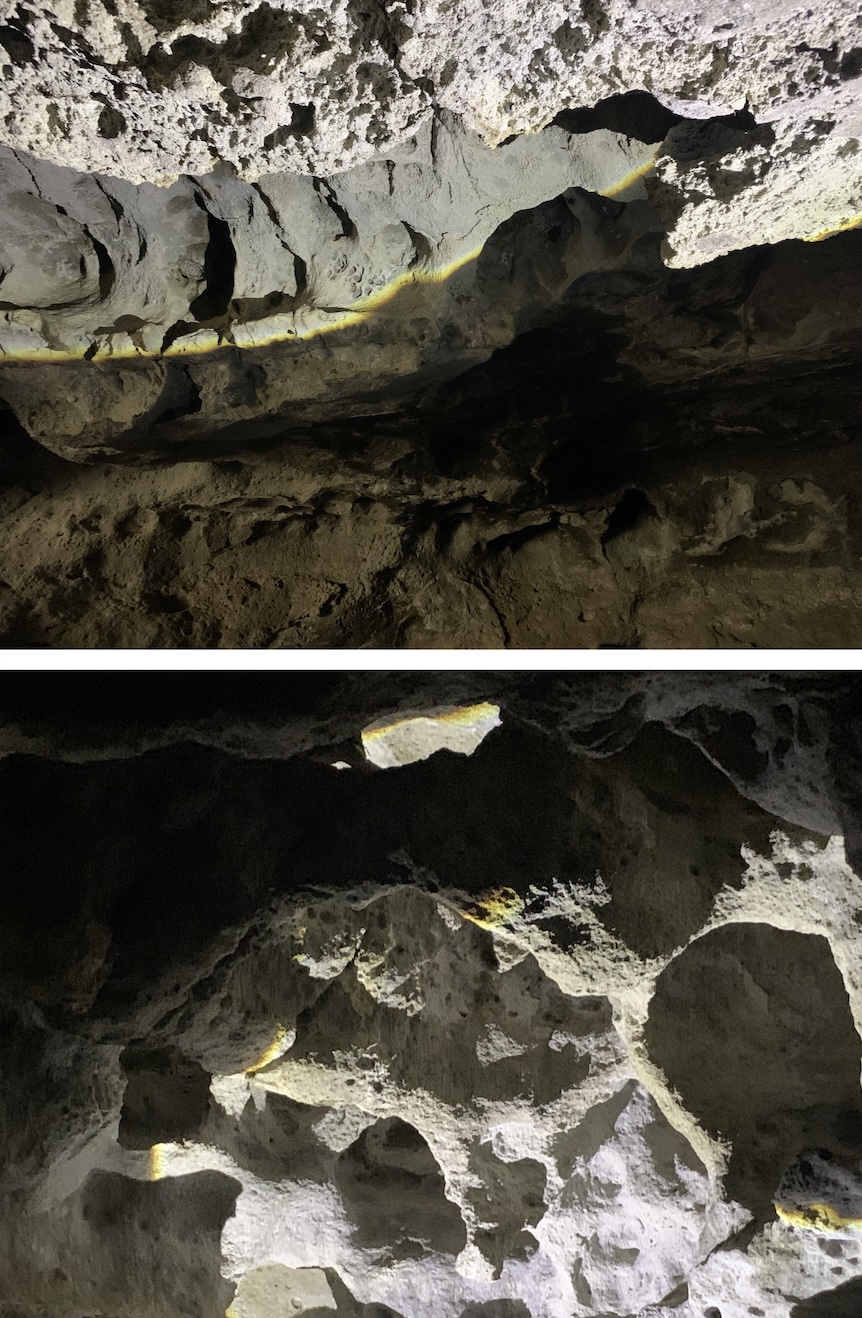
Donde terminan las montañas is an exhibition about stones and what happens between them: between one stone and another, between a surface and a hand, between a wall and an eye, between a seed and time, between a sound and a body. Its strength lies in understanding matter as a zone of contact. The rock is neither background nor stable symbol: it can hold an infertile seed, filter an orange light, or echo even when we cannot see it.
Donde terminan las montañas does not open onto a clean image of the sky, but onto a zone of friction. An edge where stone stops being the immobile evidence of the past and becomes an interlocutor—where to look means to come much closer. There, to listen is to recognize that every mark began as percussion, that all knowledge, before becoming language, was abrasion.
Translated into English by Luis Sokol
*Project supported by Sistema de Apoyos a la Creación y Proyectos Culturales.
Published on Jun 19 2026