Review
When Does a Work of Art End? No-Objetualismos at Museo Universitario del Chopo
by Carolina Magis Weinberg
Reading time
10 min
To move through the exhibition No-Objetualismos. Hacia un pensamiento visual independiente at Museo Universitario del Chopo is to discover a new world. It is a journey to a Latin America in the nineteen-seventies and eighties, a time when art seemed to be in a state of ebullition, bubbling up everywhere with a refreshing lucidity. The exhibition's main angle is to explore no-objetualismos through the multiple facets and approaches in each country, as well as the referents and agents of art, from both theory and practice. Originally presented at the Museo de Arte Moderno de Medellín, the show is updated and enriched in Mexico with local context through a dialogue between the exhibition's original curator in Colombia, Jorge Lopera, and curator Miguel A. López of Museo Universitario del Chopo.
The term "no-objetualismo" was coined by Juan Acha as a situated critical theory that observes in artistic production a migration from the object toward its meaning in a broad sense. This could lead both to the non-existence of the object itself and to the making of work that points instead toward the sense and process that take place to signify it. The work does not reside in the production of an object, but elsewhere: in its effect, meaning, temporality, irruption, or disappearance.
What can art do? Confronted with Latin American reality, the Peruvian theorist proposed the existence of an artistic reality that should offer a sociohistorical vision of production: not working in a vacuum, but within a spatial and temporal context. It was thus that Acha coined the term "no-objetualismo" to speak of an art that "ceases to be an end in itself and is established as a means[1]."
As curator Jorge Lopera notes in the wall text, these practices raised "the relationship between vanguard and underdevelopment, art and popular culture, Latin American identity, urban transformations, and the role of technology in everyday life." The exhibition centers on the Primer Coloquio Latinoamericano sobre Arte No-objetual y Arte Urbano, held in 1981 at the Museo de Arte Moderno de Medellín. This colloquium—which was also an exhibition and a celebration—is revisited as a key moment in the development of artistic thought in seventies Latin America, one that had echoes and reverberations in subsequent practices. The curator distinguishes the practices encompassed by the exhibition as the confluence of "languages such as geometrism, political graphics, environmental art, action and process art, public sculpture, ephemeral experiences, and conceptual attitudes." In other words, a universe of possibilities gathered under a single term: "no-objetualismo."
I move through this exhibition as an artist, and from that position I ask myself what my possible connection to it might be. In writing about it, I also pose another question: how does one write an artistic review of a historical exhibition? How does one approach, as an artist, a subject so dense that it also seems so definitive in its theoretical framing? I set out to enter the whole through its parts. I approach this sea of works by nearly 70 artists and collectives by way of seven that I believe can form an index of different problems—ones that touch other works while also weaving networks of possibility. The labels facilitate this journey between geographies, as each one insists on diversity by highlighting the artist's country of origin, in parentheses, alongside their name. To walk through the exhibition is to travel back and forth from Peru to Colombia, from Argentina to Chile, from Venezuela to Brazil, from Cuba to Mexico and back again.
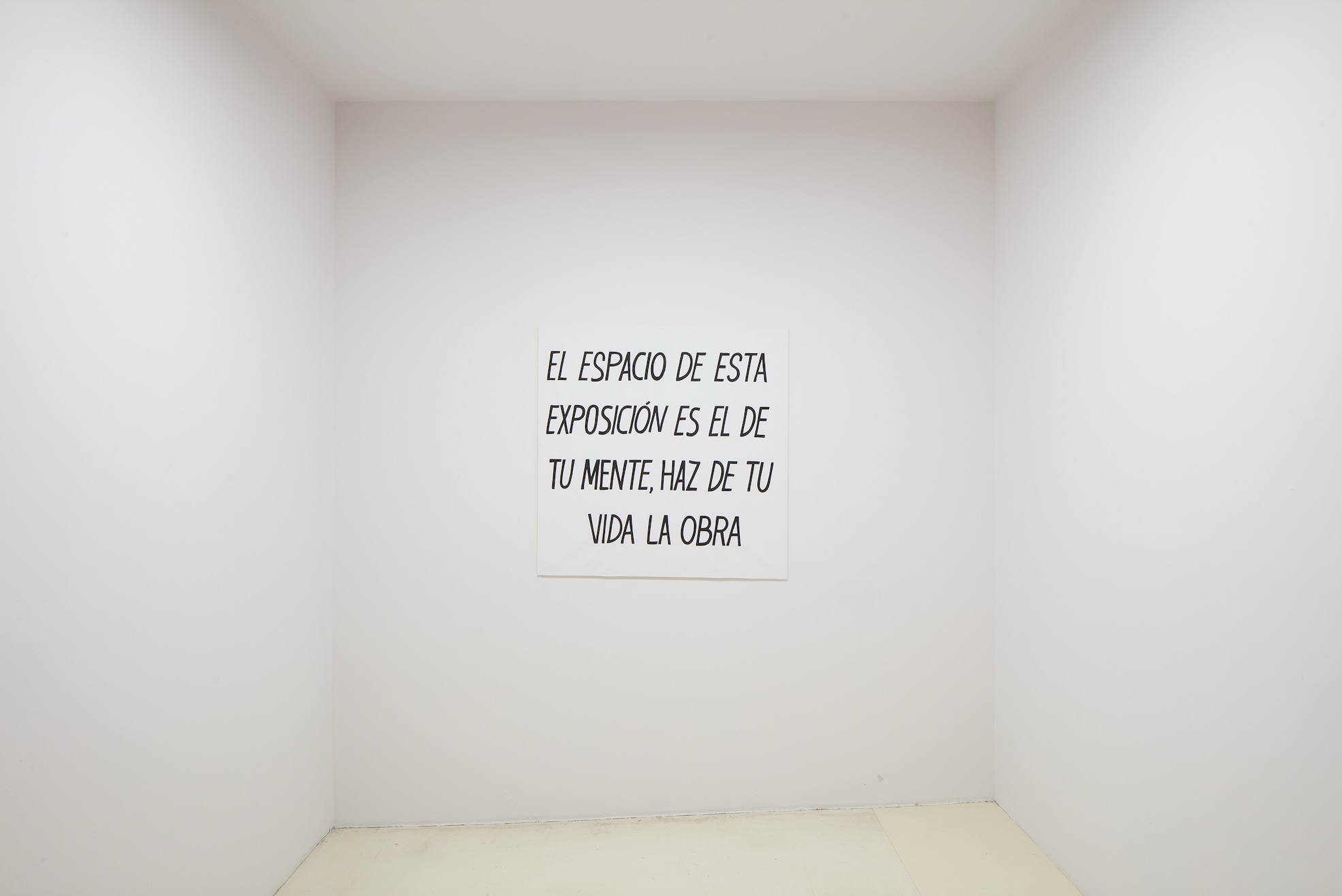
A) In the first room there is a wall. Walking around it, one discovers a small area that forms a brief white-lit chamber. Inside, a sheet of paper fixed to the wall reads, in insistent capital letters: "THE SPACE OF THIS EXHIBITION IS THAT OF YOUR MIND. MAKE YOUR LIFE THE WORK." We are standing before a piece by Gloria Gómez-Sánchez (Peru), made in 1970. It leaves us with no escape—it has entered our minds with a forceful instruction that resonates and resonates, growing louder and louder in an imperative voice: "MAKE YOUR LIFE THE WORK." Gómez-Sánchez thus devours the entire space. If we read it and truly commit to it, the phrase sets us to work going forward; life will then become the work, it has taken hold of us. The art object has disappeared and dissolved into life itself. This is a total non-objectuality, a renunciation and also a tacit commitment.
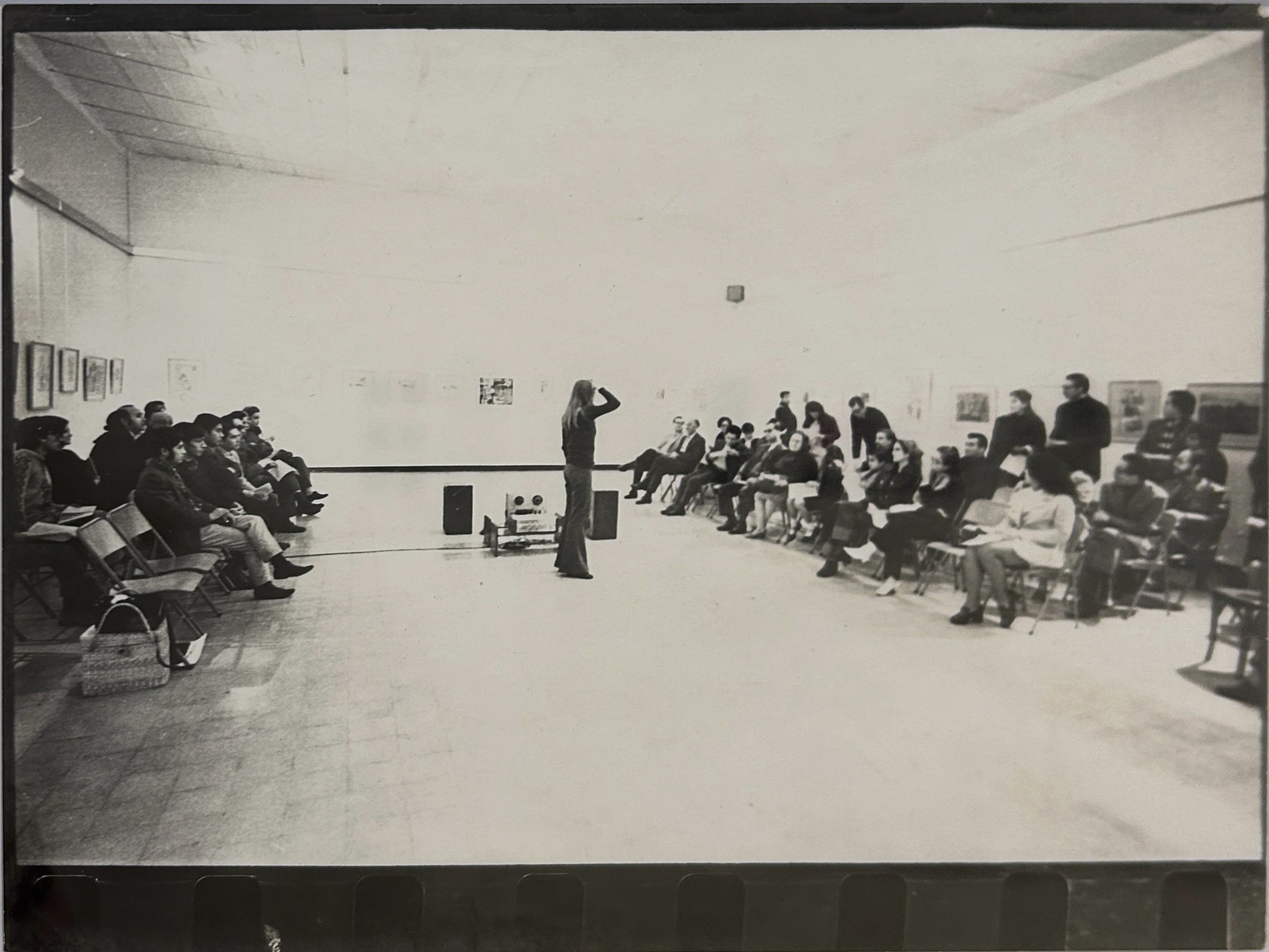
B) A photograph alongside a typewritten document. In the image, a woman stands at the center of a room between two groups of people serving as audience. An action on the part of the central figure seems expected, yet nothing appears to be happening. This is an anti-ballet work by artist Yvonne von Mollendorff (Peru), made in 1970. The label indicates that, while the audience watches, the choreographer does not dance onstage, but instead presents a narrated score that describes in audio three ballets that are never performed. By not seeing the movements but hearing them, each person had to imagine them. Beside the photograph is a document that allows us to hear what the photographic image conceals in its silence.
This work, like many others in the exhibition, proposes an additional degree of distance from the event it records: time. How does one see and understand today a piece that was carried out conceptually in 1970? Can a photograph, a typewritten document, and a label bring us back to that moment? What is the work: the then-immaterial, or its now materialized in the record? In all non-objectual practices, documentation is not only a subject but also a present-tense problem that runs through the entire exhibition.
C) Further along, a partition holds a series of photographs and drawings. One image draws me in particularly: it shows an object displayed on a pedestal, accompanied by a card that reads "Elogio al vuelo" — "In Praise of Flight" — in Portuguese. A colander contains a bird, its feathers emerging from the pot and its beak protruding to one side. Like Duchamp's shovel hanging from a thread to render it useless, here the tool has separated the bird into its parts and denied the possibility of flight. The image is part of the series Amazonia Report, made in 1976 by artist Jonier Marín (Colombia). Along with a series of drawings in different shades of green, this photograph brings to the table of no-objetualismo the problem of environmental transformation through human action. The image praises a flight that has been prevented and made impossible.
.jpeg?alt=media&token=7542bc8b-02d2-4f9f-b8fc-5f64e1d90c4e)
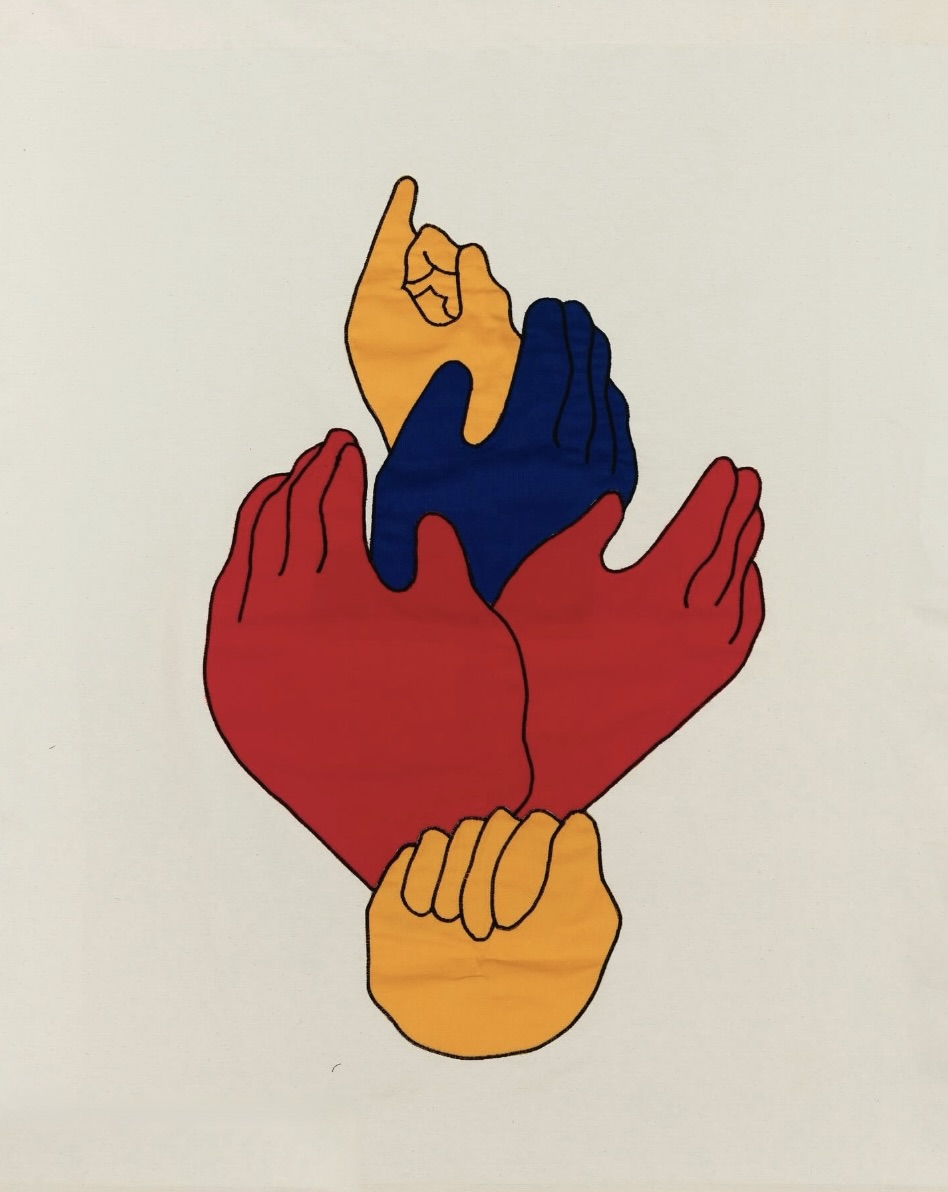
D) On the next wall, Cecilia Vicuña (Chile) presents a collage: Árbol de manos (Tree of Hands), 1974. A monument to international solidarity in the face of the coup d'état in Chile. It shows hands in yellow, blue, and red in different positions: from a fist three hands open outward, culminating in one pointing upward. Here the work materializes — from the sketch alone — a desire that remains in non-objectuality. This image, together with the one that follows it, is precisely that: only an image. Its scale moves us in relation to the magnitude of what is being denounced; the desire that drives it moves us; the profound tension between potency and impotence it sustains moves us.
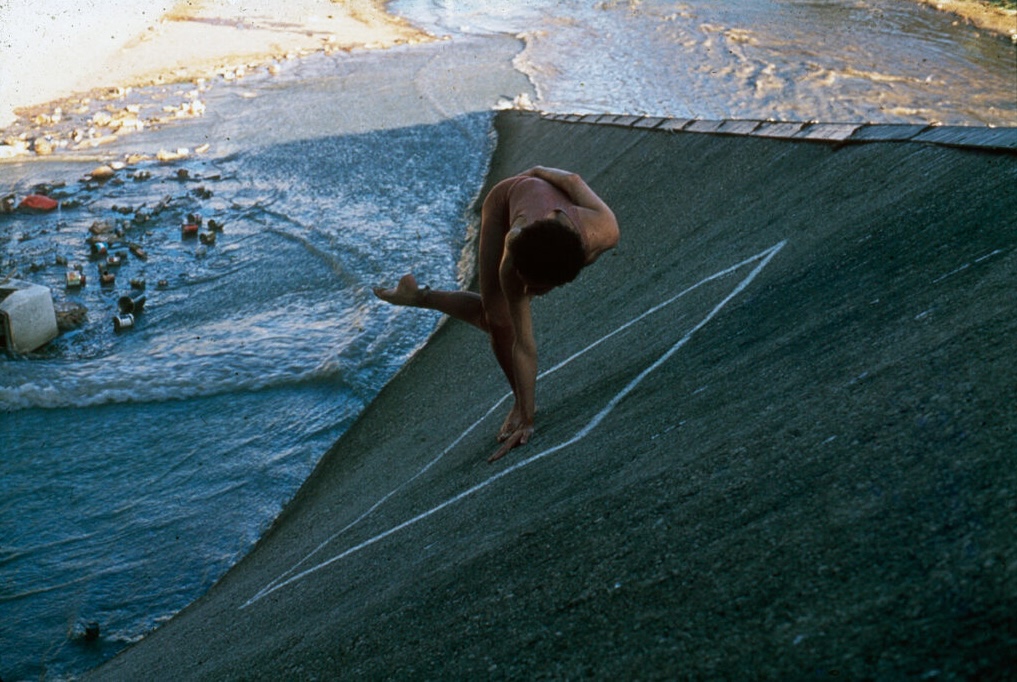
E) On a blue support perpendicular to the wall, a series of photographs records an action: Cuadrado con bailarín (Square with Dancer), 1976, by Luis Villamizar (Venezuela). The artist drew a square on an inclined surface in the city of Caracas — the channeled bed of the Guaire River — and asked a professional dancer to perform a dance within it. The slope, however, challenged and constrained his movement. The images hold the tension of an imminent fall. This is a displacement on the margins, recorded in photographs in which the body resists. The piece adds the dimension of underdevelopment and the marginality of Latin American reality to the discussion of no-objetualismos with full force. The distorted white square traced on the ground glows as a minimal stage that constrains the dancer's movements; and yet the dance prevails, and an illuminated leg emerges from the shadows with all its strength and conviction.
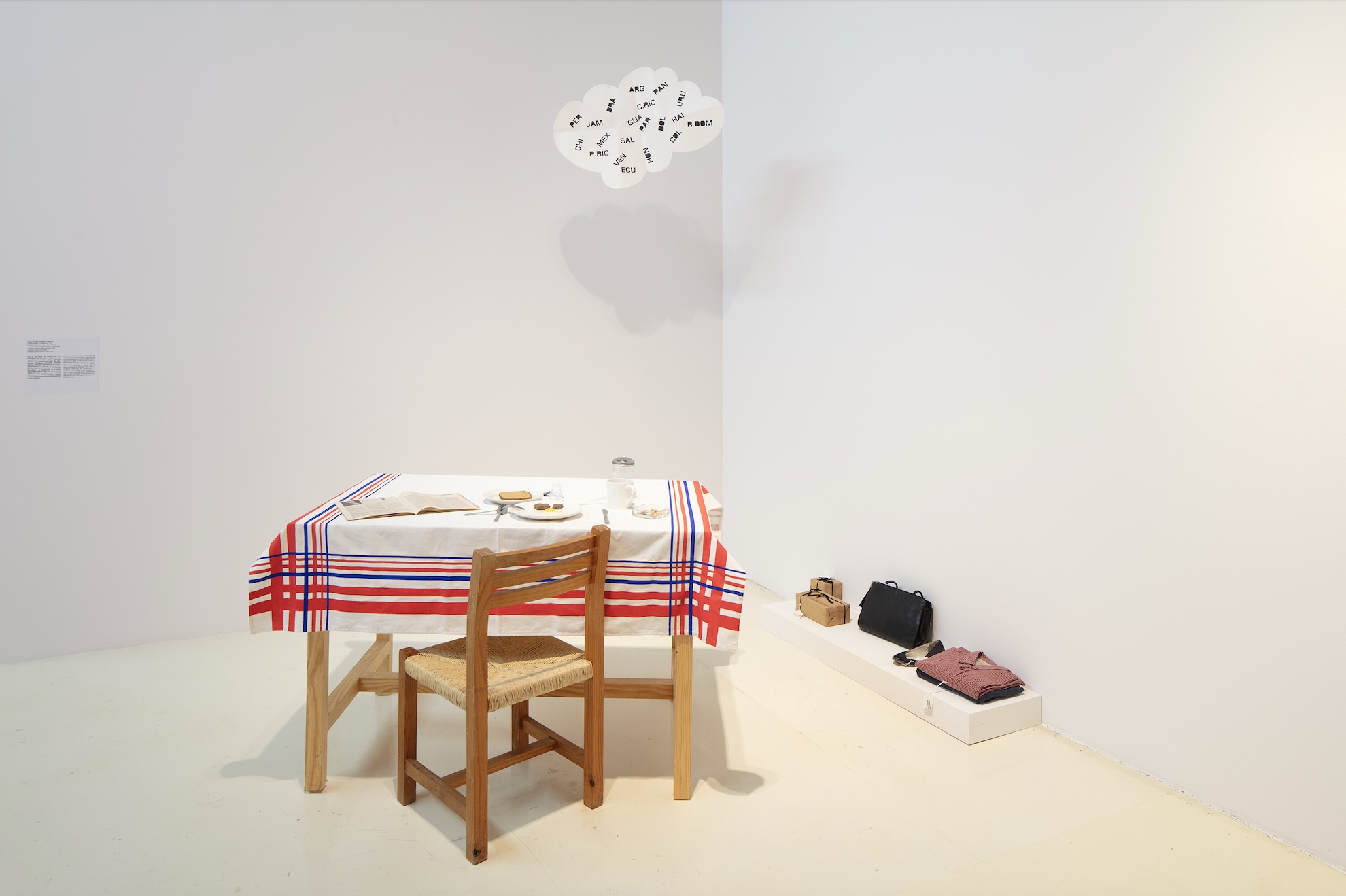
F) We approach a cloud of words floating dominant at the far end of the exhibition space. We discover they are the abbreviated names of different Latin American countries: PER, CHI, JAM, MEX, BRA, HON, ECU, GUA… This Latin American cloud rains down over a half-finished breakfast table. A plate with bread, another with an egg, cutlery, a salt shaker, a sugar bowl, a cup, and an ashtray; someone had just been reading a magazine and drinking coffee. To one side, two wrapped boxes and clothing: shirts, heels, and a woman's handbag. Each item bears an identifying tag that reads: "National Security." At the 1981 Coloquio de Arte No-Objetual, Grupo Proceso Pentágono (Mexico) presented this installation, titled ¿A qué le supo el desayuno? (What Did Breakfast Taste Like?), denouncing the forced disappearances that occurred during that period across the region. In this case, it referred specifically to the disappearance of Guatemalan poet Alaíde Foppa on December 9, 1980. The table was at once an interrogation site and a domestic space.
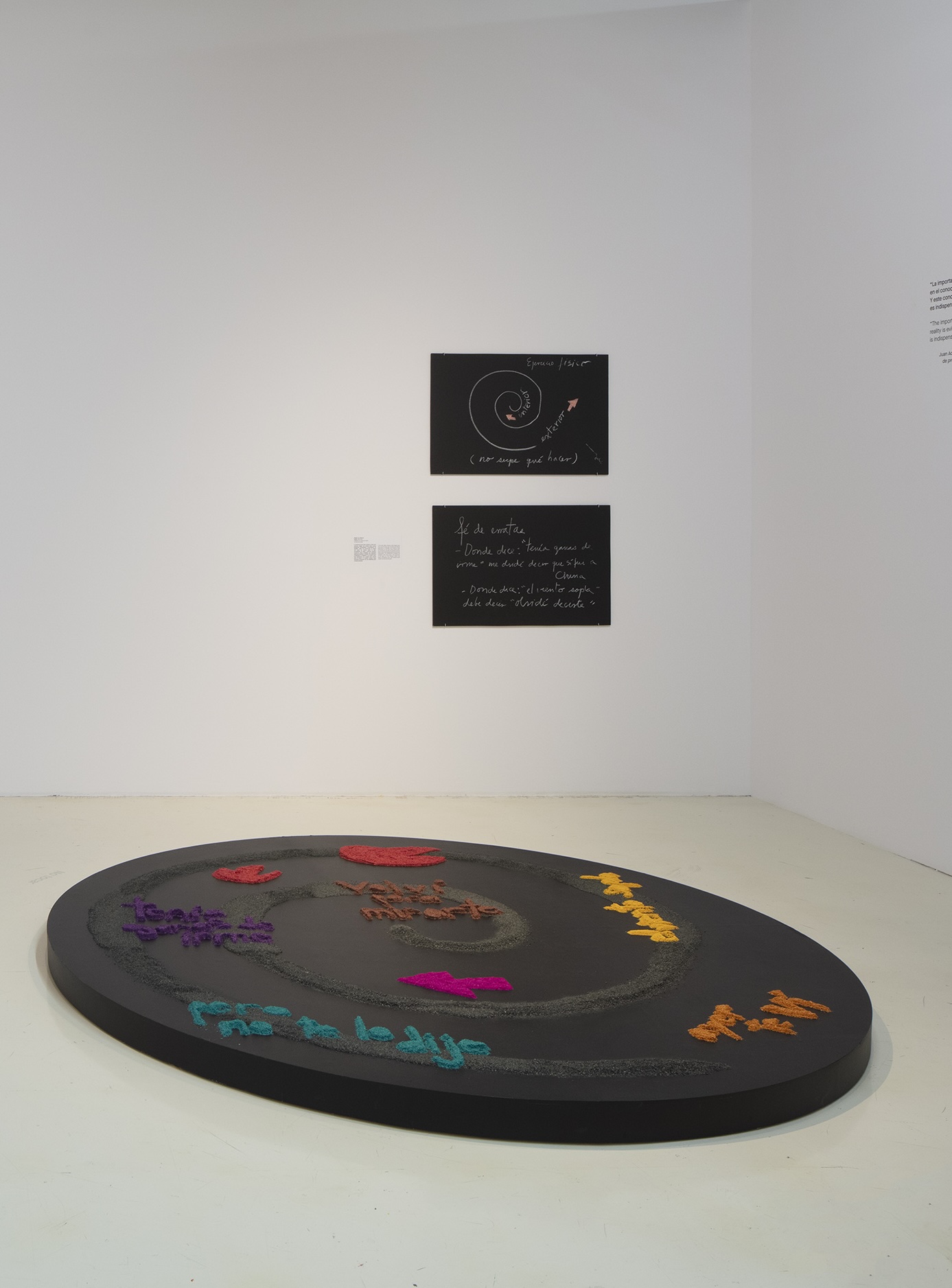
G) On a circular black base, a series of words is written in colored powders; behind it, a handwritten errata on a black background with white lettering. On one side, powder that could blow away at any moment, ready to mutate; on the other, the reiteration of error. In both dimensions, there is a possibility of escape. In the work Espiral (Spiral) by Magali Lara (Mexico), from 1981, recreated for the exhibition, one of the material ambiguities inherent to no-objetualismos is sustained by asking how to materialize immaterially. To confess, and then sow doubt before that confession. This is a saying that unsays itself at the same moment, an enunciation that negates itself, an intention that erases itself. A phrase in blue-green shines at the lower edge of the circle, insisting on the weight of the lost possibility: "but I didn't tell you."
Taken together, the exhibition shows the public the possibilities of no-objetualismos through the echoes and reverberations of 1981: human silhouettes outlined in acrylic boxes, contemporary altars with flags and televisions, a tree that briefly interrupts an avenue, crosses spanning a highway, Andean popular retablos, masks, pregnant bellies, and all manner of non-objectual objects. As at that colloquium, the questions summoned across all the works remain: When does art happen? Is it here or somewhere else? Where does it reveal itself? Where does it hide? Perhaps the most difficult question is: when does a work of art end? It seems as though it never does — that after the thunder of the work there is no silence, only reverberant noise that crosses latitudes and also travels through time in a straight line to the present.
Translated into English by Luis Sokol
1: Juan Acha, “Teoría y prácticas no-objetualistas en América Latina”, 1981, p.3. Found in https://icaa.mfah.org/s/es/item/1088533#?c=&m=&s=&cv=&xywh=-1334%2C-46%2C4367%2C2444
Published on May 8 2026