Review
Flat things whose way of unfolding is standing up. Christian Camacho at Galería Karen Huber
by Eric Valencia García
Reading time
4 min
Christian Camacho's work draws attention through its subtlety. It is as if through it he shows us what objects do in secret. His works are laboratories: spaces where he places "things to see how their relationships function"¹, things that can be an angle, a reflection, a transparency.
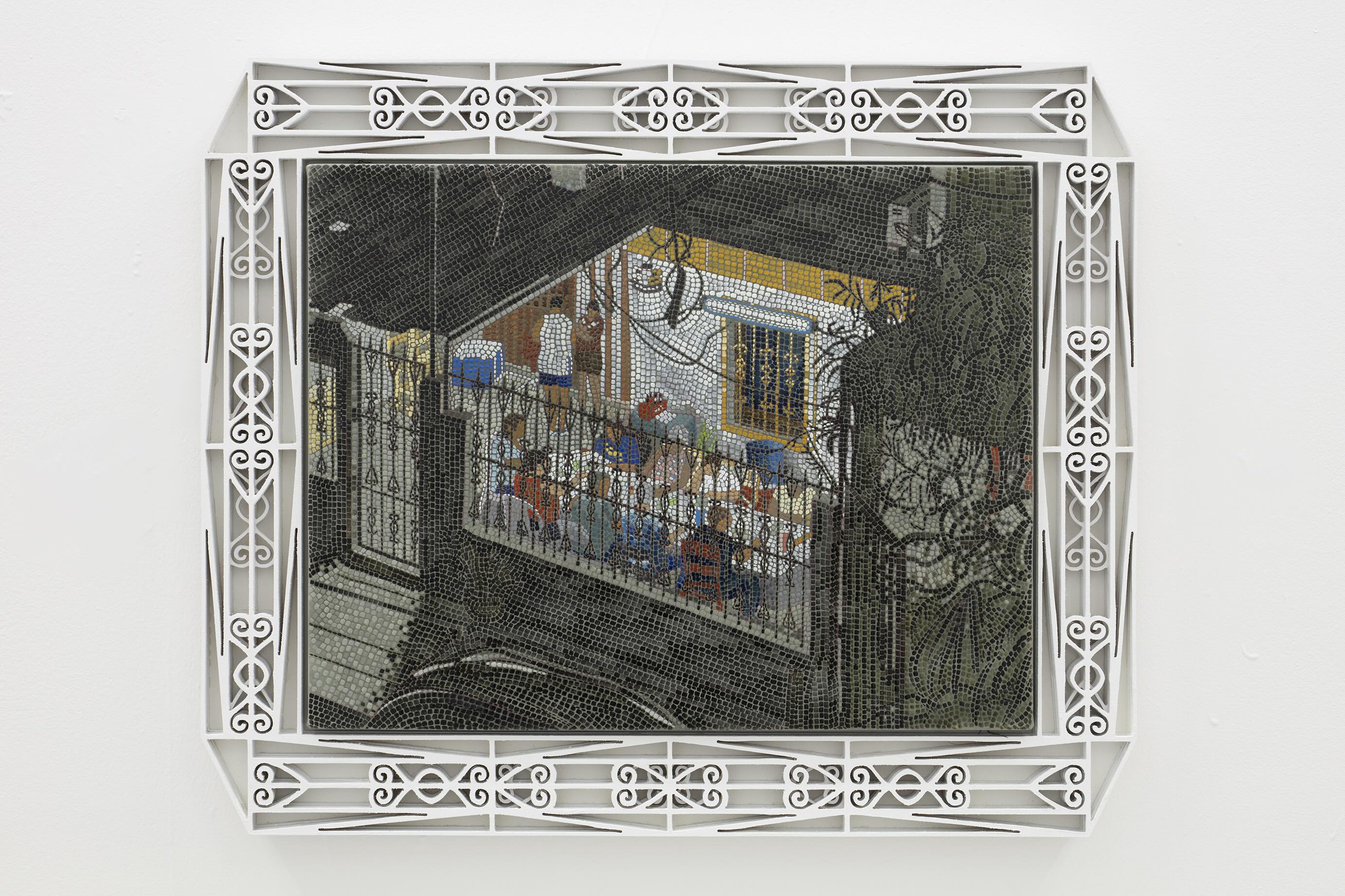
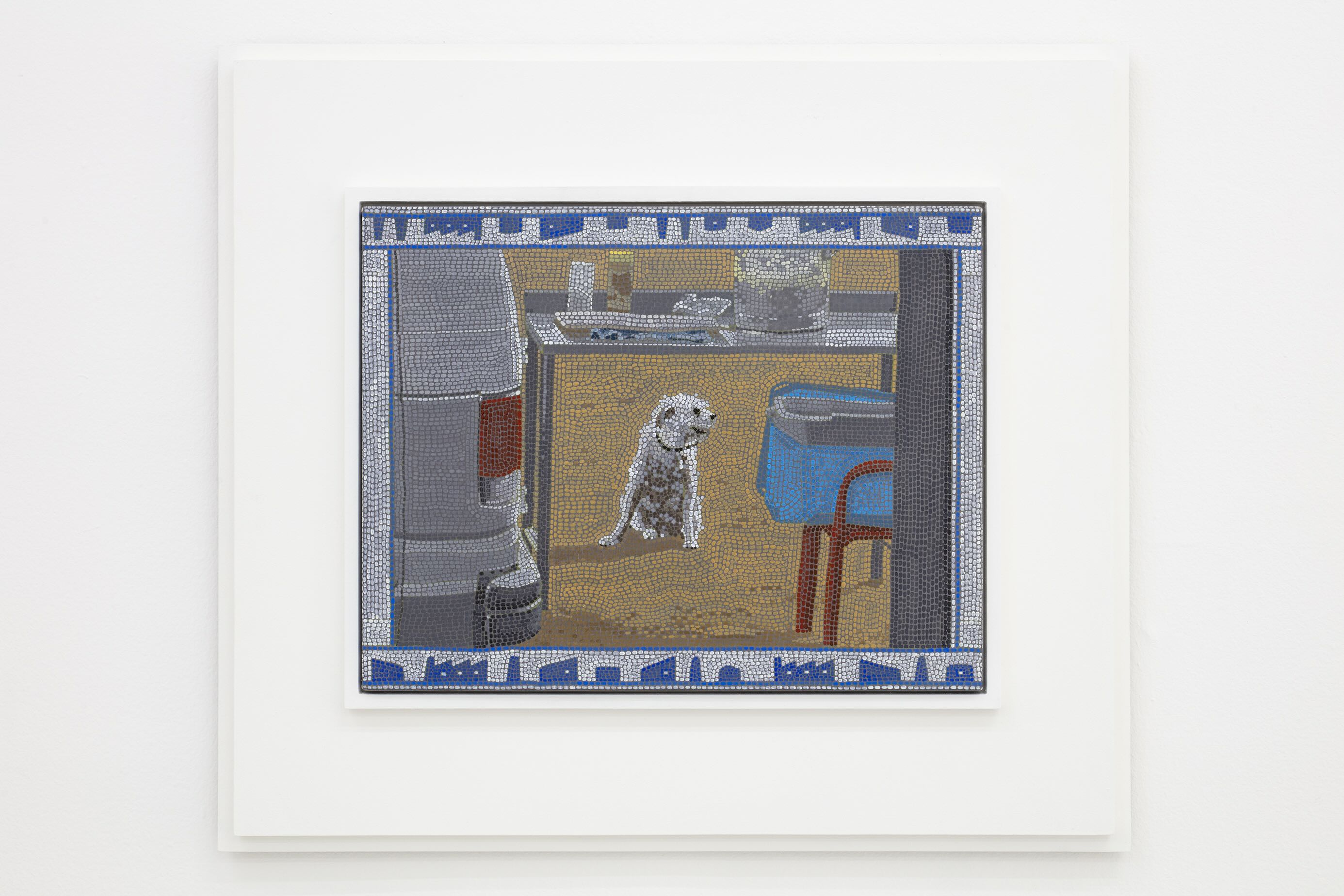
Currently, Camacho is presenting at Galería Karen Huber the exhibition titled Santa Catarina, a series of paintings in various formats, mostly with everyday scenes from his walks through the city of the same name in Nuevo León, where he lives. The works are inspired by mosaic art, a millenary tradition that consists of constructing an image with small mosaic pieces of different colors.
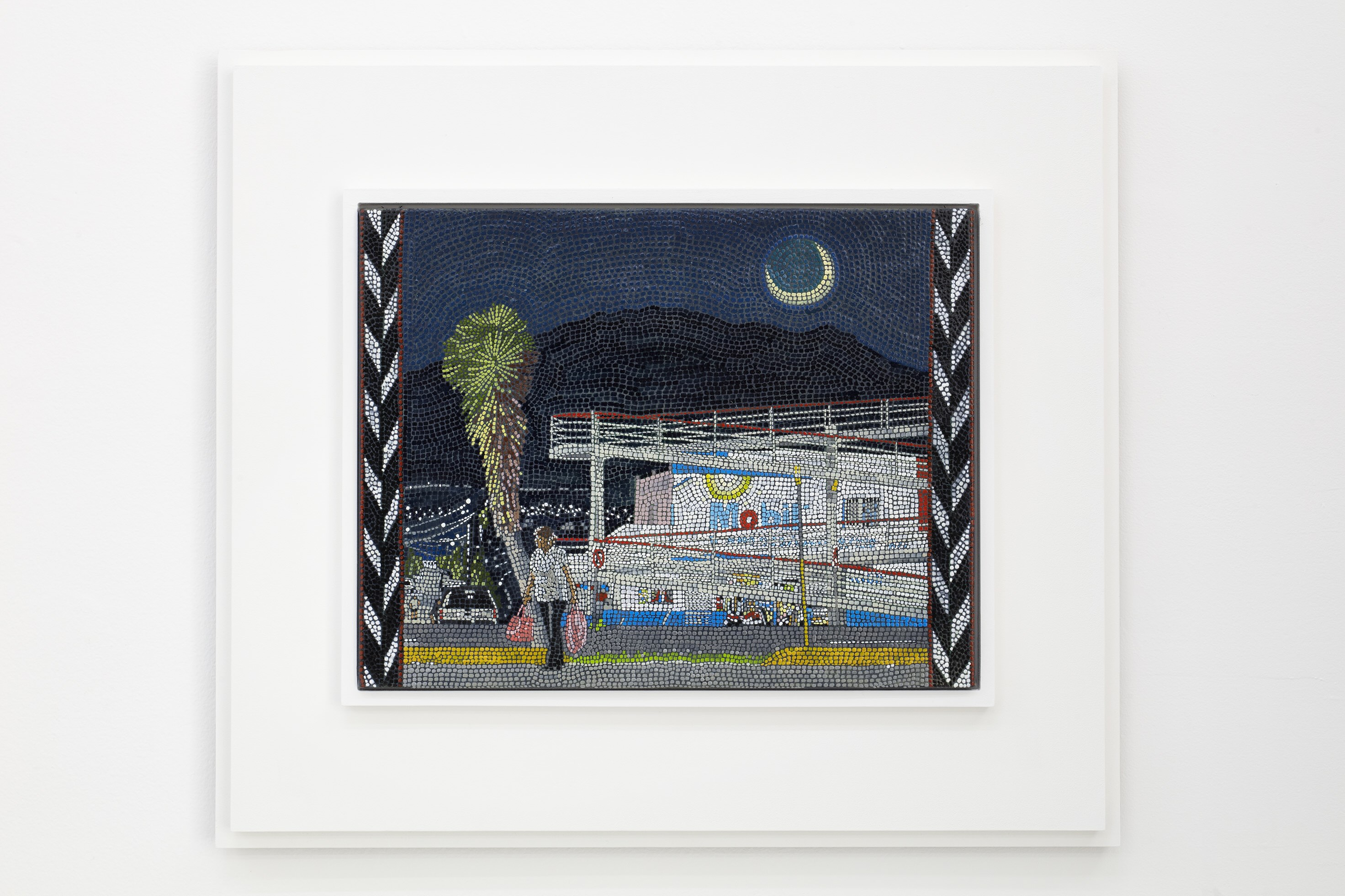
After the surprise caused by the meticulousness with which each work has been made, what draws my attention is the intensity of the color of the night sky in the work Varios lados (cruce). Looking at it closely, one can see that the effect is produced by the interaction between a gray color over which he has painted brushstrokes of a more saturated blue. The detail makes me notice that this gray corresponds to a first layer of paint placed over the entire surface of the canvas, and that just as in this work, all the works in the exhibition have a colorful background, almost always monochrome. The use of background colors is a tradition in painting that gains relevance in the Baroque: it takes advantage of the effect produced by the transparency of pigments, which are traversed by light and then refracted in the background, ultimately illuminating the pigments from behind.
The way he allows this color background to show through and makes its function explicit is very interesting, as he takes advantage of the gaps between brushstrokes to reveal them in an almost imperceptible way. The images that evoke the artist's walks through Santa Catarina have a porosity through which this background color seeps. If I dwell on these details it is because they allow us to answer, if only momentarily, the question of the things Christian Camacho puts in relation in this exhibition. I would say they are the objects proper to painting: the color background, the transparency of pigment, the gap, the image, and the light.
The fold
The interest in porosity is not exhausted by the use of small brushstrokes; we can observe it equally in some of the frames built with hollow geometric forms that seem to reveal the wall on which they have been hung. Also, though perhaps less evidently, in another type of frame that seems to submerge the work into the wall.
In a live stream where he gives a tour of his studio, Camacho shares his obsession with the idea of "flat things whose way of unfolding is standing up."² In this operation, the "unfolding" recalls the concept of the fold, which can be understood as a function that reorganizes a continuity—itself infinitely folded—so that new relationships appear between its parts: interior/exterior, above/below, near/distant. There is not a single fold, but ways of folding and unfolding; each one produces different types of relationships³. It seems pertinent to bring this concept up because of the way the artist makes objects affect one another: causing them to fold or unfold mutually, producing unusual ways of behaving, as in the idea of flat things and their way of unfolding, mentioned above.
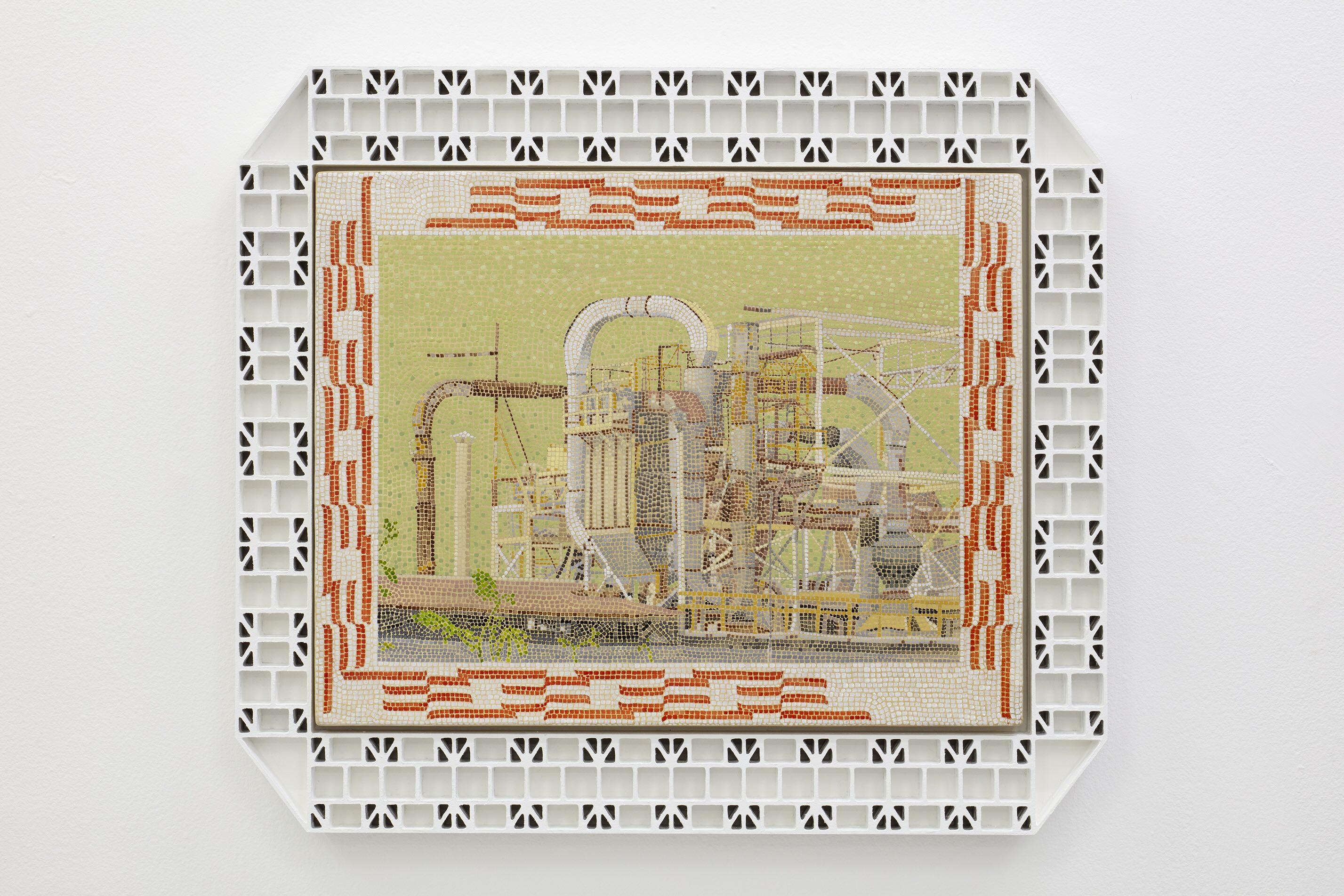
I think about this specifically in relation to the frames that submerge the work into the wall and how this relationship topologically reverses the objectual quality of the canvas: does the canvas now have a quality of wall? Is it behind? Behind what? And the frame—did it suddenly become a wall? Does it no longer separate the work from the space, but instead integrate it into it? Something similar happens with the relationship between the images, the brushstrokes, the gaps, the background color, the light, the filter, the reflection, the wall… we appreciate how they fold and unfold mutually, how their optical or narrative functions become estranged, producing small, unusual phenomena.
This is how Santa Catarina allows us to return to painting to see its secrets and the intimacy of its most subtle material, physical, and optical relationships.
Translated into English by Luis Sokol
Cover picture: Christian Camacho, Santa Nocturna (detail), 2026, oil on canvas, 48.7 x 58.7 cm (framed). Courtesy Galería Karen Huber. Photograph by Ramiro Chaves
1: Christian Camacho, "USO. Objetos de arte. Visita de estudio," YouTube video, October 19, 2020, https://youtu.be/NA3nVksC1cU.
2: Ibid.
3: Gilles Deleuze, The Fold: Leibniz and the Baroque (Buenos Aires: Paidós, 1989).
Published on May 21 2026