Review
Medium, Voice, Interface… Relation. On “Notas de voz” by Elsa-Louise Manceaux at Museo Jumex
by Mariel Vela
Reading time
5 min
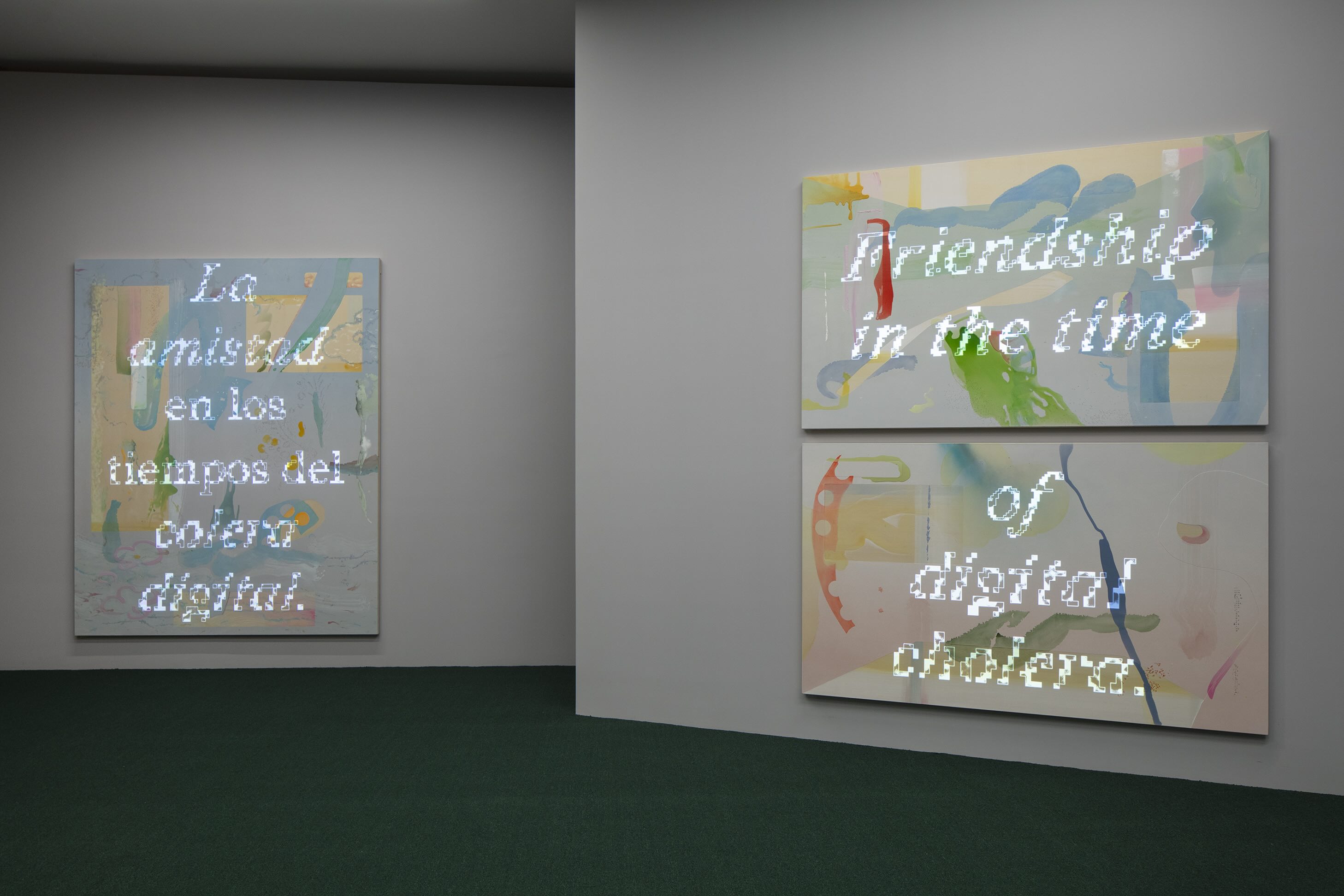
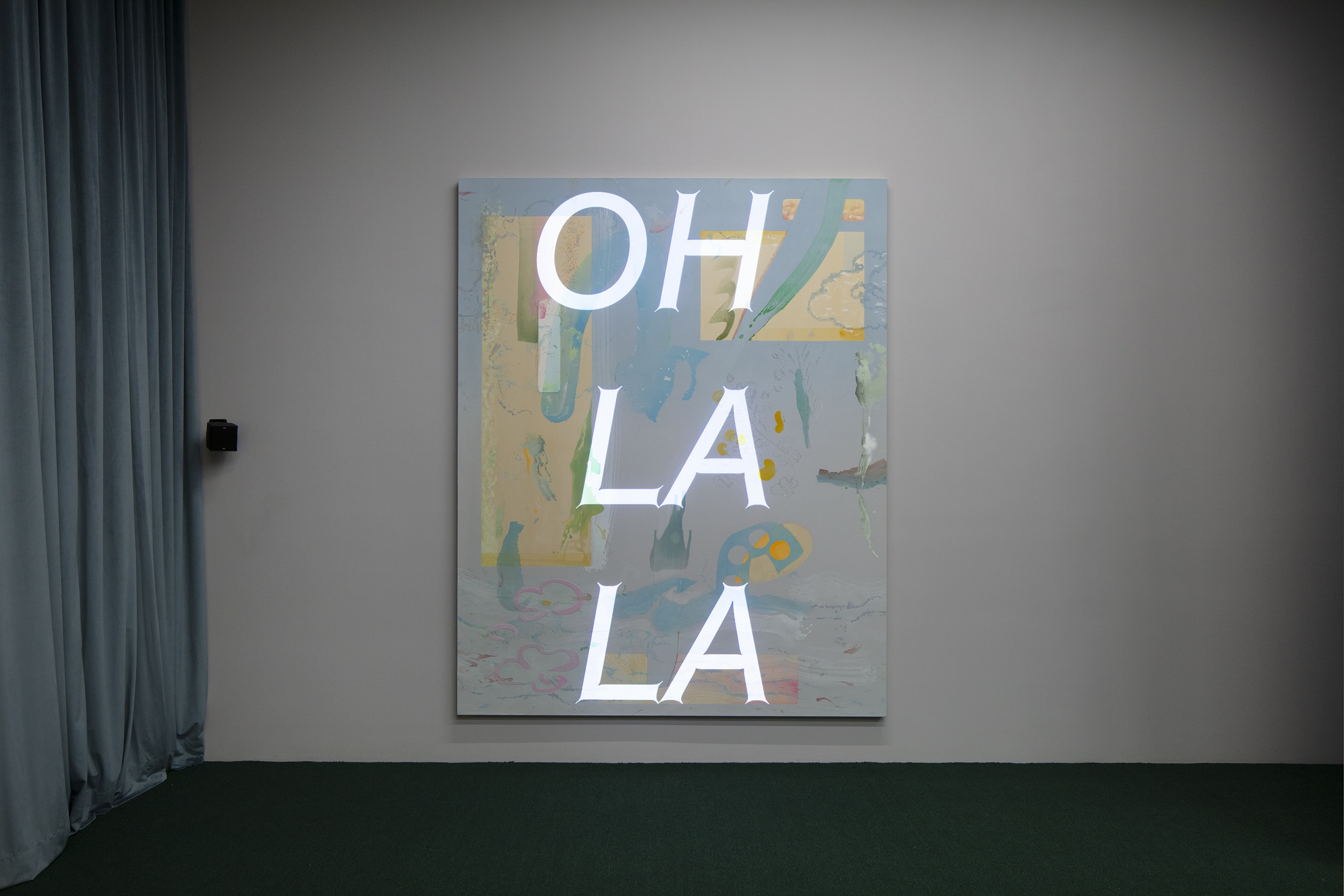
My cellphone has stopped functioning at optimal speeds due to the vast accumulation of sentimental information: photographs in multiple styles and framings, voice notes overanalyzing romantic and work situations, videos meant to shorten distances, stickers, and spam. Faced with this excess of materialities, one cannot help but wonder what will become of all our personal files. Notas de Voz [Voice Notes] is an installation by artist Elsa-Louise Manceaux at Museo Jumex that also allows information to pass through. Curated by Marielsa Castro, Rosela del Bosque, and Natalia Vargas, the exhibition consists of three paintings onto which typographies are projected—typographies that function as containers for different kinds of messages and words, as well as translations of the artist’s own voice notes. The intimate dimensions of the work become evident the moment we hear gentle intonations—some urgent—and varied accents circulating through the gallery space.
While adjectives such as “personal” or “intimate” were once avoided in discussions of art, it was from the mid-twentieth century onward that what had previously been dismissed as sentimental content began to acquire discursive force or to be intellectualized. Today, personal life is one of the dictums of contemporary art: the ability to establish within the work a series of traceable lines leading back to the artist, their biography, and their questions. What are the figurations of intimacy in painting today? What possibilities emerge when we think of painting as a terrain for transmitting other kinds of messages rather than as an end in itself? What Manceaux proposes here is a reconfiguration of painting as a medium. Its bidimensionality and objecthood—albeit metaphysical—make it an ideal spatiality for carrying out our always-human desires. Art critic Harold Rosenberg, influenced by Marxist theory and French existentialism, conceived each painting as an “arena” upon which one acts, or where an encounter between human and non-human forces takes place. “What was to go on the canvas,” Rosenberg wrote, “was not a picture but an event.”¹ In contrast stands Clement Greenberg’s notion of the immanent autonomy of painting: a space in which one deals as little as possible with human concerns, allowing pigments and forms to emerge from elsewhere as pure entities. The medium, stripped of intelligible messages, becomes an end in itself.
It is impossible today to think of painting as a dispute between the Greenberg–Rosenberg binary, whose texts were so deeply shaped by abstract expressionism. What might be the third or fourth paths? Painting-as-installation? Painting as a surface set against something truer, more transparent, more contemporary? This installation is the second iteration of what Elsa-Louise Manceaux calls Radio-pinturas [Radio Paintings,] in which she previously inscribed fragments of a debate between philosopher Catherine Larrère and historian of ideas François Cusset from the France Culture program Le Temps du Débat.² The artist poses—and inscribes on one of the paintings—the following question: Can a painting emancipate itself?³ The question suggests a binding—perhaps to the grand narrative of art history, perhaps to the artists themselves.
Through these heterogeneous devices, Manceaux inevitably evokes theories of communication, particularly those of Marshall McLuhan, who initiated a long inquiry into media and our spiritual entanglements with them. McLuhan understood media in a broad sense: clothing, watches, motorcycles, light bulbs, and more. His famous declaration, “the medium is the message,” revealed an interest in the formal question of the untranslatable—those material qualities that cannot be transferred from one thing to another. In Notas de voz, a palimpsest of sounds, textures, and temporalities is integrated through painting, which operates as an interface. It departs from its mythologies—those that understand painting as a space where forces assemble and disassemble at equal speed—and instead seeks common ground. Painting becomes a field that is hybrid yet legible. The following words emerge on the canvas in different typographies and arrangements:
Medium, voice, interface… relation
Insect attraction
Water management Increased pollination capacity
Biodiversity
Organic
Matter
Generation
The exhibition establishes a plasma of images and words that insist on “staying with the trouble” through an interconnection with beings and things in the world, in an almost cosmic sense, punctuated by the everyday intonations of human voices. It is here that the weight of language reveals itself: even in fragmentation, it persists in producing meaning. Painting, then, assumes an integrative and relational function. The collaboration with animator Paola Mercado, editor Andrea Valencia, sound designer Enrique Arriaga, and even the artist’s friends operates as heterogeneous energies converging on the painted surfaces. One might feel as though entering an idyllic relationship among audience, artwork, collaborators, and artist—everyone participating in a continuous, collective being, a paradise of seamless totality. A form of emancipation? Yet the interface—that shared boundary between independent systems—also marks the threshold where the untransferable lies. What manages to filter through or appear is perhaps the reverie of the everyday, of what is one’s own.
— Mariel Vela
Translated to English by Luis Sokol
1: Harold Rosenberg, “The American Action Painters,” ARTnews, 1952.
2: France Culture, Le Temps du Débat [The Times of Debate], episode 45 (Les termes du débat: Émancipation), Hosted by Emmanuel Laurentin with François Cusset and Catherine Larrère, originally broadcast February 3, 2023.
3: Direct quote from the work The Power of the Fragile (Radio Painting #1).
Published on Dec 30 2025