Interview
Interview with Tino Sehgal at EstaciónMAZ: The Passage as Useless Expenditure
by Sandra Sánchez
Reading time
8 min
Tino Sehgal’s first solo exhibition in Mexico does not hang from walls or rest on pedestals. Instead, it occupies a far more elusive site: the passage. There are no objects to contemplate, only situations that move through us. A fabric that exists in the interval bodies open up—and one we begin to inhabit the moment we enter the room. The passage does not preexist contact: it is contact. At EstaciónMAZ it unfolds in three ways. Kiss, Kiss (Clean Version), and yet untitled each deploy—through an unceasing transit—the same question: where does the “in-between” happen?
Previous versions of these “constructed situations” have been developed in emblematic spaces such as the Turbine Hall at Tate Modern, the Palais de Tokyo, or the Venice Biennale, where Sehgal was awarded the Golden Lion (2013). But in Guadalajara this is not about repeating a consecrated gesture; it is about activating it anew—setting it in motion in a body-to-body encounter with another city and other people who, by participating, render it singular. Because the passage—like contact—cannot be replicated; it is reinvented.
Let us begin with the kisses: clothed bodies in full light (Kiss), and barely visible naked bodies (Kiss (Clean Version)). Contact is not an attribute bodies possess; it is what bodies are. A brush and a pause between one movement and the next. A slight vibration as they hold a pose that evokes a kiss by Brancusi, Klimt, or any other work from “art history” that Sehgal took as a score.
The pose illustrates nothing: it is pure expenditure. A libidinal economy that spills over. The kiss is not represented; it is summoned—made present here and now, in the held breath of those watching. The archive as passage, not as accumulation of knowledge. Letting something pass that does not belong to us, that cannot be amassed, yet that moves us.
The passage is not a place but a movement that pauses—a pause that never stops happening. That oxymoron—arrest within transit—is what Walter Benjamin discerned in the Parisian arcades of the nineteenth century: galleries where the crowd dissolves and regathers, where the flâneur surrenders to the rhythm of commodities yet steals fragments of experience. A habitable threshold: the spatial form of a desire that never ceases to seek its object without finding it.
Sandra Sánchez: I was struck by how you work with transitions—it’s as if the performers are in constant motion, a continuous passage.
Tino Sehgal: I try to make everything a transition—or nothing a transition. Every moment matters. Kiss took time because sometimes I hide the transition. I make a larger movement to conceal a smaller one.
S.S.: I’m also curious: how does the work change from theater to museum? What is it like to work with movement using people who aren’t professional dancers?
T.S.: If you think of my dance lineage—Jérôme Bel, Yvonne Rainer, Simone Forti—it isn’t necessarily the virtuous body that steps in. In many pieces it doesn’t help to work with theater people because they carry too much information in their bodies, and you have to undo it. For example, at the Paris Opera it was difficult because their logic is the opposite; you have to rehearse a lot to unlearn it.
Those who enact Kiss do not execute a choreography to arrive somewhere. They sustain a pose—that slight delay at the threshold of the kiss—like holding one’s breath. They spend time, expend energy, expend the fiction of individuality. The sovereignty of an instant that is good for nothing. Another economy appears—not that of equivalent exchange, but of expenditure without reserve; the sovereign waste that Georges Bataille opposed to the miserly logic of accumulation. Two beings touch and, in contact, experience the profound continuity that binds and undoes them. Eroticism is not a reproductive function; it is, above all, a sharing of the discontinuous. It does not accumulate; it squanders.
Within this passage beats another politics: attention, listening, exposure to the other. Contact demands that we de-subjectivize ourselves. It wagers the fiction of autonomy—the illusion that we are individuals first and only then relate. Contact teaches the opposite: the “I” emerges from the “between,” not the other way around.
In yet untitled, two or three performers gather on the floor. From that low position they begin to articulate a sonic matter born deep in the throat: tongue clicks, rhythmic breathing, fragments of melodies devoured and transformed. Someone sounds; someone moves. Control passes back and forth among bodies. Someone joins; someone withdraws. In that dance a fabric is woven—not of individuals, but of transits.
S.S.: How do you show a relationship?
T.S.: The relationship between Maya [Renée Escárcega, curator] and María [Romero, communications] is invisible, but it exists—you and I just don’t know it. That interests me: showing those relationships. I like it when someone arrives; a third person comes and then leaves. You feel their relation there. Attention is always happening; it’s difficult to give attention to the other.
yet untitled only occurs when someone is there to witness it. Spectators are not directly addressed, yet without their presence the performers do not activate. The work needs that witness who, from silence, completes the circuit. It represents nothing; it tells no story; it simply happens. Not identity, but the common—as attention to the other’s body, as a negotiation of power, as loving control and submission. Existence is always shared and therefore exposed at the limit.
S.S.: Alongside movement, you added work with voice—how did that develop?
T.S.: In this variation, we started beatboxing as a group, without microphones. We made loops and beats, then improvised. Twelve people making music together—one or two doing different things. With more experience, they can make different sounds at the same time.
These associations
These associations was created in 2012 for the Turbine Hall at Tate Modern. As of January 31, the piece is reactivated outside the gallery, on Andador 20 de Noviembre—the pedestrian passage connecting the Museo de Arte de Zapopan (MAZ) with EstaciónMAZ.
A large group of performers moves along the walkway, creating scenes that continually transform. At times they walk in a compact formation, like a school of fish gliding in unison. At others they disperse, run, kneel, and produce sounds the wind carries away. Suddenly, someone stops before a stranger and tells them a personal story—a loss, a moment that changed their life.
There is no stage. No boundary. The public is inside.
Andador 20 de Noviembre is not a neutral support: vendors and street musicians pass through; diners at outdoor tables; workers commuting; children; strollers and tourists. Performers do not act for the passersby but with them. They envelop and address them. A subtle yet radical political inversion takes place: the public is not what belongs to everyone by decree, but what must be invented each time.
Conversation arises without preamble, with a disarming frankness. There is no script—only disposition: exposure to the other without knowing what will happen. Performers are trained to sustain that exposure, not to flee from silence. Visitors may respond, remain quiet, ask questions, even divert the course of the story. Someone offers their story asking nothing in return—no reciprocity, no negotiation. Simply giving. And in that giving, a bond is produced that bypasses equivalent exchange: expenditure without reserve, the sovereignty of the instant.
S.S.: Beyond your training in dance, you’re also an economist. What does dance open up within economics?
T.S.: Economics is one aspect of life—a very basic one. How I sustain myself. How I make sure I’m not too hot or too cold. That I have water and food. That’s economics. There are many ways of organizing life, of deciding how much attention we give to each aspect.
Toward the end of These associations, everything converges. The performers gather into a compact group, walk toward the stairs facing the MAZ, and begin to sing—not a recognizable melody, but a murmur. A shared passage: what opens between one instant and the next, between one body and another, between two stories—and more.
We deeply regret the difficult situation unfolding in Guadalajara — and across the country. We want to express our solidarity and send strength to all our friends, colleagues, and collaborators. We hope everyone is safe, that life returns to the streets, and that the violence comes to an end.
Tino Sehgal's group will present "This Joy" as part of Festival Tono 2026.
— Translated into English by Luis Sokol
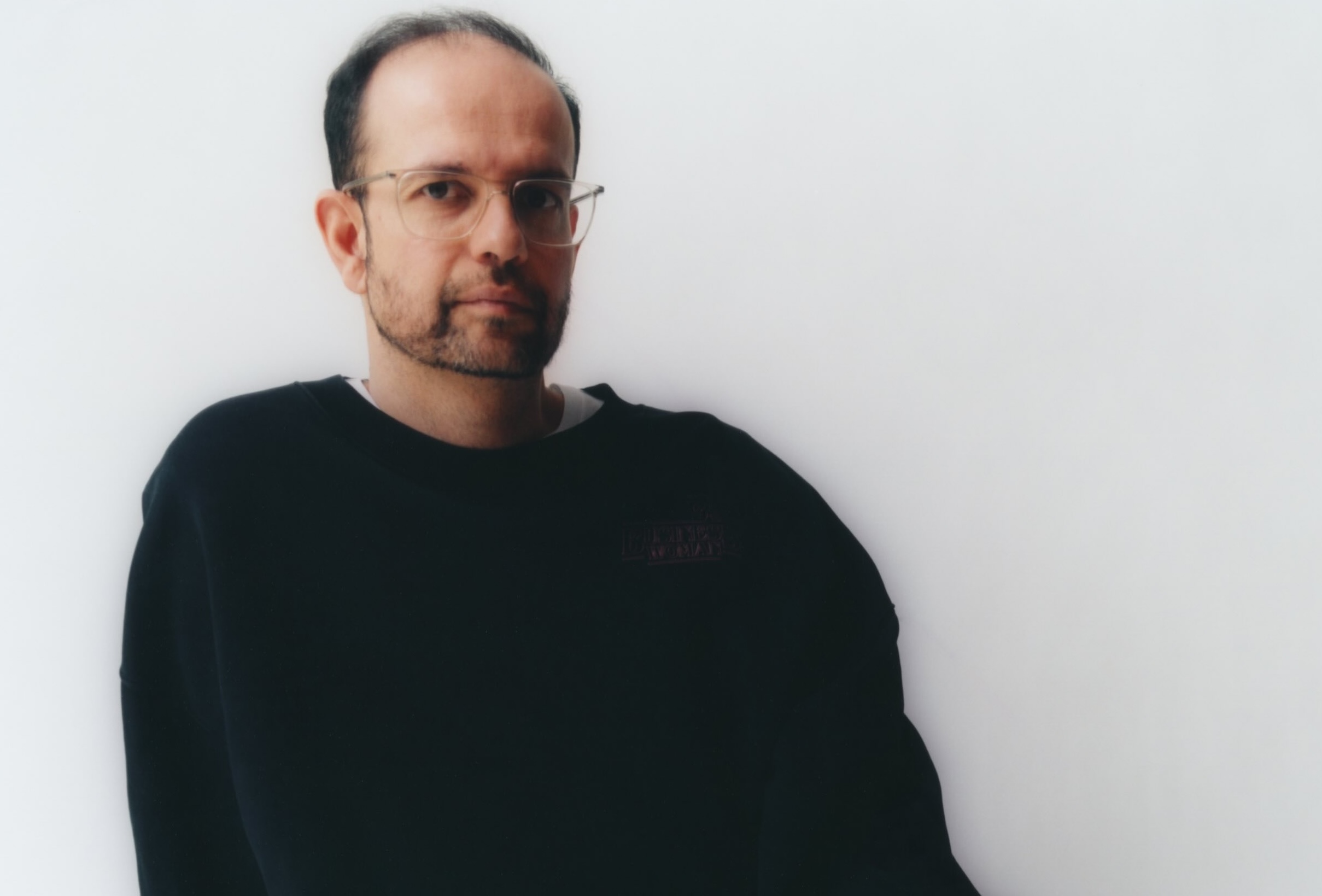
Cover picture: Tino Sehgal, courtesy of the artist
Published on Feb 25 2026