Interview
Embodying the Map. Interview with Michelle Sáenz Burrola
by Sofía Ortiz
Reading time
8 min
"Dancing is very joyful and it fills me with happiness" is the last thing Michelle Sáenz Burrola says to me at the end of a conversation framed between eating tostadas at the market and my appointment with my therapist. Although Michelle works with video, object, and performance, I met her outside of galleries and art talks; I met her dancing. Over the course of our conversation, I came to understand her work as a constellation in motion: a series of discrete interests interconnected by gestures and intuited stories. I also get the image of a large stack of tracing paper seen from above, in such a way that all the layers are transparent and we understand all the ideas at the same time, one on top of the other. In this stack of paper—Michelle's work—all the sheets have titles like: Proyección de Mercator, Movimientos de gusanos, Rutas comerciales de la mandarina y Amor en las islas de la UNAM.
The project she is working on right now—which I am grateful she shares with me, given how vulnerable it is to speak about something in process—seeks to understand how mandarins work and what they do as symbols and objects in her work.
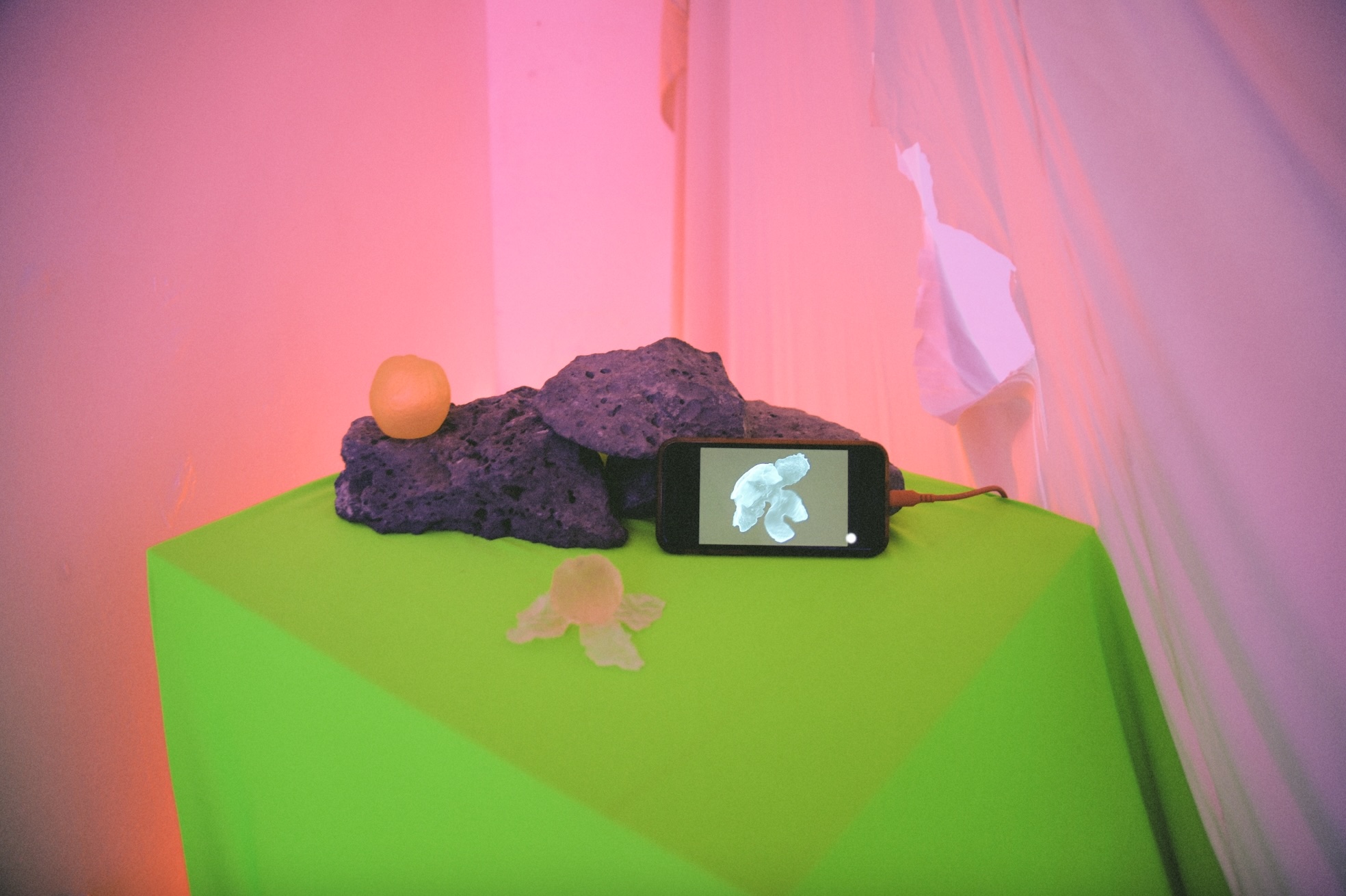
Michelle Sáenz Burrola: I want to be able to articulate a more personal narrative with the mandarin. It is a fruit that appeared in my life like a ghost. I started using it when I lived in Iceland, during my master's degree. I worked in a supermarket and began asking myself about them from a very intuitive place, about their paths and the routes they took to reach where I was. Little by little I have been complexifying my relationship with them and finding symbols in each of their parts: the membranes are like borders, or the way the segments separate in the same way we unfold a spherical body to make a map.
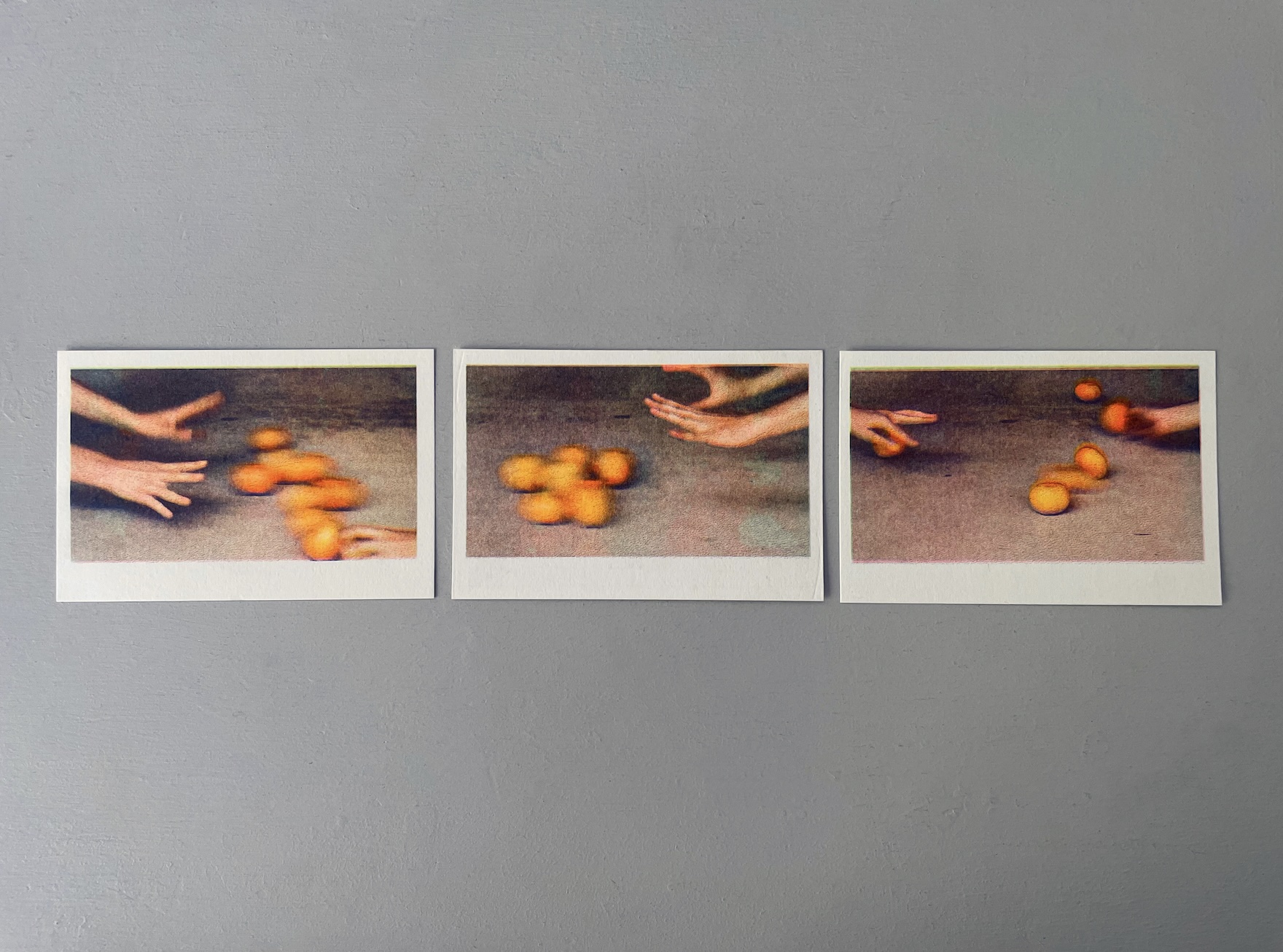
She shows me her master's thesis video Aparecer en el movimiento de agua (2020), in which a shorter-haired Michelle, dressed in purple tights, rolls fruit from one side of a table to the other. They are actually three tables assembled like puzzles mounted on wheels, shaped like a freehand-drawn map of continental America. Michelle kneels on one side of the table and sets the fruits rolling from one end to the other; they fall to the floor. "They are like bodies, or performers, traveling from south to north along their migration routes," she tells me. In that sense, the mandarin is a stand-in for herself, a fruit turned familiar (in the witchy sense) that she can multiply and place in the world like orange buoys that shift the relational meaning between things.
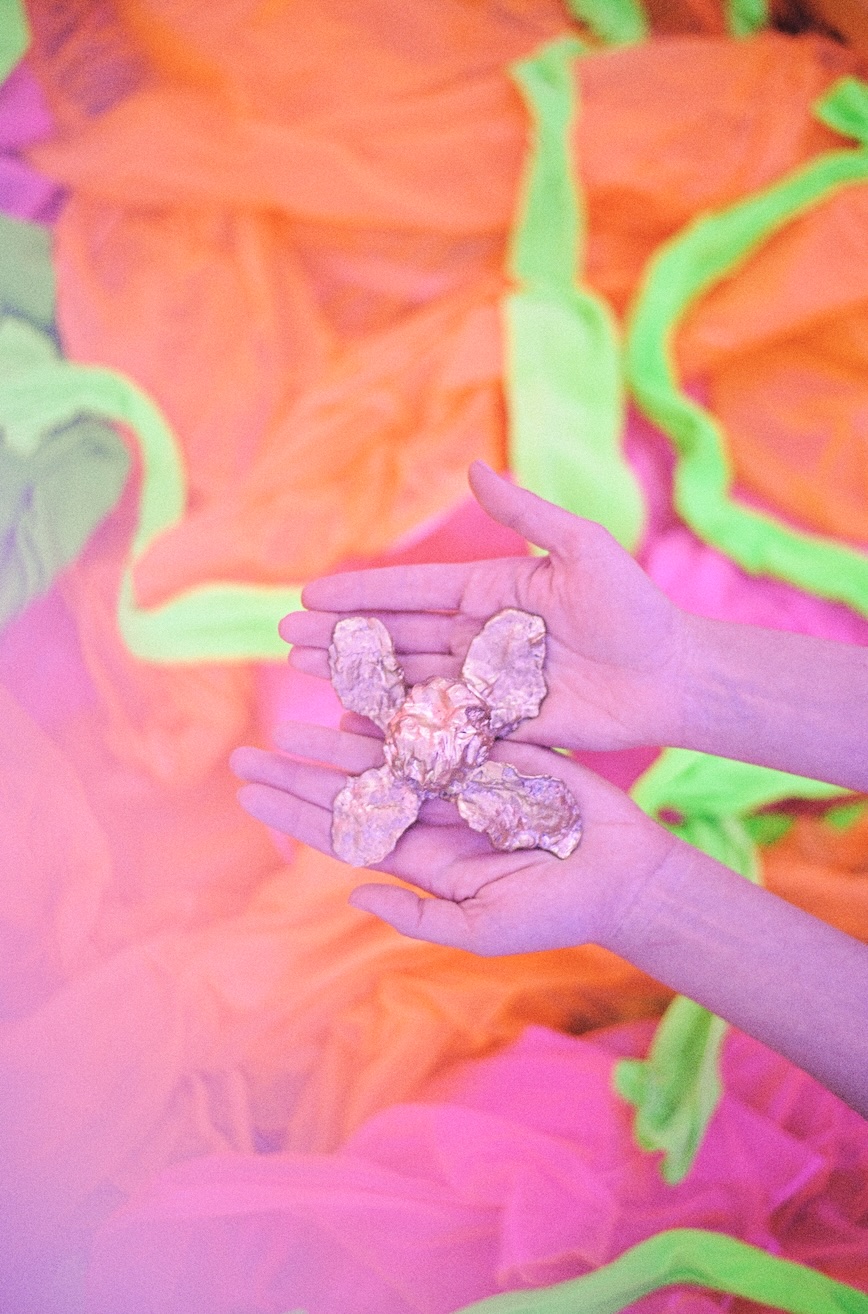
Michelle takes out a bronze mandarin and places it on my desk. I had never been confronted with a citrus fruit turned metal (long live art!); when I pick it up I feel the weight and notice the wrinkles at the edges of the skin. It is a piece she made expressly for the project she mentioned earlier, the one she is gestating. In that project, within the framework of Jóvenes Creadores, she builds a bridge between the mandarin and the central library of UNAM. It is a large leap, but those are precisely the metaphorical spaces she wants to thread together: connecting very large ideas—sixteenth-century colonialism, for example, or the nation-building project championed by Vasconcelos—with the miscellany of gesture and body, like taking off a bra or dragging oneself across the floor like a worm.
This specific project departs from the Mercator projection, the distorted cartographic projection that gives us the world map image we all know, in which Greenland is almost the size of the African continent. A map that has basically not changed since its creation in 1569, a foundational image for generations of people who have learned to locate ourselves in relation to the space it proposes. I think of Joaquín Torres-García's work América Invertida, in which, with a very simple gesture—flipping the map of South America upside down—he reveals the power relations inscribed in cartographic planes: an orientation decided from the arbitrariness of whoever holds the power to name north or south. To think of the map as an architecture of global space, one that dictates where I crouch down and which paths I am allowed to take.
MSB: Maps legitimize the control and movement of populations. They establish hierarchies and ways of doing—call it culture—which we assimilate in the body. They are codes that, by repeating and performing, we carry in the body. I am interested in the microscopic ways in which we can change these histories: dismantling the rigidity of the body and at the same time the injustices we repeat or perpetuate systemically. That is also why I use the mandarin. Not only to speak of it as an object and a process—its life cycle, its symbolic value—but also because in it I see the possibility of transformation and malleability.
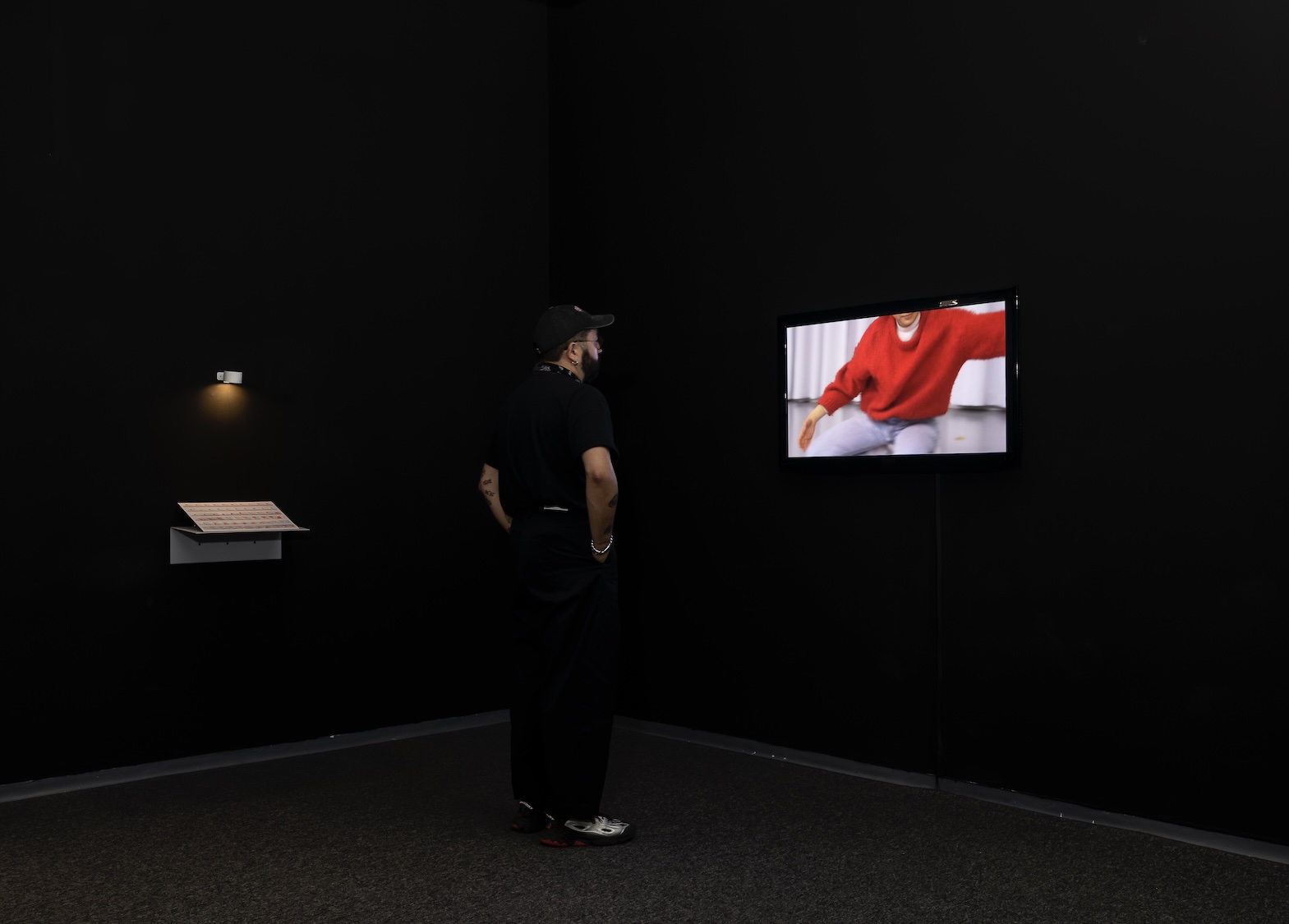
She traces a path for me: from mandarin to map, from map to book, from book to library.
MSB: If the mandarin is like a map, maps for a long time have circulated in atlases, which were gathered in libraries. The library is a place that houses knowledge and at the same time represents power. On the other hand, it holds an ecosystem of desires, affects, and tenderness. It seemed right that, for this project, I focus on the UNAM library, which in turn has representations of different maps on its facade: astrological maps by Copernicus and Ptolemy, the Nuremberg map, among others. If all power is concentrated in the word, the text, and the oral, what power does the body have to destabilize that space? In that sense, I am doing various exercises in relation to the mandarin, my body, and the library. How do we embody the power structures that run through us? How can the body resist—even in small resistances—the narratives imposed upon us? For example, I have been very struck by how students use the library for many things beyond studying. There are many couples and many people sleeping.
Here I get excited, because I too—in my university years—was passionate and drowsy among endless volumes of dusty books. I did not think of it as resistance at the time, and I appreciate the historical revisionism revealed by Michelle's eyes. If centers of knowledge are increasingly immaterial—clouds and servers—and even the faculty of thinking is increasingly delegated to the AIs that surround us, how much more important becomes the desire to sleep and to connect with other bodies, to have public-private spaces that allow us to do so.
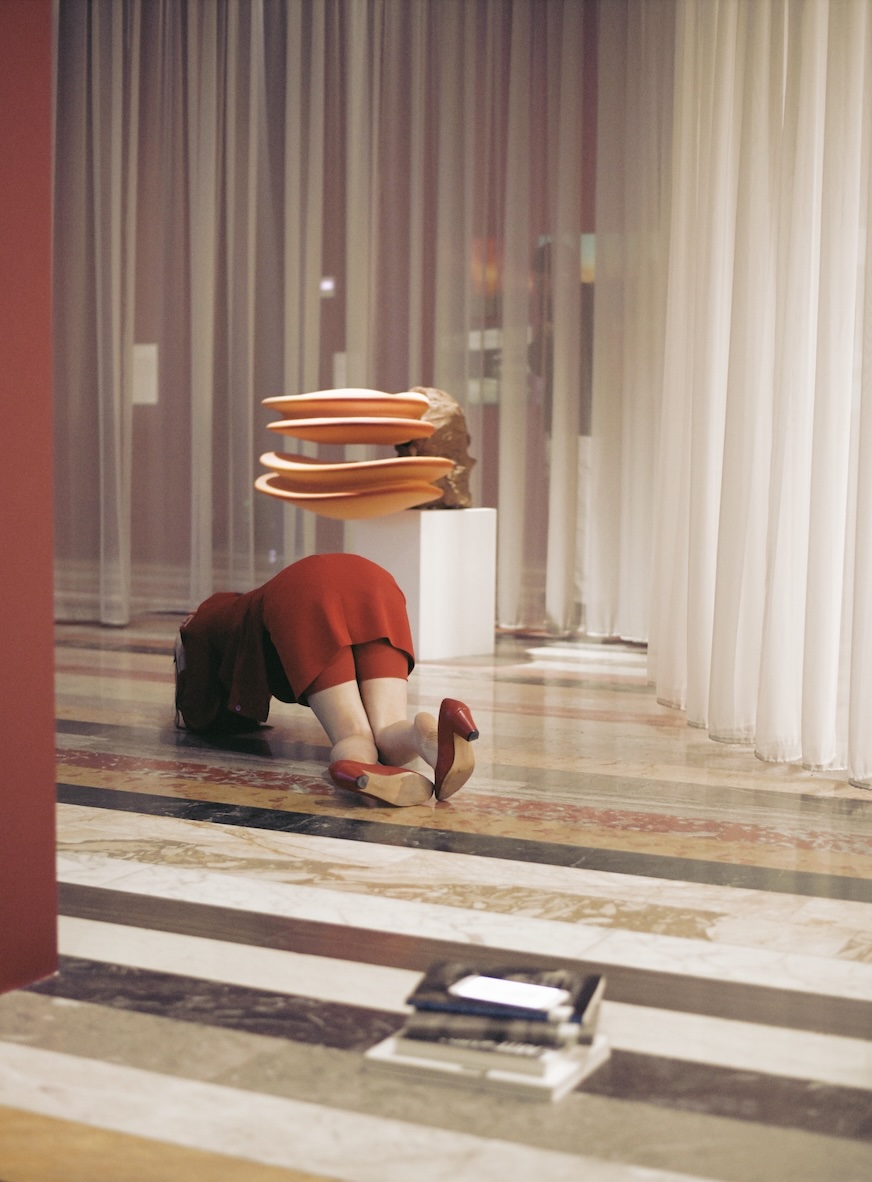
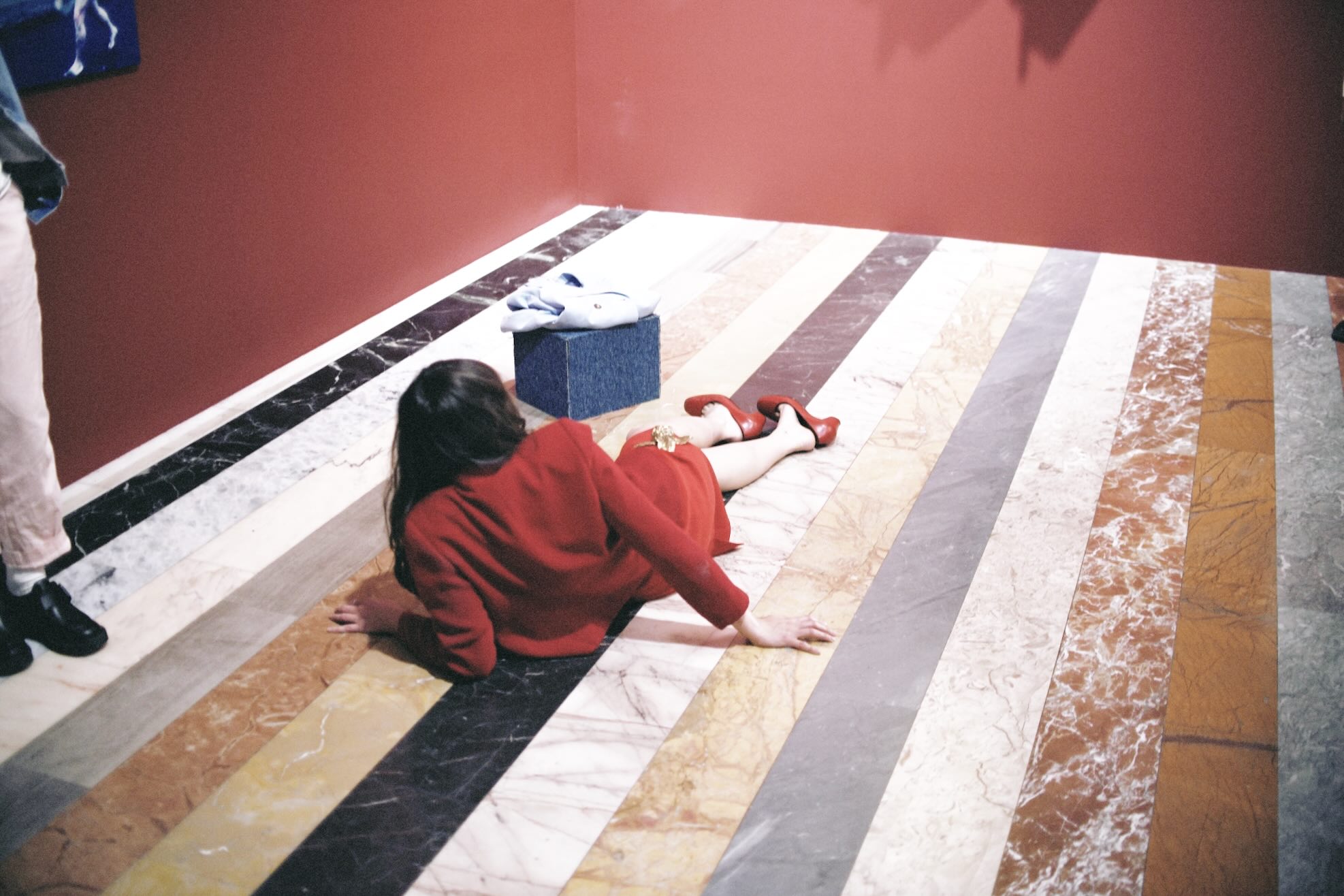
Like Amerigo Vespucci and the American continent, the idea of exhaustion already circled Michelle's interests. She was invited to mediate the exhibition Visiones difusas, which revisits the Jumex museum collection through the lens of the oneiric. For this performance, titled En este sueño ocurren otras cosas, Michelle establishes a character: an office worker, fed up and tired. She reads a text that begins by saying I am between the present and the 70s—a temporal dislocation, perhaps analogous to the geographical dislocation she now explores—in which she describes the responsibilities that lead her to exhaustion. Like someone inside a dream, the executive performs strange gestures inspired by different pieces in the exhibition.
MSB: In this piece I realized that exhaustion is very present in my life, and how that exhaustion can be something potent in the making. Being tired is not bad, even though we think so within our self-exploiting lives. For the piece at UNAM I am going to create a character who is close to me but is not me, who uses the exhaustion of her everyday life to speak about territory, map, and the power that underlies it.
I understand that for Michelle the dream is a container; dream logic can hold a constellation of interests without having to establish a single path of connection between one thing and another. One last image comes to me. I think of my body, of all our bodies moving through this great city that threatens to sink into the jaws of an ancestral lake, while at the same time it dries and cracks, while it disappears our bodies in basements and hosts world cups where thousands of people will move, like mandarins on a map, from all the segments of the spherical-body-world to here, where Michelle is—tired, joyful, and ready to embody everything we know how to say but not feel.
Translated into English by Luis Sokol
Published on Jun 7 2026