Review
Aurora Pellizzi at La Tallera: Constant Surprise
by María Olivera Monroy
Reading time
5 min
Above all, movement and insistence. The repetition of patterns is also a way of saying: “There is life here, there was play here.” Entrelazo, Aurora Pellizzi’s exhibition at La Tallera, dedicated to the memory of Carla Stellweg, who carried out the curatorial work, unfolds as a space of expansion and constant discovery—something akin to looking at things for the first time and being aware of it.
Paradoxically, nothing here appears for the first time. The works are made from materials that belong to our collective imagination and everyday life: cleaning rags, plastic bags, brooms, domestic cleaning tools, among others. In Pellizzi’s hands, these items generate a continuous sense of surprise. What seems to be a face is also a collection of metal objects. What resembles a pennant turns out to be the result of a delicate intervention of silver thread over a blue rag surface.
The installations are part of Mojigangas, a project recently developed and previously shown in spaces such as Salón ACME 2023. These are banner-like pieces made from rags and domestic objects related to cleaning and cooking, which recreate different images to explore the possibilities of masking and the distortion of scale within a festive context. Beyond their size, their spatial distribution invites us to rethink care work and domestic order—typically associated with the feminine and the private—against the carnivalesque, where roles are inverted and labor becomes collective. Suddenly, this seemingly rough textile material inhabits the space as if it were a celebration on pause.
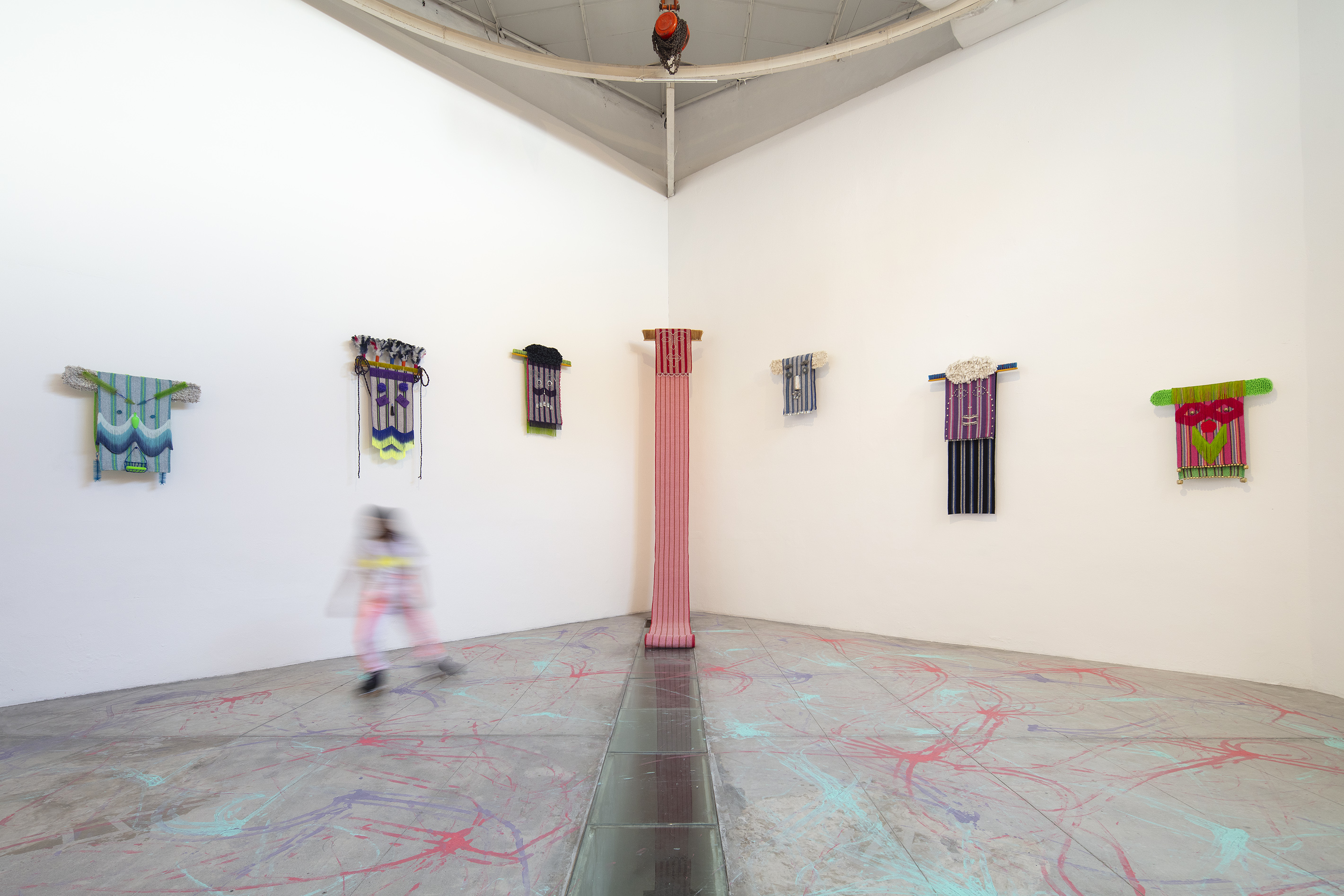
Standing before the installation, the gaze moves from sky to ground and back again in a vertical passage. There are gestures that escape control: elements that hang beyond the limits of the fabric, feather dusters standing upright, faces assembled from hair clips, sequins, pom-poms, fringes, and mop strands. Few things feel as close to ritual as recognizing a face that resembles our own. Though these are inanimate objects, by this point we have already become complicit in their personalities. Pellizzi seems to participate in this game as well: the titles of these works are proper names—“Jacinto” or “Cholita,” for instance. As Rae Armantrout once wrote, “What if there were a hidden pleasure in calling one thing by another name?” Something of that happens here.
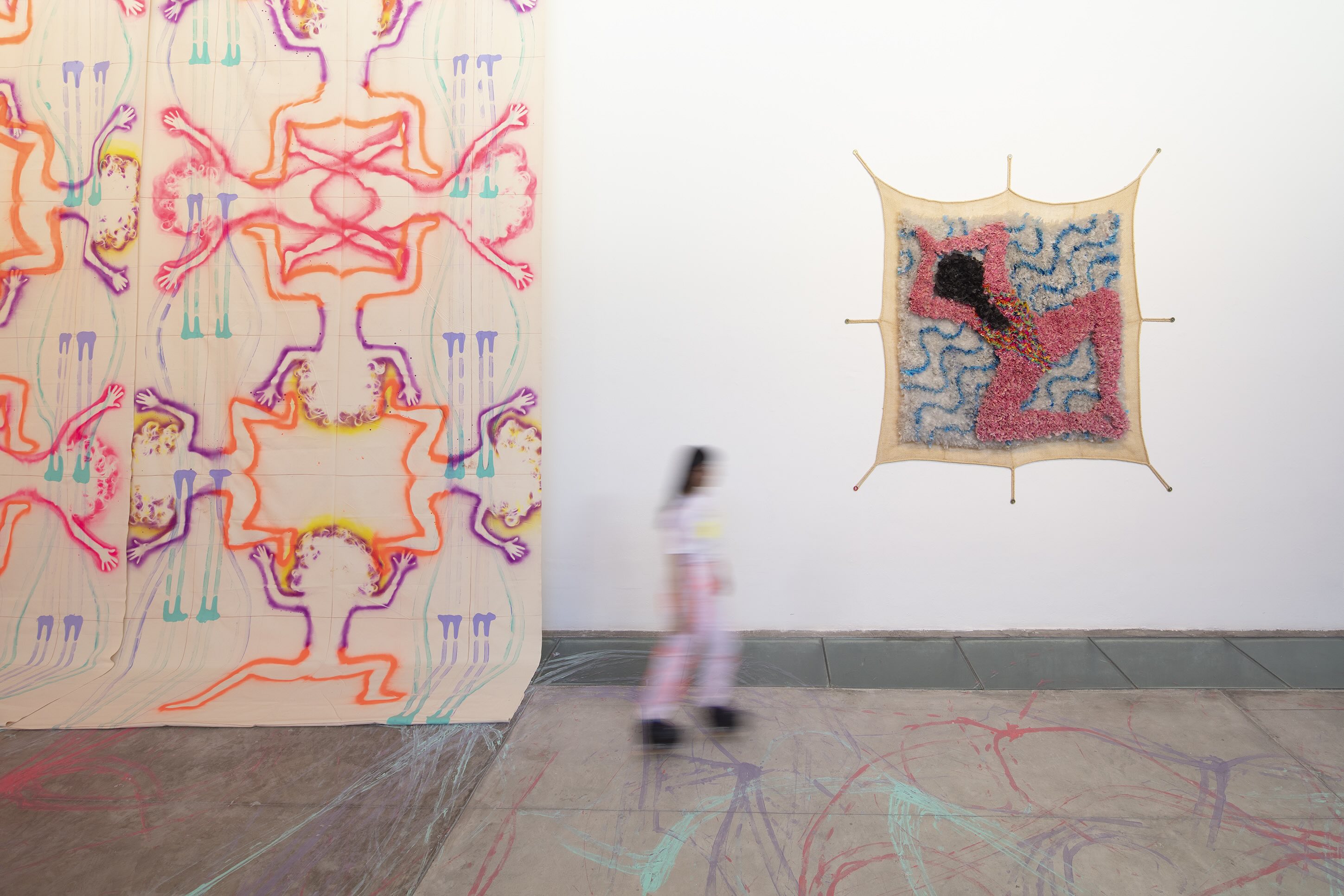
Another piece that plays between image and construction is Rana / Breaststroke(2022), which depicts a female-coded body swimming. At first glance, the work blurs the line between textile and painting; ultimately, it reveals itself as an installation made of plastic bags over ayate, part of the Plastexseries that Pellizzi began in 2017 after the earthquake, with the intention of creating mats to improve improvised shelters and transforming waste materials into useful objects. There are many things to appreciate here: the surprise of recognizing the material, the figure evoking a moment aligned with Cuernavaca’s “eternal spring” imaginary, and the way it clings to the wall like an animal poised before its next movement.
To be body. To be painting. To be repetition.
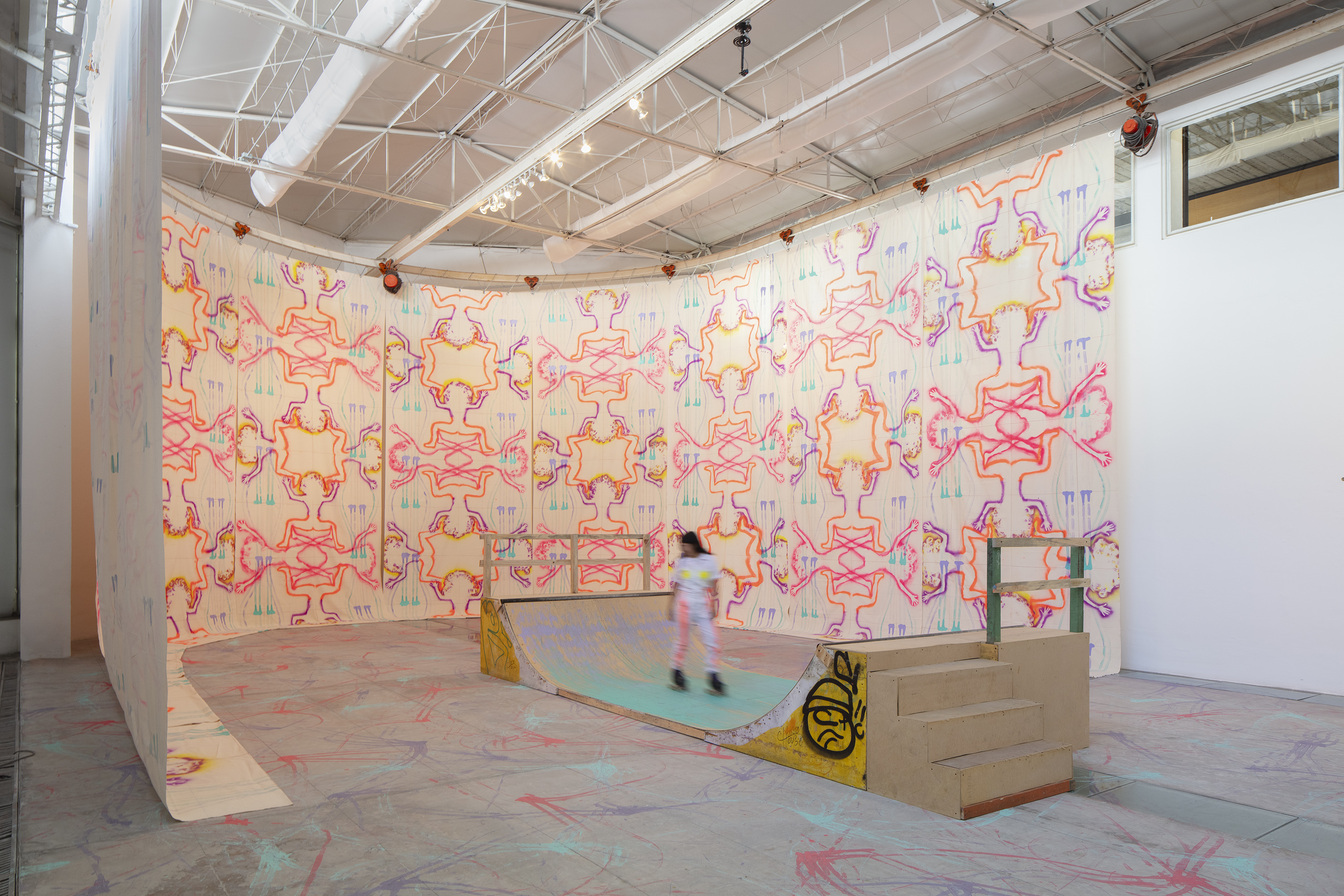
The sensation of suspended movement that defines the first section of the exhibition expands with greater dynamism into a large-scale installation created specifically for this show, one that dialogues with the aspiration toward an integrative plastic language championed by David Alfaro Siqueiros. Entrelazo, which also gives the exhibition its title, embodies movement and collaboration in such a way that the gesture extends across floors and walls. It emerged from a collaborative process with the roller-skating collective Roller Bunny Babes, with whom the artist developed actions combining bodily imprint with spatial displacement.
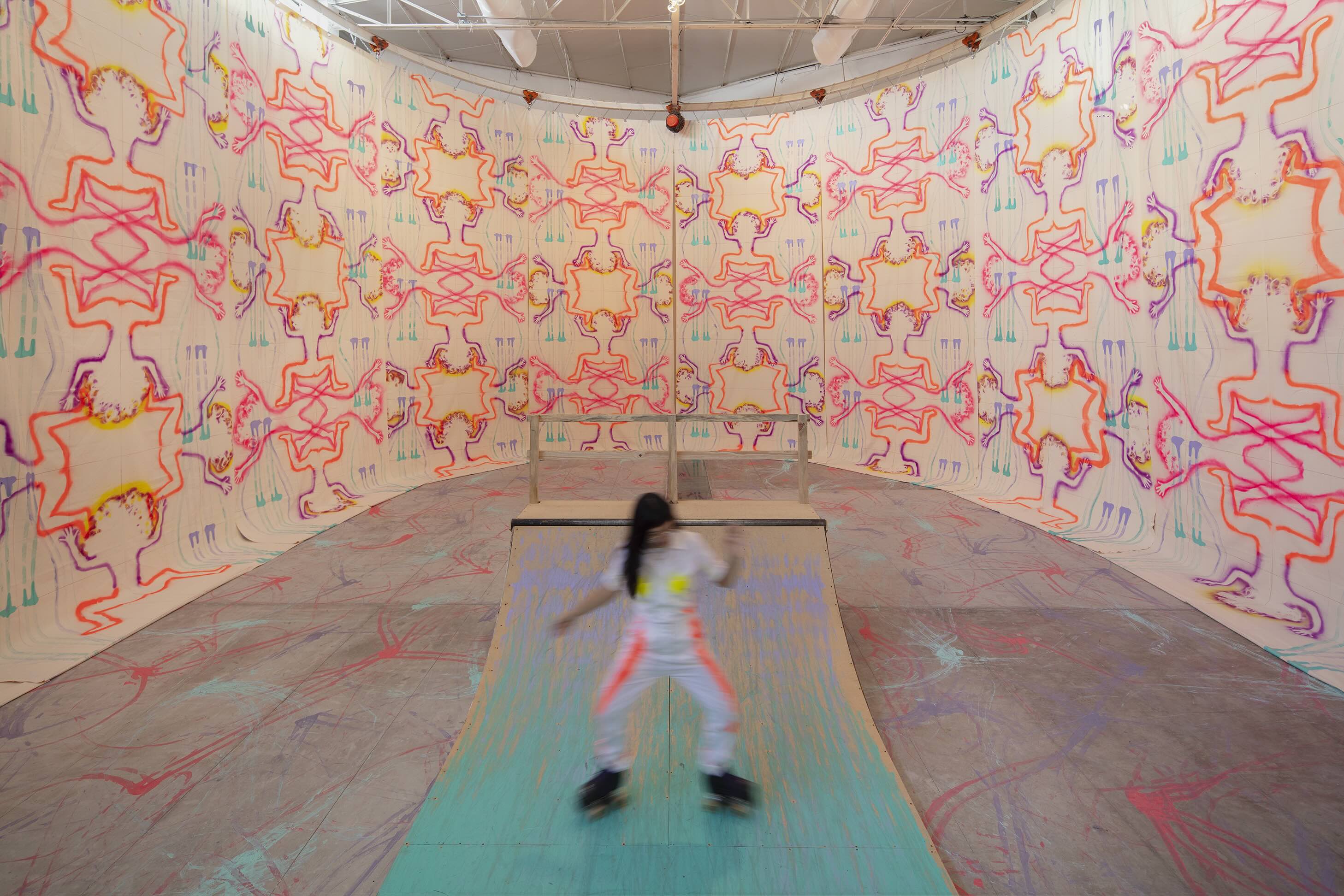
The result is a series of large curtains that retain traces of movement—both from the skates and from the skaters’ silhouettes in different positions, almost like cave paintings. Could it be that granting the moving female body an active space within exhibition halls remains a revolutionary gesture? The textile installation is accompanied by a skating rink, insisting on alternative ways of inhabiting and activating exhibition spaces. A series of video projections by Cristian Manzutto also documents the process behind the mural work that extends onto the floor.
Finally, the exhibition includes Gorgona, an intervention originally designed for the Espacio Uno gallery at the Museo de Arte Contemporáneo de Monterrey, here installed between two columns leading into Siqueiros’s mural room, emphasizing its web-like quality. The work is made of wool dyed with natural pigments over nine ayates of henequen fiber, which together form a spiral of interlacing serpent legs. In Greek mythology, the Gorgon functions as protection at the entrance to temples. It is associated with the terrifying, but also with strength—both connotations historically linked to the figure of woman, calling into question the associations and superstitions surrounding such representations.
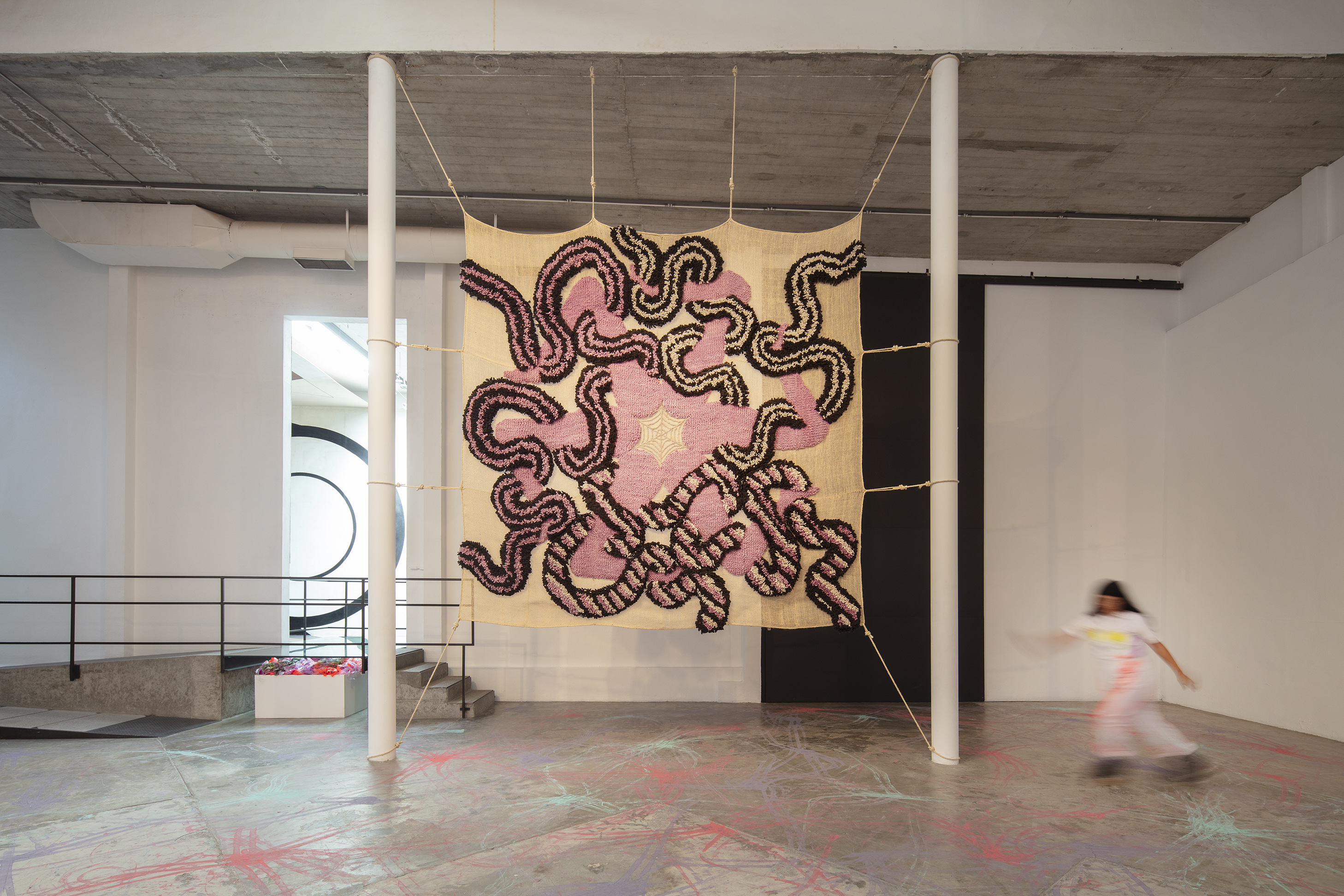
During my visit, I lingered in front of this piece, discovering its image while thinking about the metaphor Lucy Lippard proposes when speaking of feminism: the spiderweb as an image of connection, inclusion, and integration capable of breaking down barriers of race, class, and gender. I also thought about the sensations produced by the exhibition as a whole: what floats, like the web of interwoven legs; what falls, like the rags insisting on their weight; and what transforms through repetition and bodily movement. There is also a clear intention to situate this proposal within a collective dimension that forms a shared network: the curatorial dialogue with Stellweg and its many references, the interventions developed alongside the roller bladers, and the attention to objects tied to the domestic sphere. At its center are bodies, the desire to build in common, pleasure, and boldness.
Translated into English by Luis Sokol
Published on Mar 26 2026