Karian Amaya
Umbrales desiertos en el cuerpo de la tierra
Exhibition
-> Apr 23 2026 – Jun 6 2026
On the occasion of CONDO, Arróniz presents Umbrales desiertos en el cuerpo de la tierra, a solo exhibition by Karian Amaya, in collaboration with Galería Rebelde from Guatemala. Curated by Alberto Ríos de la Rosa.
In Las ruinas circulares, Jorge Luis Borges imagines a man who sets out to dream another man and insert him into reality. The story unfolds as a ritual of obsessive creation until the dreamer discovers that he himself is the dream of another. The circularity of the tale deploys a structure in which every act of creation bears the trace of a previous creation, and where every origin is also a return. This logic—by which giving form to matter implies being shaped by it—constitutes the conceptual axis of the work of Karian Amaya (Chihuahua, 1986) and the starting point for this exhibition.
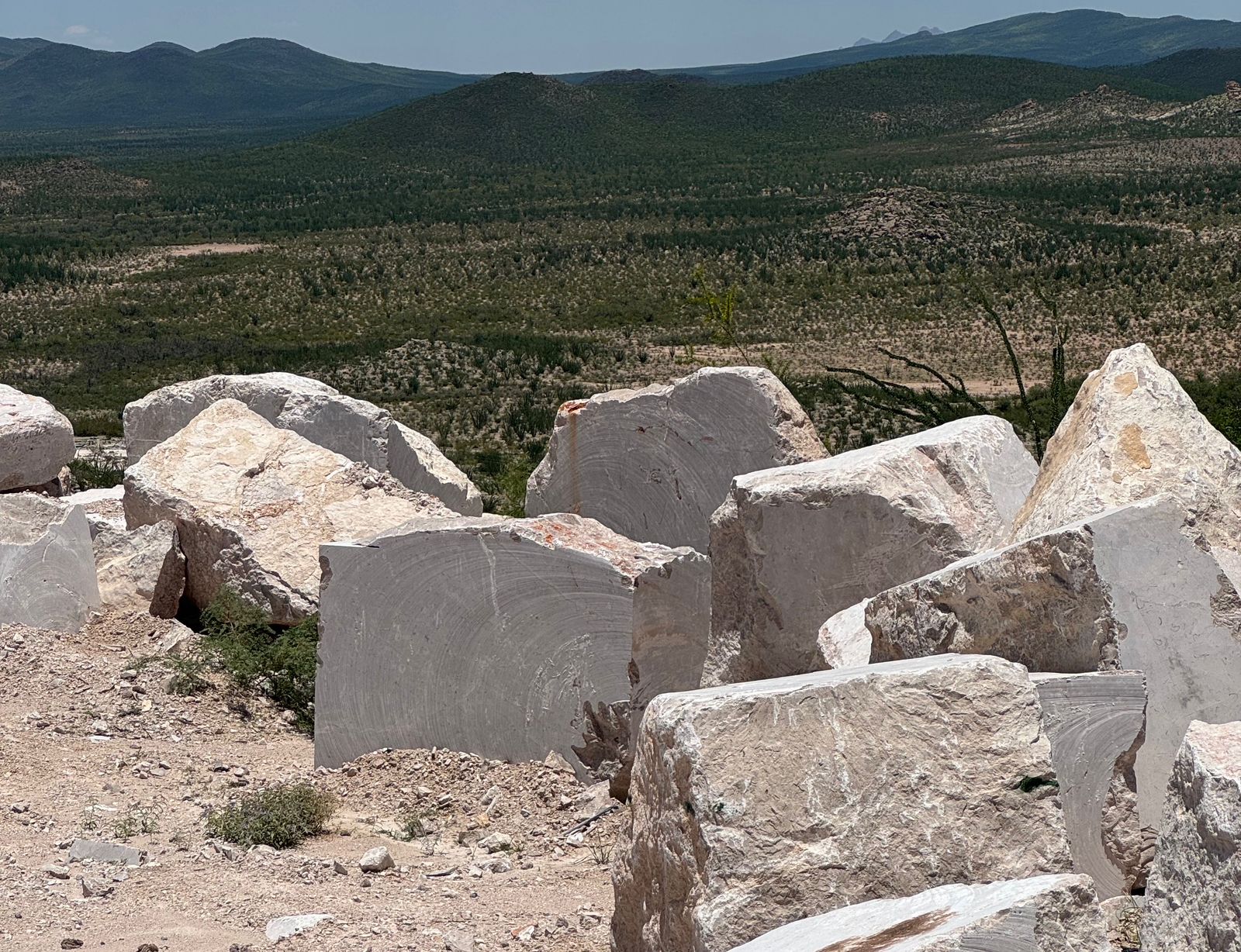
The sculptures that make up the show, crafted from black Monterrey marble and beige Puebla travertine with copper interventions, present the excavated circle as a central gesture and as a form that concentrates tension, memory, and meaning. Perforating the stone replicates, on an intimate scale, the violence of the mining extraction from which these materials originate. Cutting, hollowing out, and perforating are actions that leave an irreversible mark on the mineral body, with traces that speak of an intervened territory and a history inscribed in the matter. But the circle is also an opening, and like Borges's dreamer, the artist does not impose a form upon the stone but rather discovers it within, excavating until the hollow reveals what the marble already contained.
—Alberto Ríos de la Rosa
Artist