Héctor Falcón
Elipsis
Exhibition
-> Aug 22 – Oct 29
Opens on Aug 22 | 11:00AM - 5:00PM
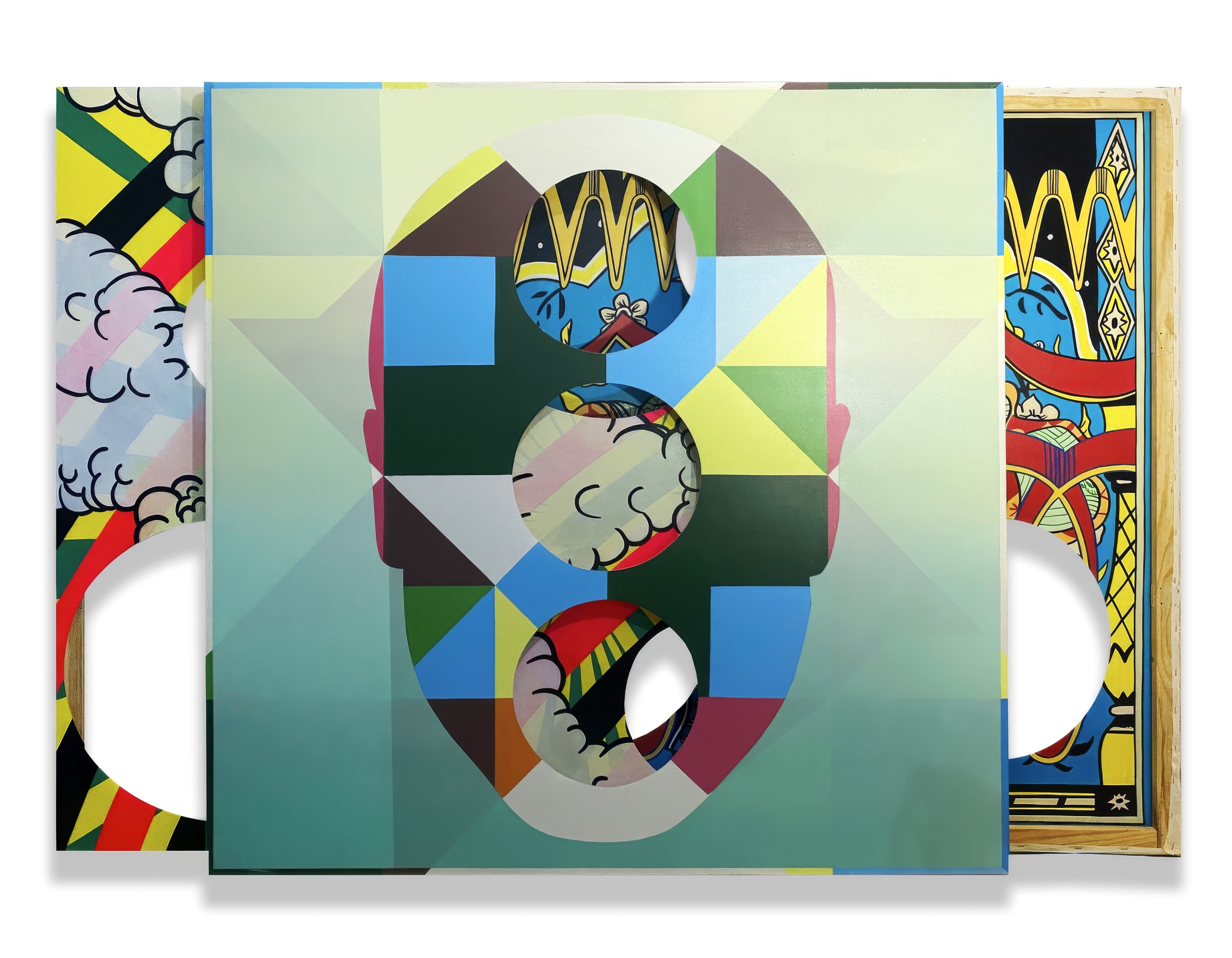
Ricardo Reyes invites you to Héctor Falcón’s solo exhibition, Elipsis.
Héctor Falcón’s work has come to be defined through the body, whether his own—documented as the ultimate object of affects and effects through a working out, straddling the Renaissance ideal and the culture that has shaped our becoming—or as an extension of the world itself, marked by the word UNTITLED tattooed on his forearm. From this starting point, he allows himself, in a kind of superhero gesture, to point toward the objects and situations of the world, to assume them as works and give them a name that is not a name but a designation, a failure: something that was not said and that, precisely for that reason, remains said in that way. It can be compared, by way of simile, to the Nobody that Odysseus assumes in the Odyssey before the Cyclops, who, when attacked by the hero, invokes this nobody as someone, giving the world the possibility of remaining nameless, since it has become something else, and from there can be described as an act rather than as an object. It has no title or name, yet it is a lamppost, a garbage bin, a bench, or a traffic light, without our having to refer merely to objects but rather to entire scenes: at intersections, in parks, in rooms, markets, bathrooms or bedrooms, whatever we may see through a window. We are told, sublimated, at that particular moment, in order to be so at that moment, even if it ceases to be so a moment later.
It is from the body itself that he disarticulates, becoming the extension that points and speaks, working—and resorting for that very reason to a metaphor of creation drawn from the cybernetic—to the use of three-dimensional printers. In their process, these invite us to reflect upon the very construction of bodies, their transposition and designation; spoken or traced, line by line, so as to manifest themselves in a consistency akin to the apparitions we had been promised, knowing that our future would be made of plastic. It is, insofar as it is a medium, but what Falcón seeks to represent is the body of the ineffable, the body that is constructed like an evolution condemned to dissolve, as an object that defines the landscape, being—if one wishes—a derivation of the clouds of smoke that take shape as liberated bodies—souls, one might suggest—from the fire that, as language, communicates and consumes that which is experienced as a continuity between assembly and disassembly, construction and deconstruction, death and rebirth. Matter that denies itself in order to dissolve into its surroundings like powdered chocolate in a glass of milk, remaining what it was even though it is now—or may be—something else.
From the remains, new life will emerge, but once articulated as representation it becomes an object, one that, rather than being born, is assembled—line by line—like a pattern in space. What would be missing is the three-dimensional printer itself in the exhibition space, so as to create in situ the installation that might tell us the landscape as abstraction, placed there to constitute and define it as space, the body of the work taking shape as an arrangement, functioning as bodies that, unlike bodies in performance, survive or remain after the act in order to speak of themselves as a dynamic—immobile despite themselves—that articulates the eternal disintegration of environments, the trance that converts and transforms them, the lightning strike that falls and sets the fire ablaze. The remains will be left behind, so that the damage may later be assessed; but in the meantime, we are left to behold, filled with awe, the forms that take shape in their combustion, acting as a phoenix, separating themselves through a play of light and shadow as a pattern of the ineffable: that which is assembled and arranged only to open itself and manifest, filling the sky of the moment, only to disappear a moment later, dissolved into a vessel turned into an entelechy, without edges, even though we may wish to give it some, knowing—or wanting to know—that it is a container. But we make an ellipsis, as the very title of this exhibition asks of us. To imagine the processes is our task, since I have brought them into the discussion; what remains for us is the result. We omit the process in order to assume it constituted, assembled, finished, contingent, even as we retain the illusion that it has suddenly appeared before us. We must resign ourselves to its horizon. This is what remains; this is what it is.
For the moment, we are left to refer to it as a body, suspended in the instant in which it comes into being, like shoots that, by their very nature, know themselves to be both detached and unlearned, ready to fill the sky, transformed into the moment that allows itself to be captured within the passage of all things. It is the moment in which we assume ourselves to be motionless witnesses, although we are not, nor can we be, resigned as we are to letting it pass. As bodies, we too are carried along, in equal measure both consistent and relative, by space-time. While we are in the process of being, there will remain—if one wishes—our portraits, such as those constructed by Héctor Falcón, abstracting that which cannot be held onto in order to possess it: smoke as a bouquet, the span of time it takes us to make or speak a portrait, clouds herded like a flock and arranged upon the table, conjured into being, knowing themselves as objects, with a body and a weight, denied in that which constitutes them—denied as a kind of game—their representation. Could it be, then, that particles perform ellipses in each of their quantum leaps? How often? How much?
—Ricardo Reyes
Artist