Blasto
Conteniendo el vacío
Sala:GAM presents Conteniendo el vacío, solo exhibition by Blasto.
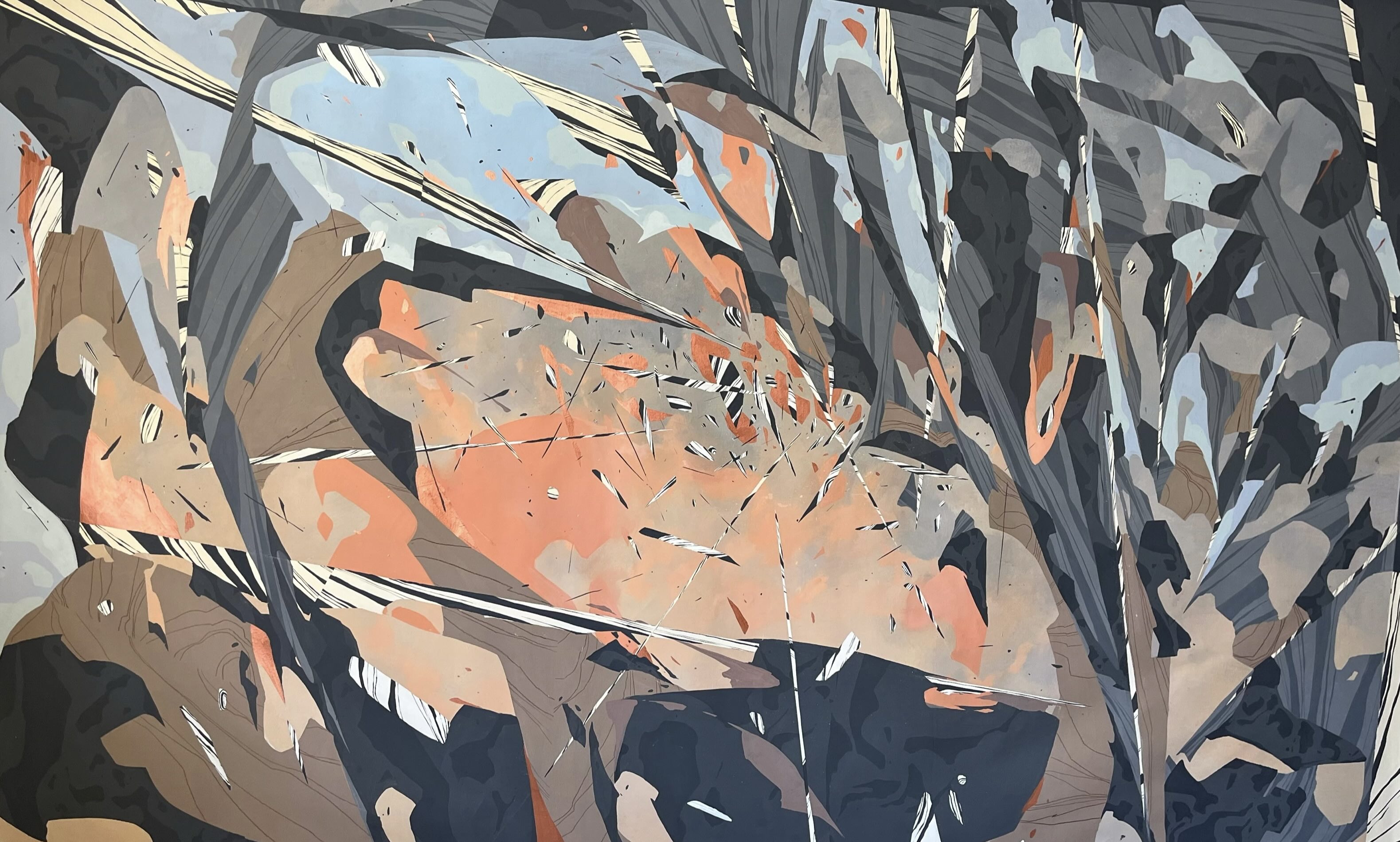
Representation of the flow of energy. Blasto paints the evolutions of a phenomenon articulated by physical and psychic factors, understanding energy as an eventually stable substance, and as instants of perception. It is linguistic matter that traverses bodies, spaces, climates, systems, and synesthesia. It is an aesthetic experience that operates as a field of condensation where emotional, environmental, and graphic-will vectors acquire intense pulsations.
These "allusions" do not seek to fix an instant or illustrate a concept, but rather to register the modulations of a force that manifests simultaneously in the material realm and in the imaginary. In this sense, his painting operates as a sphere of condensation where emotional and—perhaps—environmental vectors guide the contemplation of open-language horizons.
In the perceptual circulation of this phenomenon, the experience of the one who translates that energy into plastic matter and that of the one who receives it visually constitute moments of the same circuit. The work does not conclude in the pictorial gesture, but continues to unfold in the act of observation, where relationships between color, rhythm, texture, and accident generate new associations and play with chimerical interpretations. The represented energy is, at the same time, the energy that mobilizes the process of signification.
Thus, painting expands as a linguistic event potentially disposed to metaphorical escapes. Much like J. M. W. Turner, Pablo Picasso, Marcel Duchamp, or John Cage might have done. Each form can refer to biological processes, atmospheric dynamics, digital networks, urban cartographies, or affective states, without being exhausted in any of these references. Configurations such as a semantic interface where different reading regimes coexist and contaminate each other, constantly shifting meaning toward new interpretive possibilities.
This condition acquires a particular resonance in the post-digital urban context, where everyday experience is mediated by codifications of information, data, images, and stimuli. But also, perhaps, in a psychedelic model, tethered to a certain aesthetic incorporated into global visual culture for over five decades now. And in keeping with those chains of (groovy) sensual association, referring to processes of musical and/or joyfully sonic indexing: the imaginary of techno and rave vibration.
Blasto's practice also dialogues with the category of automatism. Certain Surrealists and Robert Motherwell could be among his antecedents. As well as the geographies of the urban landscape, that landscape in which Blasto intermittently marks logics of circulation, transfers, and mutations that characterize both the graffiti essence and the disruptive information of one who identifies as unique within the suffocating anonymity of the city.
Blasto's paintings evoke the millenary and infinite human that Carl Jung or Joseph Campbell studied. And indeed, an ecology of energies where the organic and the artificial, the sensitive and the computational, the individual and the collective circulate in a state of permanent exchange. In them, flow does not merely constitute a contrast to the grid or the grate, but a principle that rethinks aesthetic experience as a constant of meaning for and of our intelligence... and also containing the void.
—Guillermo Santamarina
Artist