Yukinori Yanagi
El Mare Pacificum
Exhibition
-> Mar 26 – Aug 9
The Museo de Arte de Zapopan presents El Mare Pacificum at its EstaciónMAZ venue, the first exhibition in Latin America of the work of Yukinori Yanagi, one of the most important Japanese artists on the international contemporary art scene. For forty years now, the artist has based his practice on the paradox of “wandering as a permanent position.”
This notion has allowed him to critically interrogate a wide range of themes such as nationalism, migration, and identity. He is one of the first Japanese artists to take an openly critical stance towards the national narratives and governmental policies of his country, dealing with the social, political, and environmental consequences of the Second World War.
Through large-scale installations and sculptural projects, this exhibition proposes a reflection on frontiers and war in the imaginary of the Pacific Ocean: the scene of nuclear tests, naval wars, sunken ships, and the legacy of imperial power. In the exhibition, Yanagi presents works that incorporate materials symbolically associated with transportation and the crossing of borders.
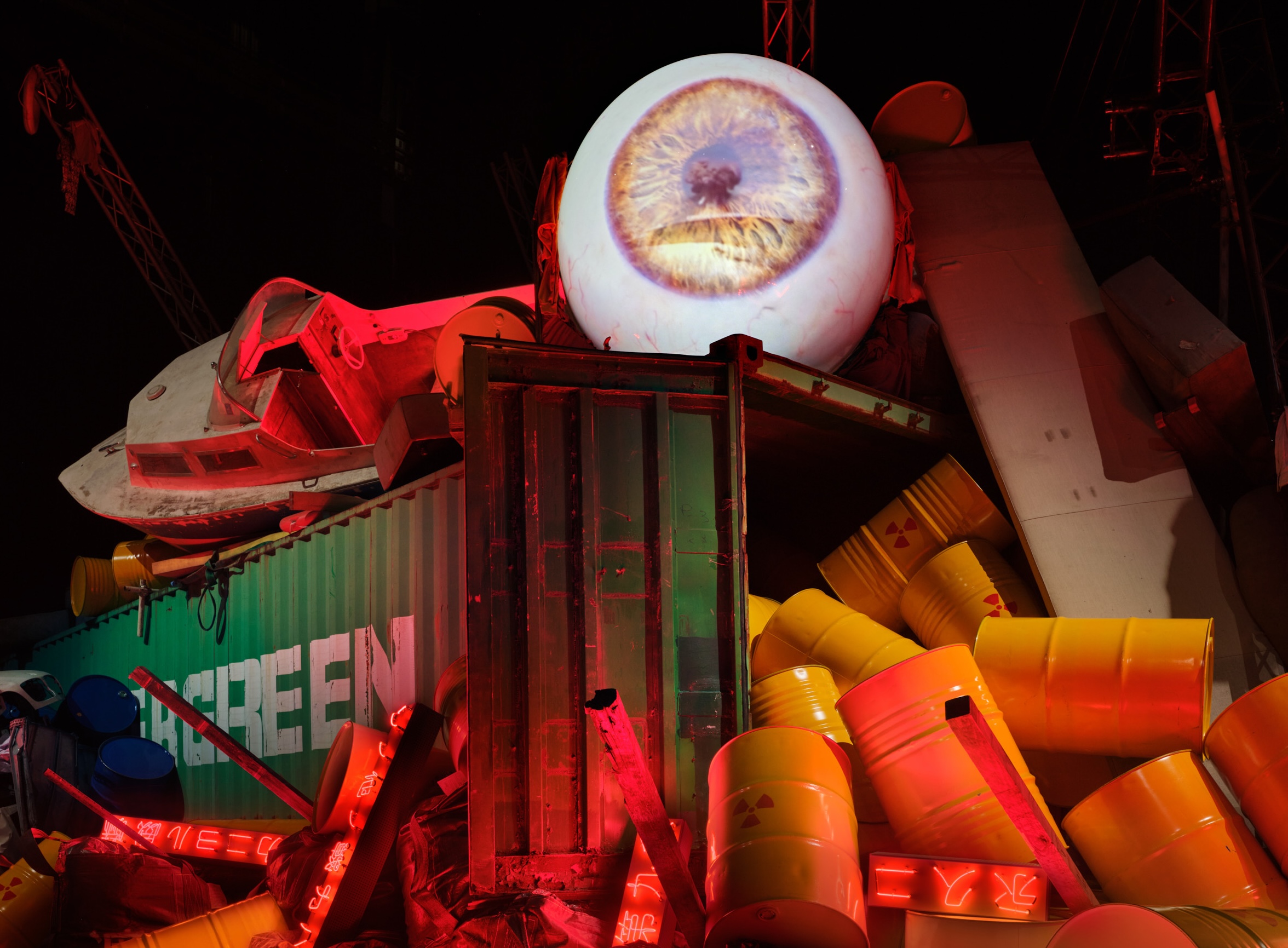
On the one hand, he uses organic and living materials in constant movement, such as the colored sand tunnels burrowed out by ants in AMERICAS (2025), a work belonging to the emblematic series World Flag Ant Farm (1990). On the other, he incorporates salvaged objects and industrial components —including neon lights, barrels, and containers— present in pieces such as Hinomaru Illumination (2026), an installation that uses the symbol of the Japanese flag to examine the country’s imperial past.
His work brings different audiences into complex conversations and debates on taboo issues through elements evocative of childhood, such as toy soldiers and scale models of the Godzilla monster of Japanese science fiction and fantasy movies. These are combined with easily identifiable symbols such as maps and flags, as well as images of devastation etched in the collective memory, such as the mushroom cloud of the atomic bomb. This last image finds a place in Absolute Dud (2007-2016), a one-ton iron replica of Little Boy, the bomb dropped on Hiroshima in 1945, which looms over the exhibition space.
In an ongoing dialogue between past and present, destruction and rebirth, movement and permanence, Yanagi probes in his works the porous nature of identity and the permeability of frontiers, demonstrating that an explicit representation of violence is not required in order to formulate important questions. Thus, El Mare Pacificum offers the Mexican public an opportunity to approach the history of Japan as part of a shared human history.
— Museo de Arte de Zapopan