Matías Paradela
El camino del dodo
Exhibition
-> Feb 2 2026 – Apr 18 2026
Campeche presents the first solo exhibition in Mexico by Matías Paradela (1989, La Plata, Argentina), titled El camino del dodo, in reference to the bird endemic to Madagascar that disappeared in the 17th century and is now an icon of extinction.
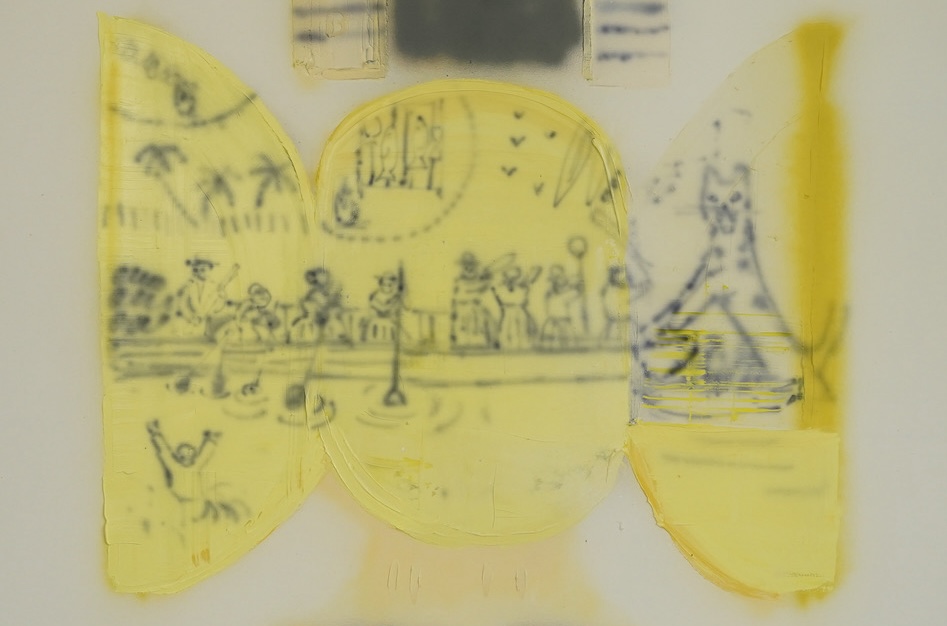
The seven canvases included in the exhibition were produced in the naïve style characteristic of the Argentine artist. Through maximalist brushstrokes and vibrant tones, his compositions offer an anthropomorphic vision of certain everyday objects, particularly gas canisters or tanks. These are a distinctive element of Bolivian society (where Matías has lived for the past 10 years) and condense meanings linked to the political, economic, and social transformation the South American country is currently undergoing, as a result of the energy crisis and a scarcity of resources that has intensified over the past decade. Here, this object becomes the historical subject of the end of an era, which likely implies its forthcoming disappearance. Once a symbol of modernity and progress, the gas tank is gradually approaching obsolescence and may come to be regarded as a vestige, in the same way that ancient amphorae once served a practical and commercial function and today constitute treasures within institutional collections around the world.
Interested in the naturalism of the 18th and 19th centuries, Paradela finds resonances between his work and that of two artists who, like him, are self-taught: painter Melchor María Mercado (1816, Viceroyalty of the Río de la Plata—present-day Bolivia), whose illustrations sought to depict Bolivian reality across different social strata, and painter Cándido López (1840, Buenos Aires), known for his detailed war scenes and landscapes. Following this intuitive and personal approach to the references that nourish his work, the side panels of the present exhibition establish, with humor, a dialogue with an iconic painting by artist Alex Katz, in which the gas canister takes on a stylized, almost feminine appearance, similar to Katz’s approach to his muse and wife, Ada Katz.
El camino del dodo unfolds at Campeche as an immersive scenography in which the symbolism of yellow predominates and is reclaimed—the original color of gas canisters, delivery trucks, and industrial pipelines in Bolivia—and historically evokes Bolivian wealth and abundance, present as one of the colors of its flag. The large formats and near-mural continuity of the works refer to the theatrical dimension of the construction of history, which involves the invention of myths and the veneration of icons. In this context, the anthropomorphized gas canisters are presented as characters in a mise-en-scène that, after years of being integrated into the everyday Andean landscape, are transformed into present witnesses, embodying the weight of collective memory.
— Campeche