Manuel Solís
Residual
Exhibition
-> Mar 12 2026 – Apr 11 2026
Drexel presents the exhibition Residual by Manuel Solís.
Glossary of Analytical Concepts
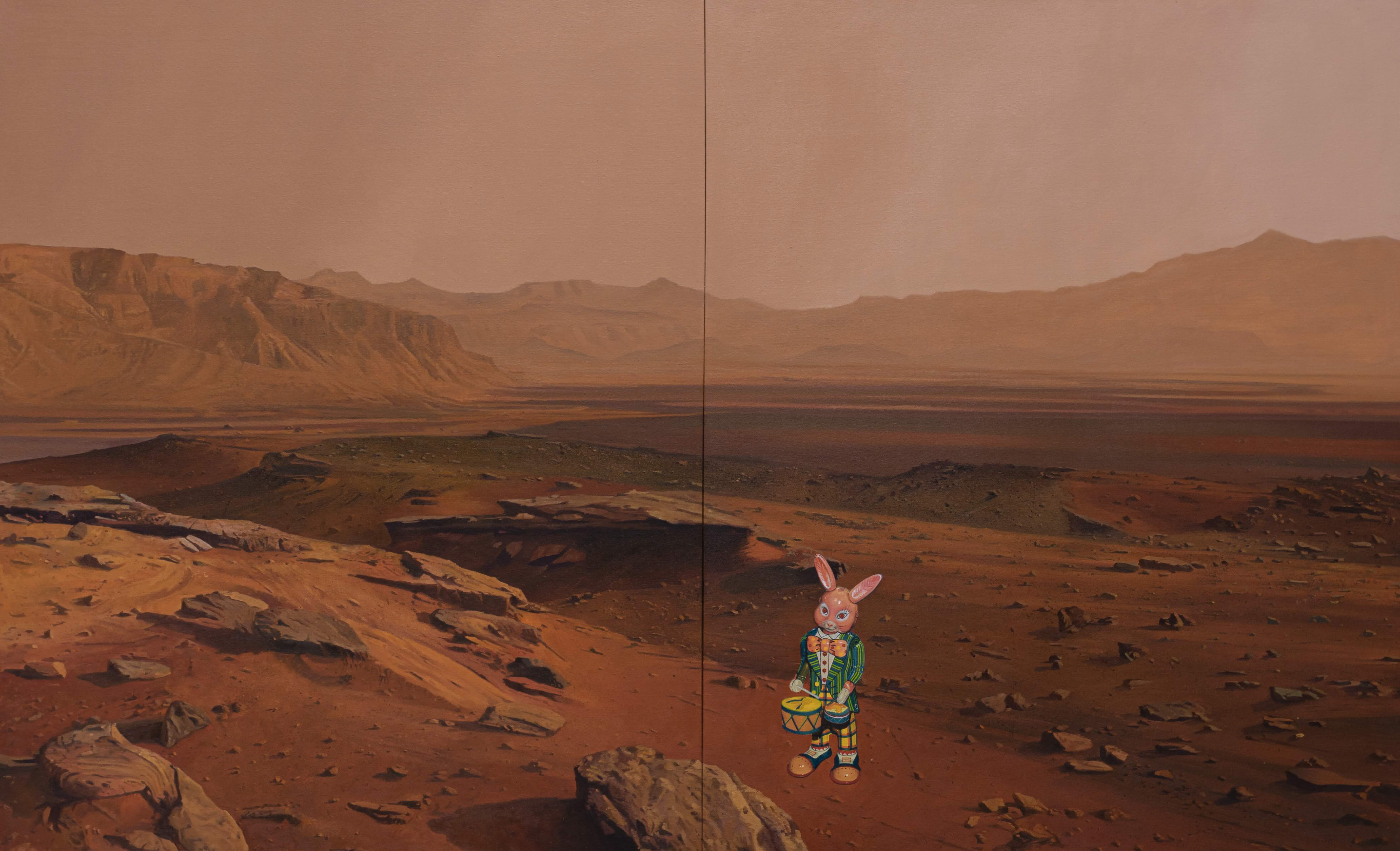
Archive-Based Painting: One of the most advanced practices within the Global Contemporary Art System is the symbolic processing—by artists or theorists—of material drawn from archives. For more than a decade, Manuel Solís has produced his figurative work in the form of series based on themes drawn from specific iconographic bodies. The project Residual was developed through the reactivation of a preexisting image archive compiled by the artist himself, which he had not previously worked with. This archive is of a prosumer type (production-consumption), a repository containing images of dual origin. On the one hand, photographs captured by Manuel Solís for creative purposes; on the other, downloaded screenshots taken by other people with diverse intentions.“Poetics of accumulation”: a notion coined by Manuel Solís himself to refer to the process of “reactivating a latent archive” with the aim of generating a collection of new pictorial works. Residual, the resulting series of paintings produced through what the artist calls the archive’s “poetic postproduction,” possesses what he describes as “density and permanence.” In these terms, the dispersed imaginary of the matrix-archive or seed-archive is transformed by Manuel Solís into a complex and propositional pictorial artifact (the series itself), charged with material, formal, and iconological singularity.Iconosophy: a term that remains relatively unprecedented within the critical field of contemporary culture, although it designates a phenomenon clearly present within it. The idea it conveys relates to the possibility open to contemporary art to reflect—across various levels and approaches—on everything connected to the production of images within different creative ecosystems and industries. Once the question of the coexistence of multiple disciplines and media defined as art on equal terms (plastic arts / visual arts / expanded art) was resolved during the twentieth century, one of the challenges now facing contemporary art lies in its capacity to think through, process, and manage—both aesthetically and ethically—the endless flows of images circulating within the iconosphere of the digital era. The complete visual oeuvre of Manuel Solís is situated within this tendency.“Residual assemblage”: with this concept Manuel Solís names the sequence of compositions that make up the series presented here. The discursive convergence of the two words within the concept (assemblage, residual) suggests that each painting proposes an organic construction that articulates dissimilar or heterogeneous iconic fragments. The artist succeeds in making the resulting arrangements of this “pictorial collage” captivate our gaze and trigger multiple interpretive associations, much like when we explore a hermetic scene or decipher an enigmatic dream. From my perspective, this series of images achieves one of the forms that advanced contemporary analysis defines as the critical hyper-visualization of images: in this case, Solís assembles disarticulated iconic residues and transforms them into asemantic poetic artifacts—compositions that intentionally dispense with a clear meaning while radiating a vast open allegorical potential.
— Erik Castillo