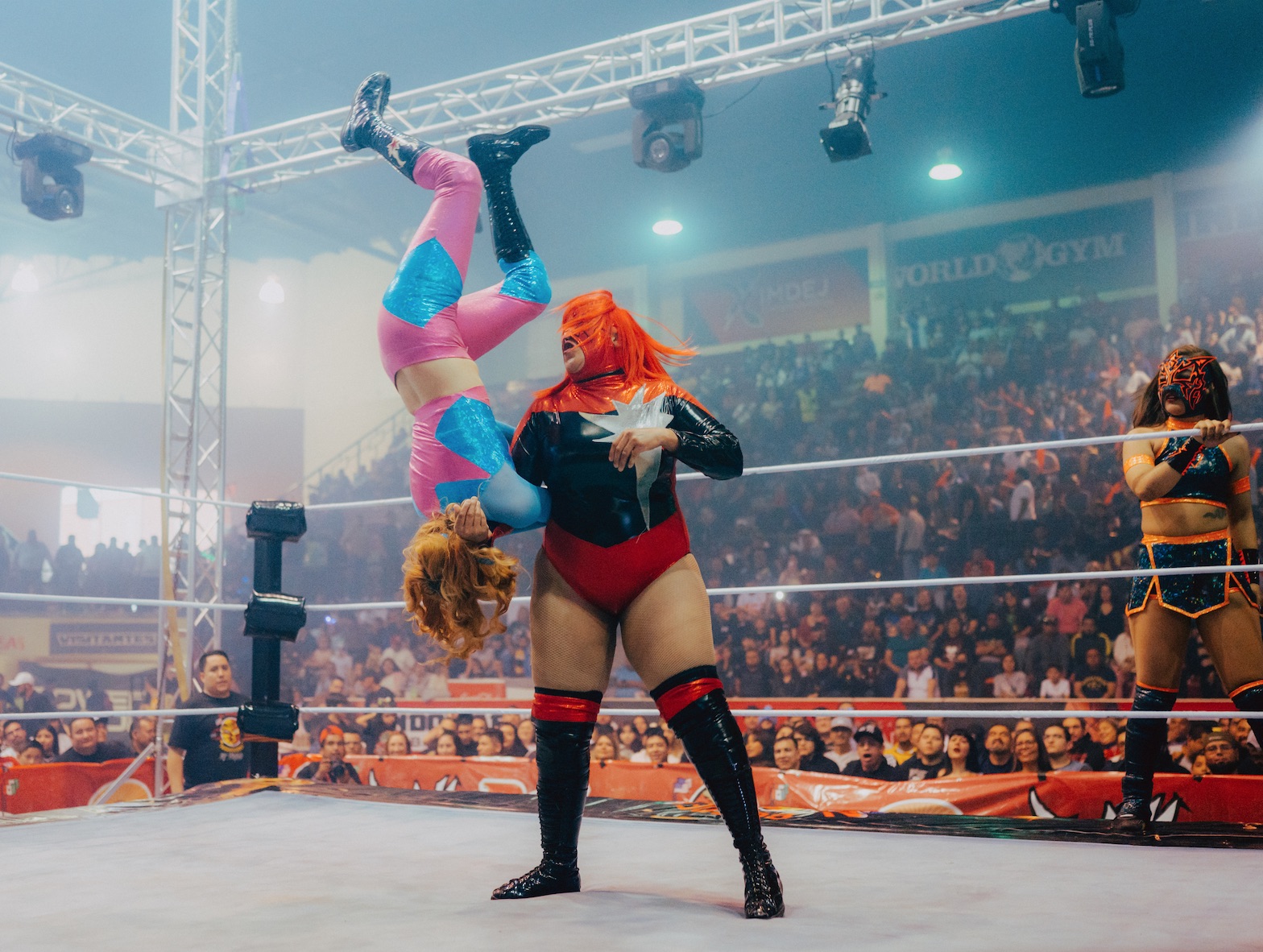
Jana Margarete Schuler and Kathrin “Miss Kath” Zeiske
Entre sangre y brillos
Exhibition
-> Mar 7 2026 – May 2 2026
Azul Arena
Azul Arena presents Between Blood and Glitter, an exhibition by Jana Margarete Schuler and Kathrin “Miss Kath” Zeiske, produced in collaboration with Alharaca and Azul Arena.
The project offers an intimate look at the lives of women wrestlers in Ciudad Juárez—women who during the week work, support their households, and study, and who on weekends transform the wrestling ring into a space of visibility and empowerment. Through the photographic work of Jana Margarete Schuler and the testimonies gathered by Kathrin “Miss Kath” Zeiske, the exhibition opens a space for listening and reflection on gender, violence, popular culture, and female agency on the border.
The opening will feature the presence of legendary wrestlers Lola “Dinámita” González and La Sirenita, as well as the wrestlers whose portraits make up the exhibition. Also in attendance will be Cristina Rodríguez de Mehuys, Honorary Consul of Germany in Chihuahua, and Elvira Urrutia Castro, Director of the Municipal Women’s Institute (IMM).
We thank Alharaca for their collaboration in the editing and production of the audio pieces, and the Goethe-Institut for supporting the public program of this exhibition. This project is also made possible thanks to the generous support of the German Embassy, the Ciudad Juárez High Commission of Lucha Libre, the Municipal Women’s Institute, Paso del Norte Community Foundation, Fondo Community, and the Municipal Government of Ciudad Juárez.
Shimmering layers, gleaming muscles, daring aerial moves, and inescapable holds.
In Mexico, lucha libre is cultural heritage, popular culture, extreme sport, and dazzling spectacle, present in suburban arenas, private celebrations, and major event venues. Lucha libre represents an omnipresent cultural offering: a form of pop culture with affordable live events for the whole family.
In the working-class neighborhoods of the industrial metropolis of Ciudad Juárez—where electronic components for automobiles, fiber-optic cables, and robots are manufactured—people flock to the arenas on weekends to escape the monotony of daily life and hard work.
The first wrestling matches took place on this border at the beginning of the twentieth century, and to this day the birthplace of Mexican lucha libre remains an important center of this glamorous combat culture.
Yet it is not only male wrestlers who practice this contact sport, which combines martial arts and spectacle and offers catharsis for audiences. Over the decades, women’s wrestling has grown increasingly popular. Although female wrestlers are still a minority, there are now few events without women on the card. Leading global companies such as WWE, AEW, and Mexico’s CMLL are investing in female talent and building women’s divisions that are literally stealing the spotlight from the men.
In Ciudad Juárez, female wrestlers work conventional jobs during the week: they study, take care of their households and families, and raise their children. All have grown up amid the everyday violence against women and the femicides that plague their city. For girls in Ciudad Juárez, childhood and adolescence often mean confinement at home; they have fewer opportunities than boys to participate in public and cultural life or to develop hobbies and talents.
In an industrial city oriented toward production for the global market, women are often seen primarily as cheap labor, and their voices are rarely heard.
In their daily lives, the female wrestlers of Ciudad Juárez face the same challenges as many other women in the city. Yet on weekends they become the center of attention under the lights of the spectacle—whether as celebrated heroines or feared villains.
They are loud, commanding attention, mastering both attack and defense. They are the stars of the night, though made of flesh and blood; after the match they meet their fans for selfies and autographs.
This exhibition is dedicated to those women who, both now and in the past, have served as local role models for girls and women inside and outside the ring. Over the course of three falls, they break roles and challenge traditional gender images. We seek to highlight lucha libre as a cultural heritage of Ciudad Juárez and Mexico, and to show that its future is female.
The exhibition offers an intimate glimpse into the everyday lives of women who compete in the ring through striking photographs. A compilation of audio recordings allows the wrestlers to speak about their realities, family lives, dreams, and challenges from their own perspectives.
These audiovisual impressions invite reflection on socially relevant themes that extend beyond the world of lucha libre, beyond Ciudad Juárez, and beyond Mexico.
The project brings together the photographic work of Jana Margarete Schuler, a German photographer whose work has gained international recognition in recent years. Through numerous visits to the border region, she has portrayed the wrestling community with empathy and sensitivity, both in the ring and in their everyday lives.
The oral histories were collected by Kathrin “Miss Kath” Zeiske, known in the city’s arenas as “the most Juárez German.” Drawing from her own experience inside the ring, she recorded the voices of her fellow wrestlers outside the spectacle. Her close relationship with the local community made possible this intimate portrait of life in Juárez.
The images were presented in Bamberg, Bavaria, in the summer of 2025, causing considerable excitement within the regional art scene and introducing German audiences to the world of Mexican lucha libre. Individual photographs of wrestlers from Ciudad Juárez have also been exhibited in Great Britain, France, and Italy, and have been published in Vogue in several European countries. After Ciudad Juárez, the project will be presented in Mexico City, Berlin, and Winterthur, Switzerland.
— Azul Arena