Review
The Sacred Wonder: “Trece Lunas” by Chelsea Culprit at Plataforma
by Maya Renée Escárcega
Reading time
10 min
We tend to forget that medieval art was not art. We readily acknowledge that megaliths, cave painting, early ceramics, or Paleolithic figurines were not conceived for aesthetic contemplation; this becomes less evident when considering a sculpture of a saint, a retablo, or a reliquary in a cathedral. Their functions were multiple and diverse, ranging from accompanying social life and exalting the spirit to operating as pedagogical tools. Before the notion of autonomous art—formulated in Europe around the fifteenth century and refined in the salons of the eighteenth—images existed because they were necessary and because they were used.
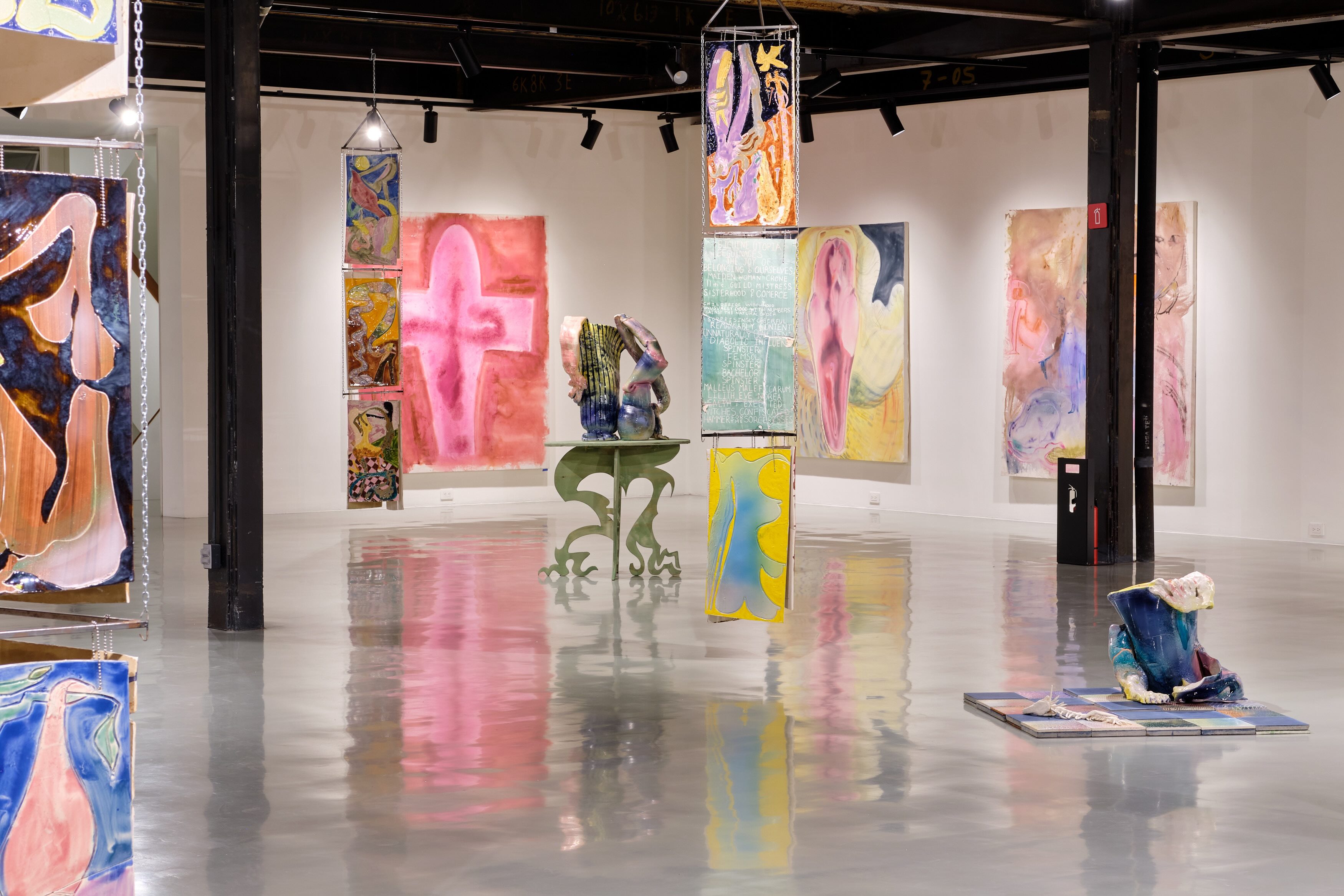
Trece Lunas, Chelsea Culprit’s solo exhibition at Plataforma, revisits this denaturalization in order to think of spirituality and art as spheres not separated from health, labor, and knowledge. To conceptualize the project, the U.S. artist imagined a total work of art: she conceived the gallery as a sacred space in which architecture, painting, and sculpture would be integrated to produce an experience grounded in a feminist sensibility.
In her initial proposal, three glazed ceramic sculptures would greet the public like gargoyles. Creatures with three faces and claws would bring together the sinister and beauty at that threshold where the sublime takes place. Unlike medieval gargoyles, meant to ward off sinners, these would welcome the audience into a space that questioned what we understand as sin today. Inside, close to twenty large-format paintings would occupy walls and windows. Shoulder to shoulder, the canvases would embrace the visitor, provoking religious experiences that, across a broad phenomenological spectrum, would foster a sensation of deep presence. A series of ceramic sculptures would rest on tree-trunk-shaped bases built from water bottles, trash, and tape—materials deliberately non-virtuosic materials.
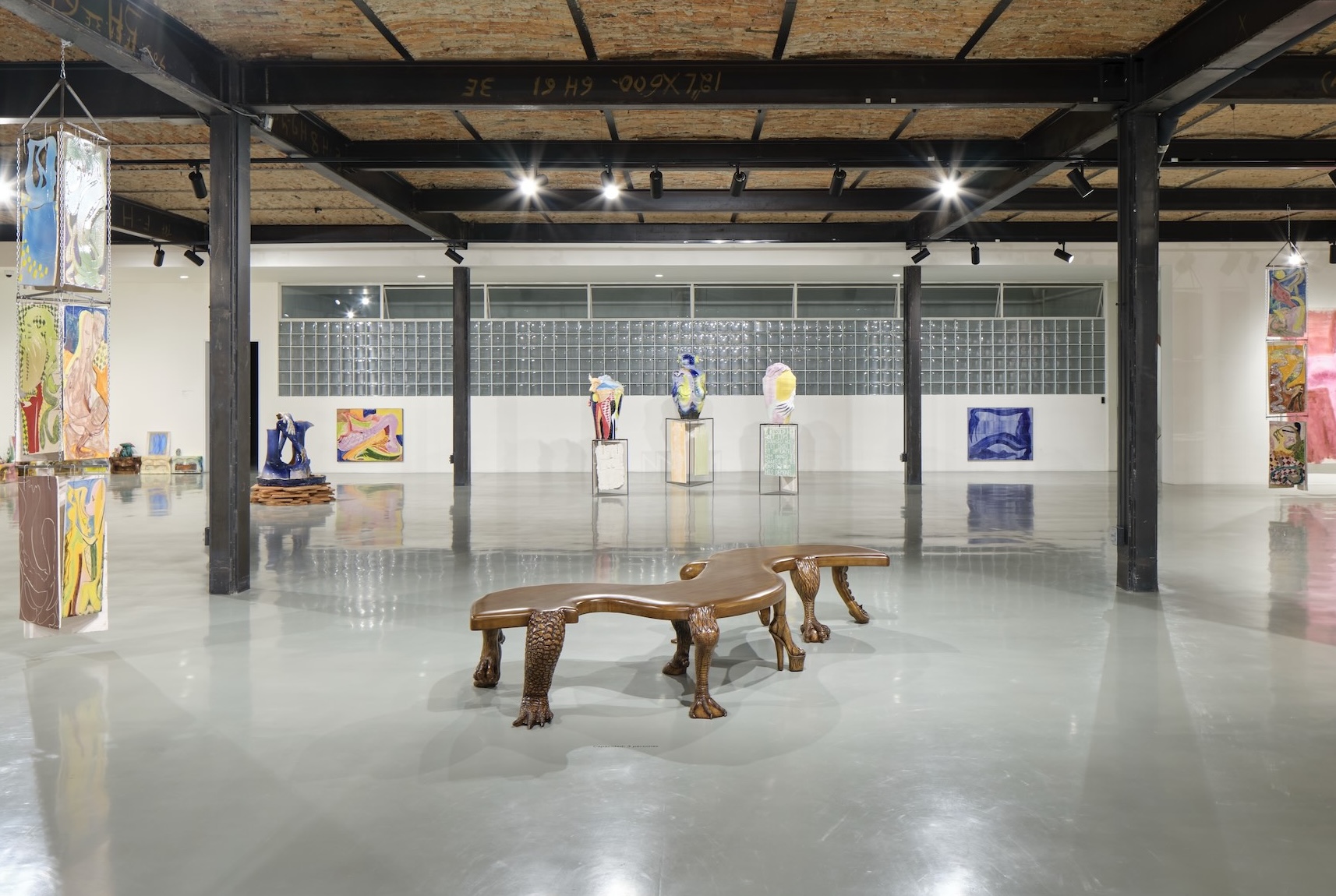
The final installation took a different direction. Plataforma’s gallery appears elegant and carefully ordered. Emptiness and silence were introduced; the number of works was reduced; saturation was eliminated through a perimeter distribution of the sculptures, allowing air to dominate between the paintings. At the center rests a bench as an autonomous object. Five sculptural totems composed of nine triangularly articulated planks— Columna Flotante I-V [Floating Column I–V] (2025)—rhythmically echo the architecture of the space. The Jarrones Guardianes [Guardian Vases] (2025)—Diosa [Goddess], Toro (Bull), and Manos (Hands)—no longer guard the entrance; they now wait at the back, in a corridor leading toward a space that evokes an altar with Father, Son, and Holy Spirit.
Given the questions that traverse Chelsea Culprit’s practice—her exploration of gender, sexuality, and labor outside the male gaze—it is worth asking: is an exhibition feminist because of the themes it addresses, or because of the methodology through which it is constructed? How is what is shown negotiated, and how is it presented? Which bodies, temporalities, and forms of labor are considered “professional” within the process?
In Trece Lunas, the work is not the result of a theme; rather, the theme emerged from the processes themselves—it revealed itself through making. The title responds to this becoming, alluding to a production guided by bodily and lunar cycles. For this reason, rather than moving through the exhibition space, this text moves through time: how did we get here?
The point of departure was a desire to trust. Seeking to establish meaningful connections with the agents presenting her work, Culprit left her studio in New York and embarked on a nomadic path that impacted her practice at a formal level. She abandoned oil paint in favor of fast-drying, water-based media such as watercolor and gouache, and adopted portable, smaller-scale formats. Along the way, she undertook a residency in a Neapolitan monastery that granted her access to an archaeological museum, decisively shaping the exhibition’s imaginary. Her premise was simple: “I want to be happy.” Each door that opened was received as an act of trust.
One such door led her to a stay of thirteen lunar cycles in Guadalajara, after being invited to the Cerámica Suro residency. Without a defined project or precise idea, she set out to explore the “wonders” the factory offered. She embraced the existential charge of wonder: standing before the unknown and directing that astonishment toward a question that, voiced in her own words, became: “what is done here?”
Among tiles, vessels, glazes, and slips, one machine captured her attention. The artist commissioned it to perform a function other than its usual one: to produce clay slabs measuring 90 × 45 cm, dimensions determined by the mechanism but directed by her. How does one negotiate with a worker who has spent a lifetime performing their craft in a way that is, of course, the correct one, in the name of artistic experimentation? Between the device’s resistance and Guadalajara’s stormy climate, the clay fractured. From these repeated breaks emerged an association with ancient Sumerian and Mesopotamian tablets. It was there that textual motifs appeared on the slabs, and with them, the thematic core of the exhibition.
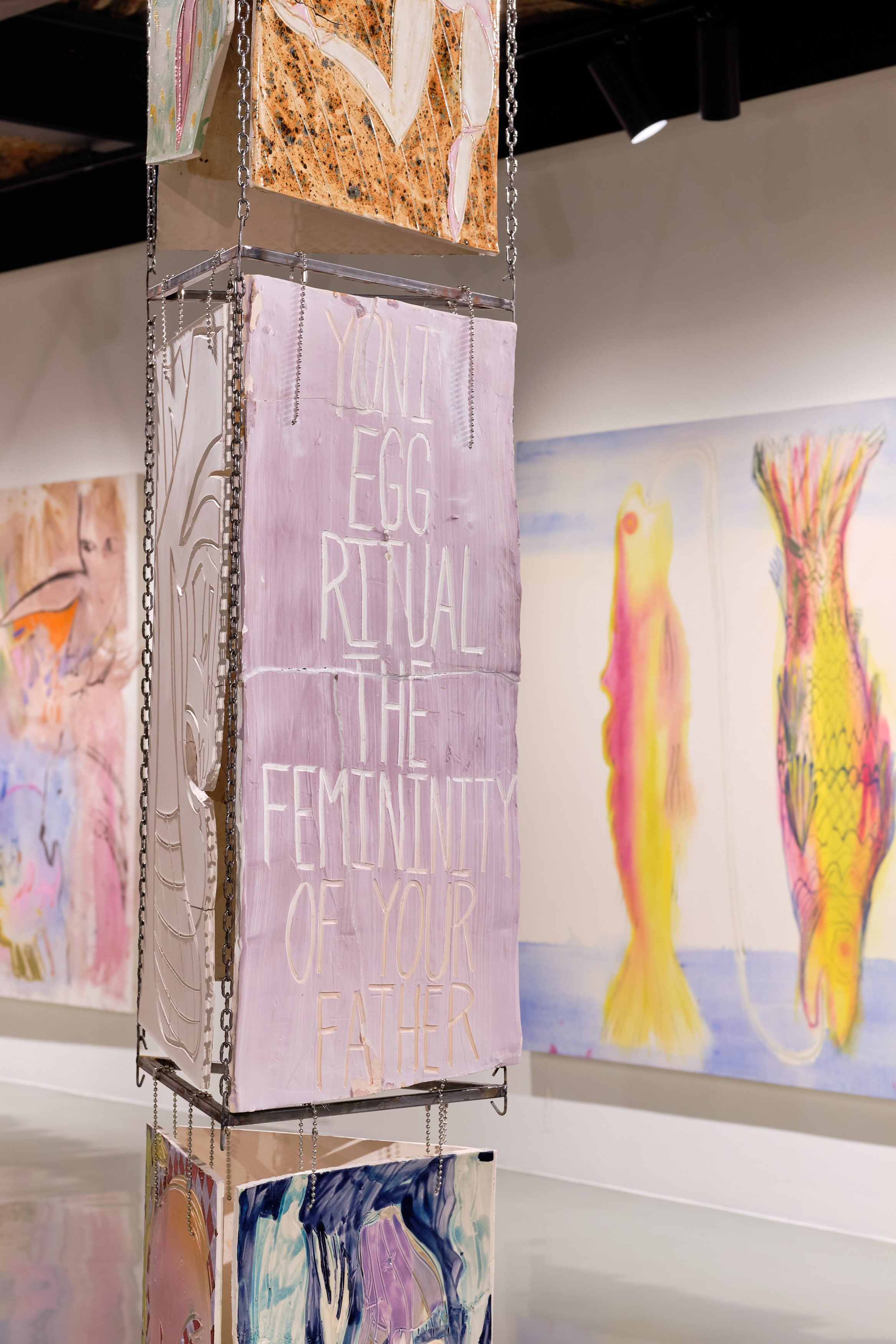
Within the temporalities of ceramics, the reading of bodies of law written on stelae and clay tablets—such as the Code of Hammurabi (ca. 1750 BCE)—alongside the poetry of the priestess Enheduanna and Sumerian hymns to Inanna, became legible in the iconography shared by tablets and vessels produced simultaneously.
Works such as Huluppu Tree of Wisdom and Forbidden Fruit (2025) and Columna Flotante III [Floating Column III.] Estela de los Códigos de Poesía Ancienne [Stele of the Codes of Ancienne Poetry] (2025) share motifs drawn from the Sumerian myth of the Huluppu Tree and from the Book of Genesis, both centered on a female figure and a tree planted in the early days of creation and occupied by a serpent. Whereas Inanna retrieves the tree from the river, plants it in her sacred garden, expels the serpent, Lilith, and the invading bird, and transforms it into a throne and a bed—symbols of political and sexual power—Eve is expelled from the Garden of Eden for a minimal interaction with the tree. Where one tradition founds authority, the other condemns.
This difference is not merely symbolic. The treatise Malleus Maleficarum (1487)—the next text referenced in the ceramics—translated knowledge and practices embodied by women into theological arguments that later became the legal language legitimizing the witch hunts. From now-classic readings, Silvia Federici has articulated how forms of knowledge useful for survival in precapitalist economies—herbalism, healing, reading natural cycles, and reproductive knowledge—were persecuted because they sustained communal modes of production not organized around waged labor.
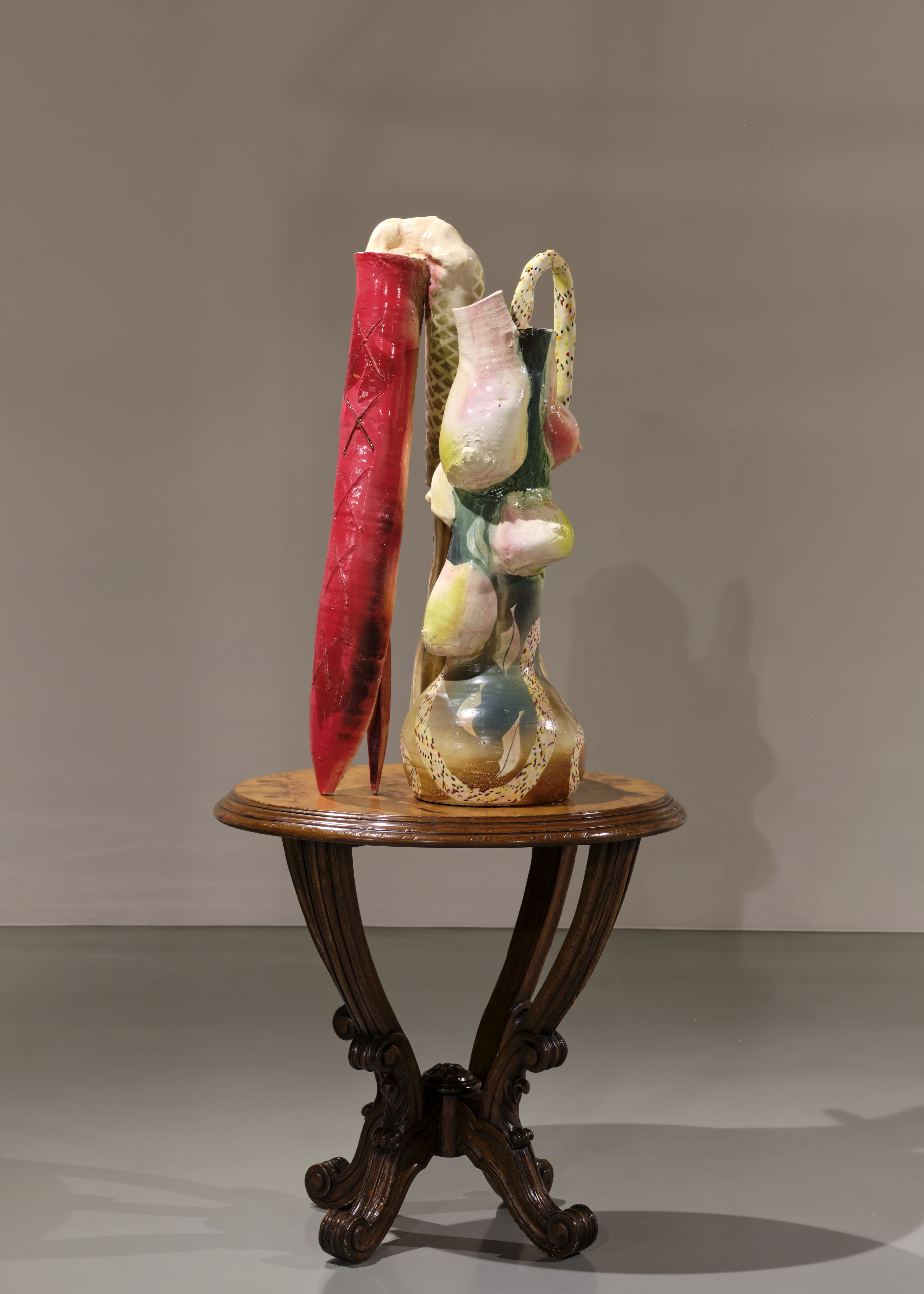
Through corporeal fruits—the serpent that becomes branch, the heel that becomes trunk and descends like a chela, the tree that rises as a leg shedding its skin with serpent stockings—icons migrate from one tradition to another, and another, and another. In this intertextual operation, the layered symbolic and sculptural strata place knowledge, sexuality, agency, and female disobedience on a single plane, without fixed moral hierarchy, functioning as a recovery of magic coded as sin and crime. Another possible story for Eve.
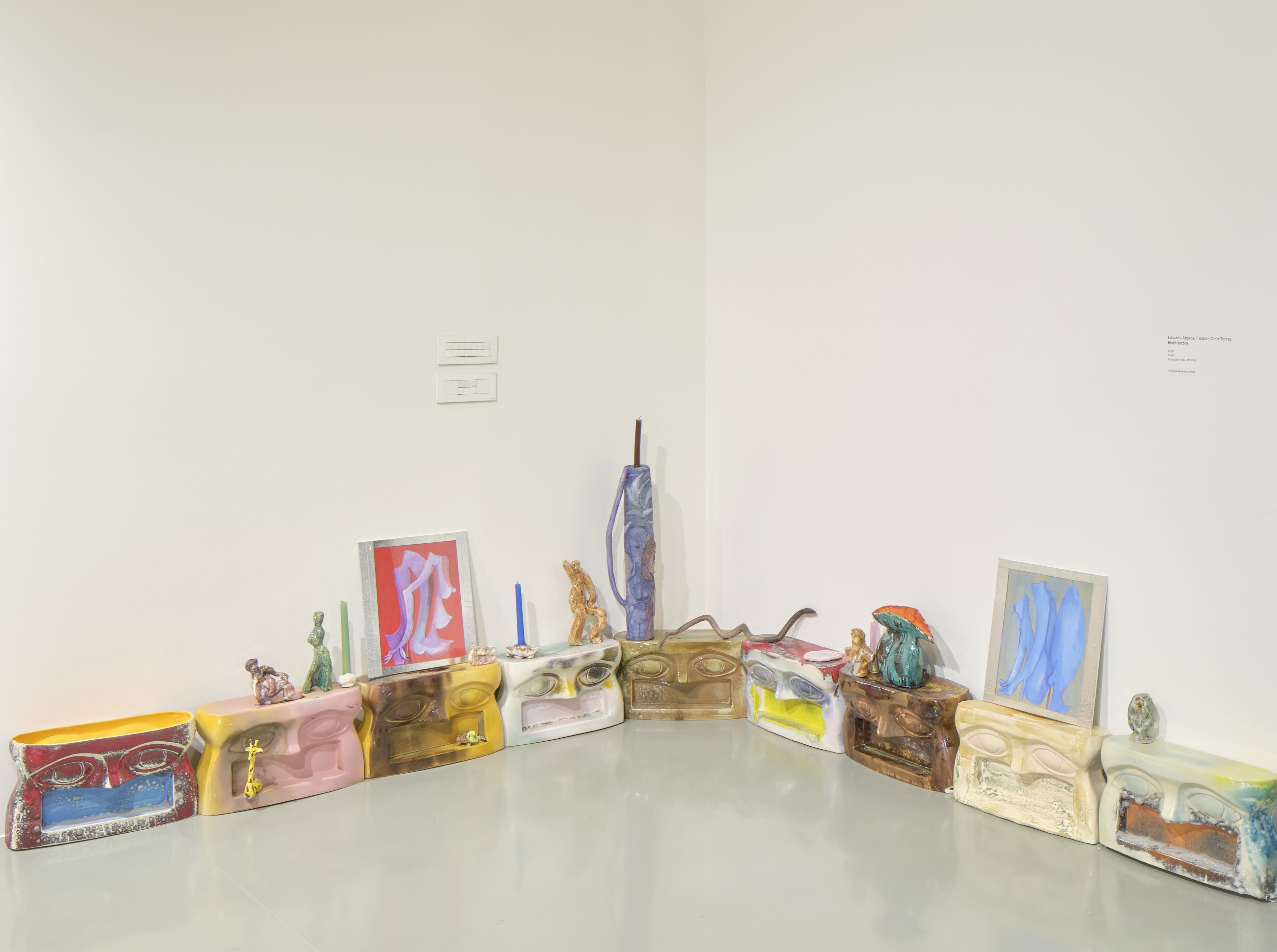
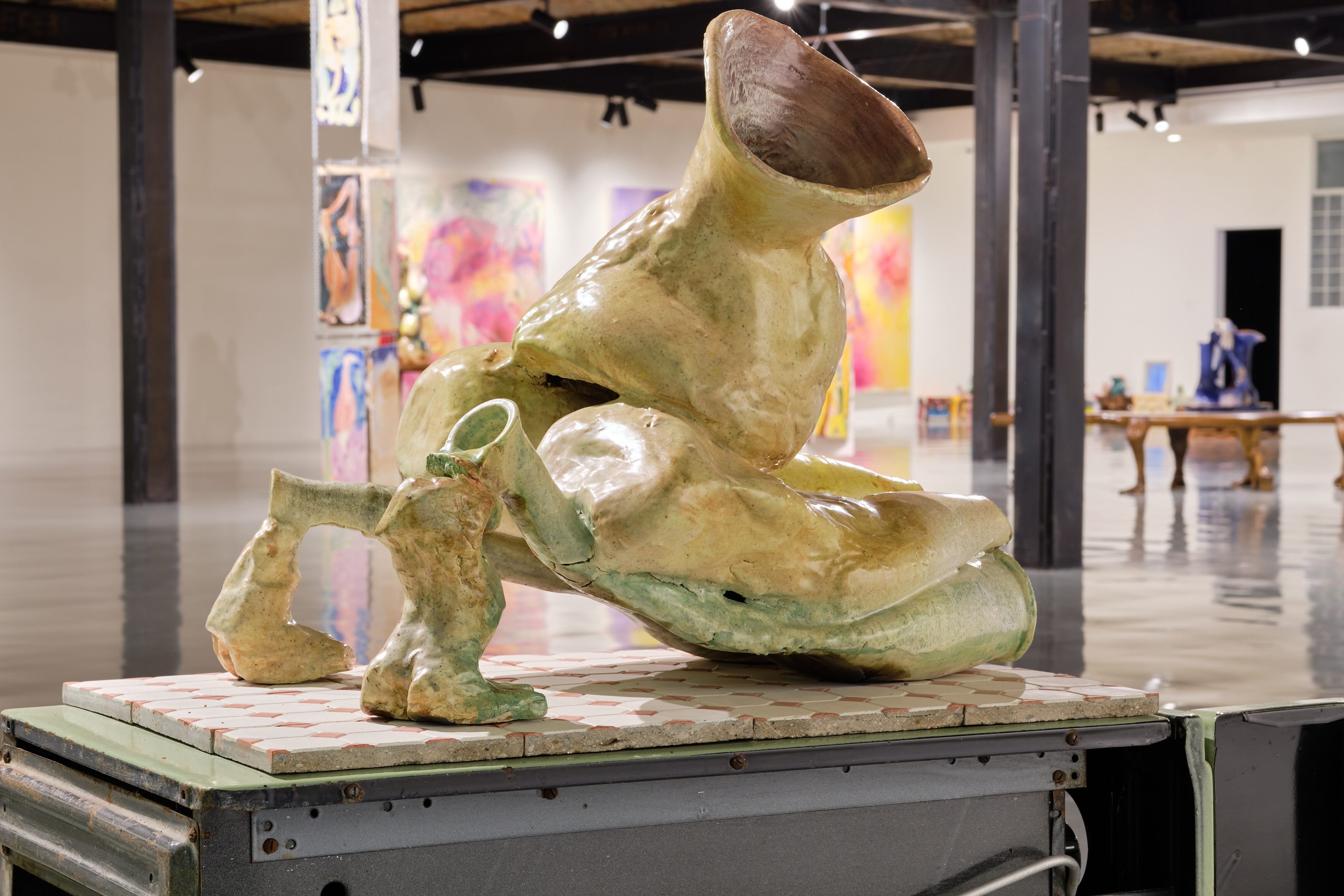
To produce the sculptural-vessel body of work Altares de Transmutación (Vasos y Cuerpos Inútiles a Vasos y Cuerpos de Expansión) [Altars of Transmutation (Vessels and Bodies Useless as Vessels and Bodies of Expansion)] (2025), Culprit made drawings—also exhibited—and presented them to the factory’s wheel-throwers. In the process, it became clear that each saw something different, and there was no clear answer as to how to resolve the pieces’ technical complexity. In response, the artist embraced a sacred “I don’t know” as a production methodology—one that required both patient waiting and the exercise of curiosity and intuition.
Among the series, Swamp Queen Refusal / Petrified Prokaryotes (2025) presents a fragmented figure adopting a kneeling but not submissive posture, akin to a predator poised to strike or an animal in prayer. Its form recalls how, under Cartesian mind/body dualism, witches were considered bestial and purely corporeal—like animals—because their practices escaped “the mind,” that is, the social and economic discipline emerging with the transition to capitalism. Like this piece, the other vessels overflow and pour into themselves, with feet and hands articulating the relationship between the female body and domestic objects. In particular, they point to woman as guardian of domestic spirituality, morality, and emotional order—a form of labor that, prior to the witch hunts, was not separated from life nor emptied of authority, and afterward was not recognized as paid work but naturalized as function.
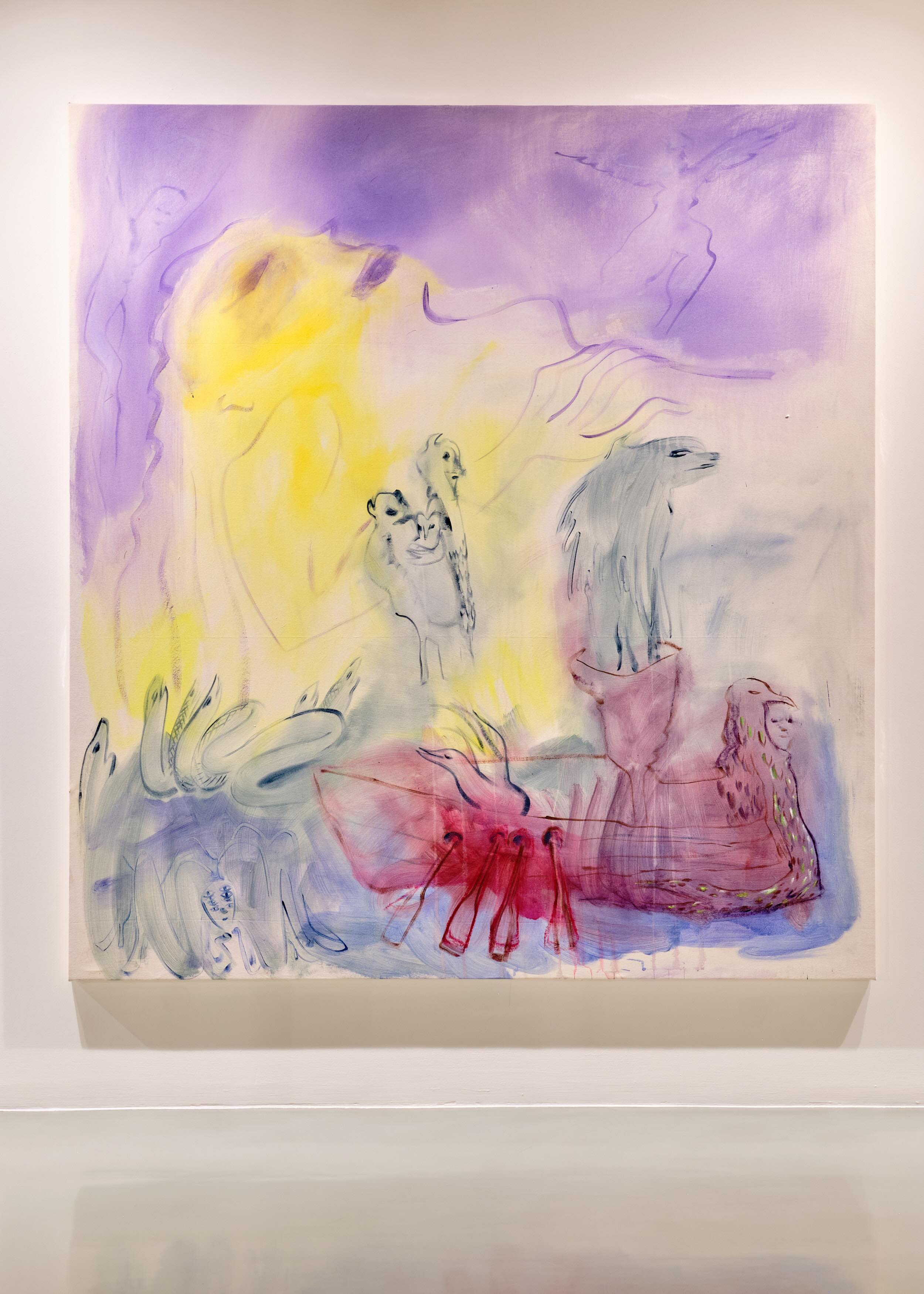
The paintings appeared last. In a circular gesture, Culprit transferred the conditions of her nomadic period onto large-format canvases averaging two meters per side. Embracing the city’s climate, she took them out into the rain and recognized that acrylic behaved like the small-format watercolors she had made a year earlier. In brief intervals, she painted automatic gestures, letting whatever was there emerge in a leap of faith before the color expanded and bled across the surface, marking a departure from her earlier painterly work of hard contours and defined chromatic fields. The gestures are informed by Cycladic iconography, Greek mythology, Minchiate tarot symbolism, Paleolithic Venuses, but also by the memory of sexual encounters, functioning as narrative thresholds: after-states, crossings, and residues of experience.
Surrounded by the color fields of the paintings, the bench Cuerpo Colectivo (Ancestral Evolution) (2025) was conceived to prompt two precise sensory experiences: to induce deep presence, akin to that which reveals mysteries in a church, and to generate a conversational space connecting human and animal bodies.
However, the final installation reinscribes the experience within the regime of contemplation. The neutral space returns the work to the museological logic that O’Doherty described half a century ago as a secular temple—one that, through white walls, controlled light, and isolation from the outside, seeks to erase the body and history, neutralizing the political under a universalized viewpoint (male, white, Western, as later thinkers formulated). Rothko carried this logic to its religious conclusion with his chapel in Houston (1971), a space that, even under these codes, promises transcendence. Within this framework, the liturgy imagined by Culprit—its internal architecture and sensory dramaturgy—was displaced.
According to international museographic best practices, the convention prevails that “air” allows works to breathe and that saturation renders a space “impure.” In an artistic approach like Chelsea Culprit’s—deeply punk and built through the direct confrontation of beauty with the grotesque and over-the-top (shitty next to beautiful, in her words)—the question posed by Trece Lunas is not minor. Is it possible to imagine, in Guadalajara, a feminist art chapel that is dense and disobedient?
With a strident visual language, Trece Lunas reminds us that female spirituality in antiquity was tied to concrete practices, among them the reading of lunar cycles, without separation between praying, knowing, healing, and working. After centuries of strategies of social, religious, and legal control, Culprit offers a window onto what such a spiritual practice might look like today: a labor ethic. The sacred becomes operative by coordinating production with bodily cycles, resisting unsolicited advice, surrendering to fragile materials like the clay slabs that kept breaking and to the city where it rained all the time, trusting her intuition, forming alliances, and learning to rely on the accompaniment of those who guided the project. In a field that often equates neutrality and its fictions with rigor, embracing “I don’t know” as method, ethic, and politics is a profoundly feminist gesture.
Translated into English by Luis Sokol
Published on Jan 10 2026