Interview
Another Breath Inhabits the Air. Interview with Tania Pérez Córdova on "El aire, hoy" at Travesía Cuatro
by Jimena Cervantes
Reading time
8 min
Dear Tania,
When Onda invited me to write about your recent exhibition at Travesía Cuatro (CDMX), I was excited by the idea of proposing a conversation. Your work has accompanied me for years and, at a certain moment, allowed me to begin working with an idea of materiality that exceeds the traditional dichotomy between the material and the immaterial that has structured readings of conceptual art. In your sculptures I encounter a mode of thinking in which the object does not merely operate through meanings but also records processes of use, condensation, and accumulation; this inscription transforms its history into form and experience.
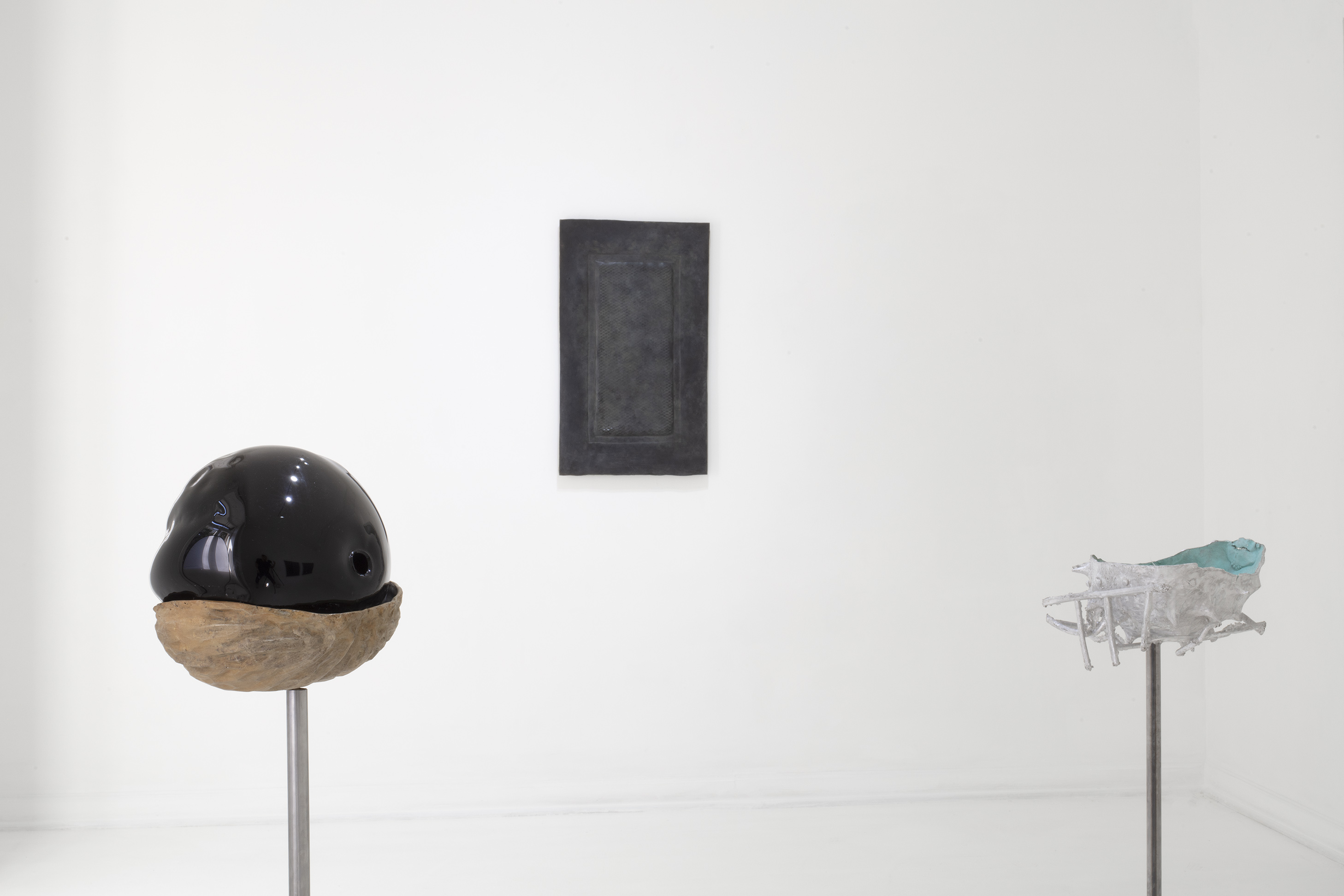
In your recent exhibition El aire, hoy [The Air, Today,] one senses a persistent concern with the present as a time in which multiple crises accumulate, as well as with a future that no longer presents itself as a secure horizon. What interests me deeply is that this urgency does not translate into a language of denunciation or direct representation. Instead, it shifts toward a sensitive economy in which air becomes a sculptural medium. A sensation of suffocation runs throughout the exhibition, as if composed of interrupted breaths–lungs that cannot fully fill, air that cannot be filtered, and latent witnesses of what remains between holding and letting pass.
In this sense, the works produce an experience that renders perceptible the concerns that call you to them. Starting from these ideas, I would like to begin a conversation with you.
Jimena Cervantes: In the exhibition there are at least five works titled Oráculo. All of them share the fact that they are made of blown glass and “contain a person’s breath.” If the oracle, in tradition, is an instance that anticipates or translates destiny through word or vision, I’m curious how you displace that dimension toward something nameless—or perhaps toward something closer to reflection. Could you tell me more about this?
Tania Pérez Córdova: When I began planning the exhibition, I was interested in the gallery’s narrow shape; as you move upward, it gradually expands. I thought about this simultaneously as a mental journey in which air becomes the main material circulating through the exhibition from the first floor to the last. The first is the floor of protest, the second that of speculation, and the third that of the future. The works titled Oráculo are located in the speculative space.
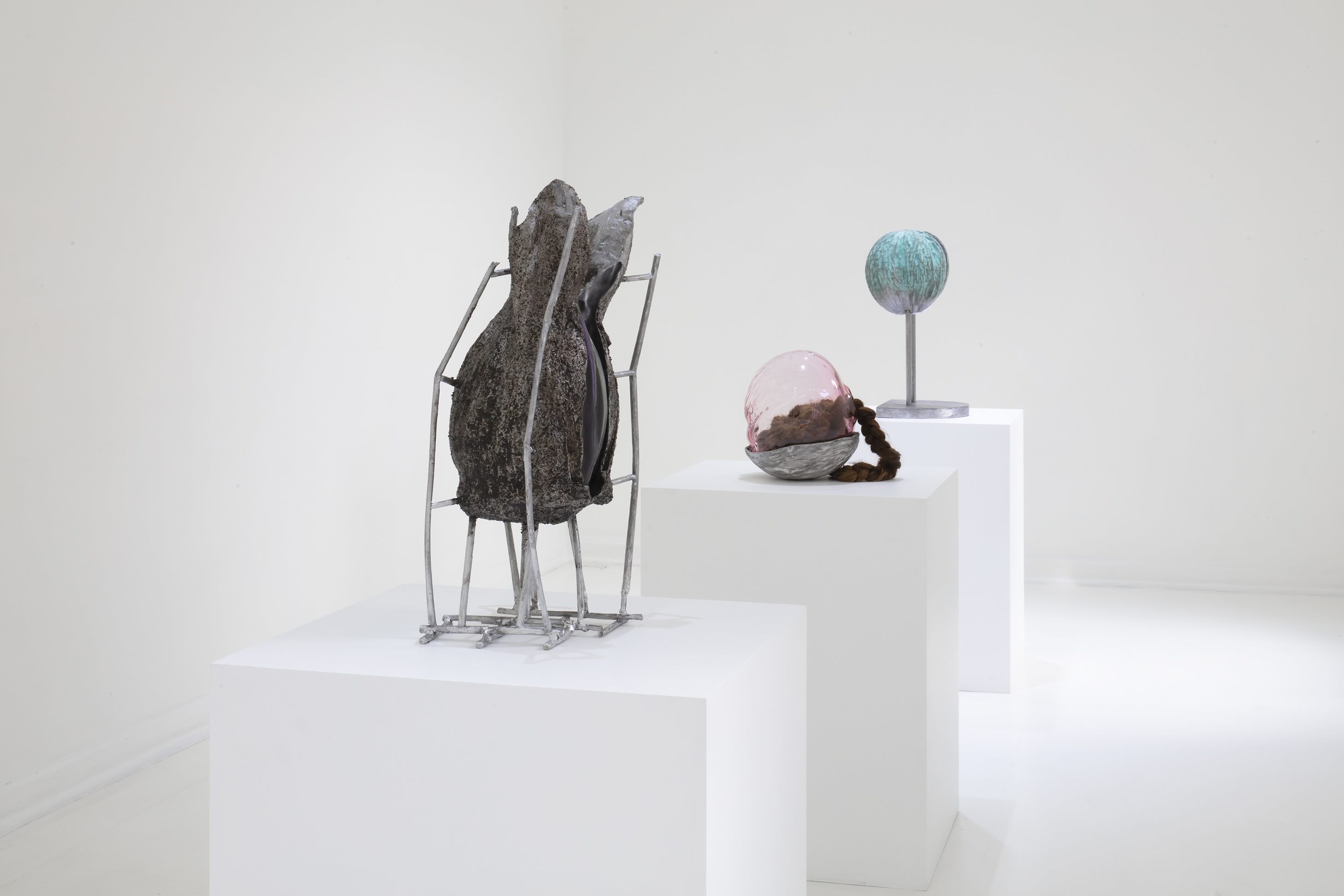
I usually arrive at a material through a story. Some time ago I learned that wine bottles contain 700 milliliters because they were historically made using blown glass; apparently that is roughly the lung capacity a human body can exhale in a single breath. I was interested in thinking that the limit of an object is, in the end, the same as that of a body. At the same time, I found in patterns of inhalation and exhalation a kind of score–a rhythm for measuring time in the form of air.
For me, objects extend beyond their form; an object exists through the echo it produces. The idea of the oracle came while reading a poem by Luis Felipe Fabre in which he suggests that an oracle might also be a group of barking dogs. Since antiquity, oracles have existed across cultures as something that allows you to see beyond what you can see–something that attempts to cross a limit. I found it interesting to play with the idea of “pieces made at the limit of an exhalation,” and with what, in principle, allows one to go beyond. I wanted the images evoked by these works to move between the natural and the human worlds, which is why there are elements like a dead bee or a braid of hair that evokes a snake in its nest.
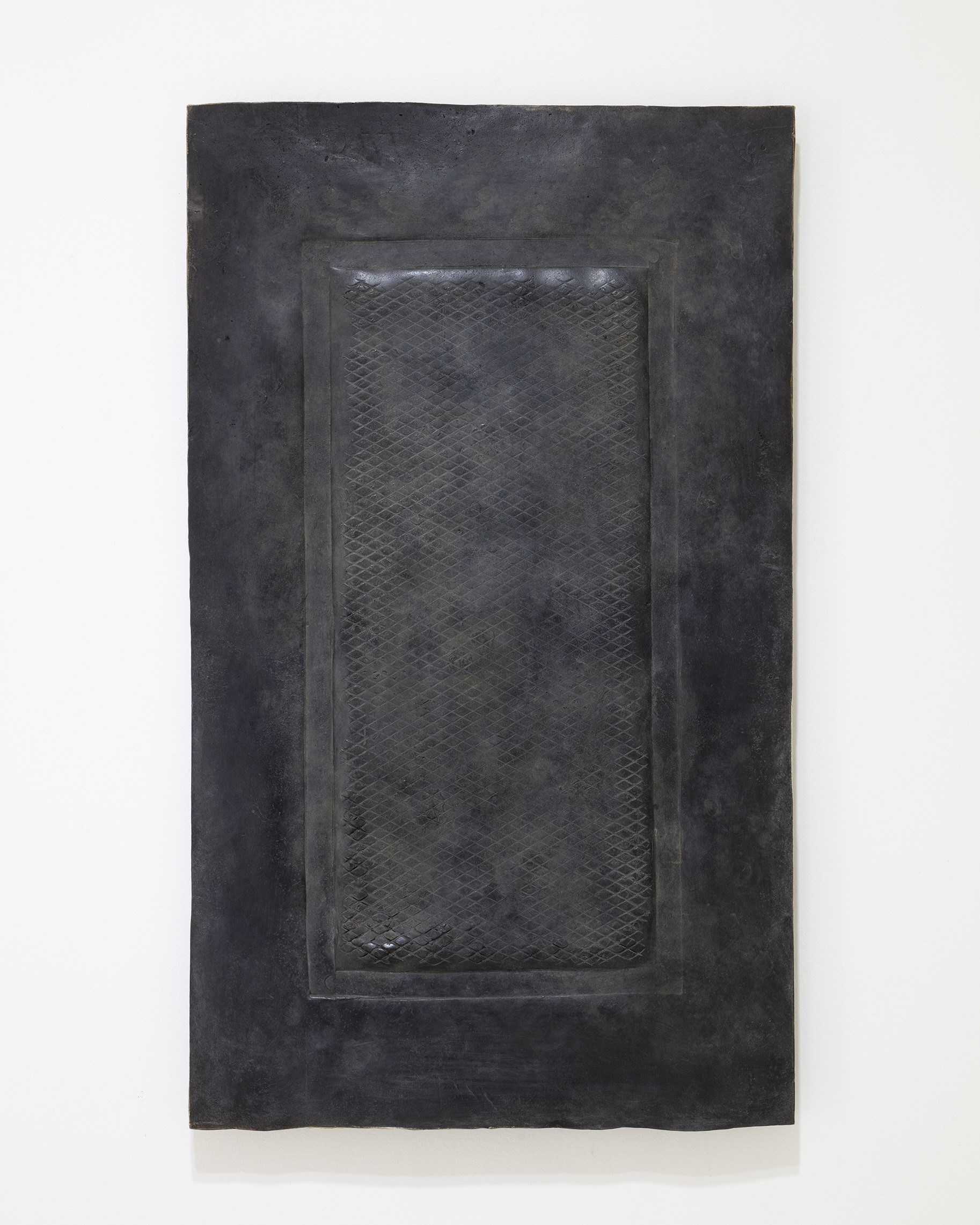
JC: Many of your works involve materials that have undergone processes of wear or transformation. In pieces like Humo (2025), how are these processes inscribed in the final form?
TPC: That piece is in dialogue with the works 17,000 horas I and II(2025), two sculptures made from recovered industrial filters. If the blown-glass pieces are made from human breath measured by lung capacity, the filters refer to industrial exhalations. I try to place those two temporalities in tension.
Humois an impression of an industrial filter in wax, which made me think about what kind of trace air leaves when it passes through things. Another aspect that was very important in my work with the filters was discovering their almost poetic diversity. Each filter corresponds to different processes of filtration–dust, mist, suspended particles in the air–in other words, different states of matter in the air. At the same time, the deep brown color they acquire results from accumulation, a density produced by time.
JC: In Pronóstico | Forecast (2025) elements appear such as fruit seeds and dead bees–bodies that simultaneously evoke fertility and extinction. I’d like to ask what personal experience triggered the creation of this work.
TPC: This piece revisits an image from my childhood: calendars featuring seasonal fruits. At one time those calendars were a way of understanding time, of knowing what was happening on the planet at a given moment and place of the year. There was a kind of synchrony between nature and its seasons. Today that correspondence has become blurred. Imagine papayas growing in Norway.
I don’t believe in the oracle as a device for prediction–I’m skeptical. But I do try to read signs, to attend to the misalignments that reveal deeper changes; for me, materials are verbs.
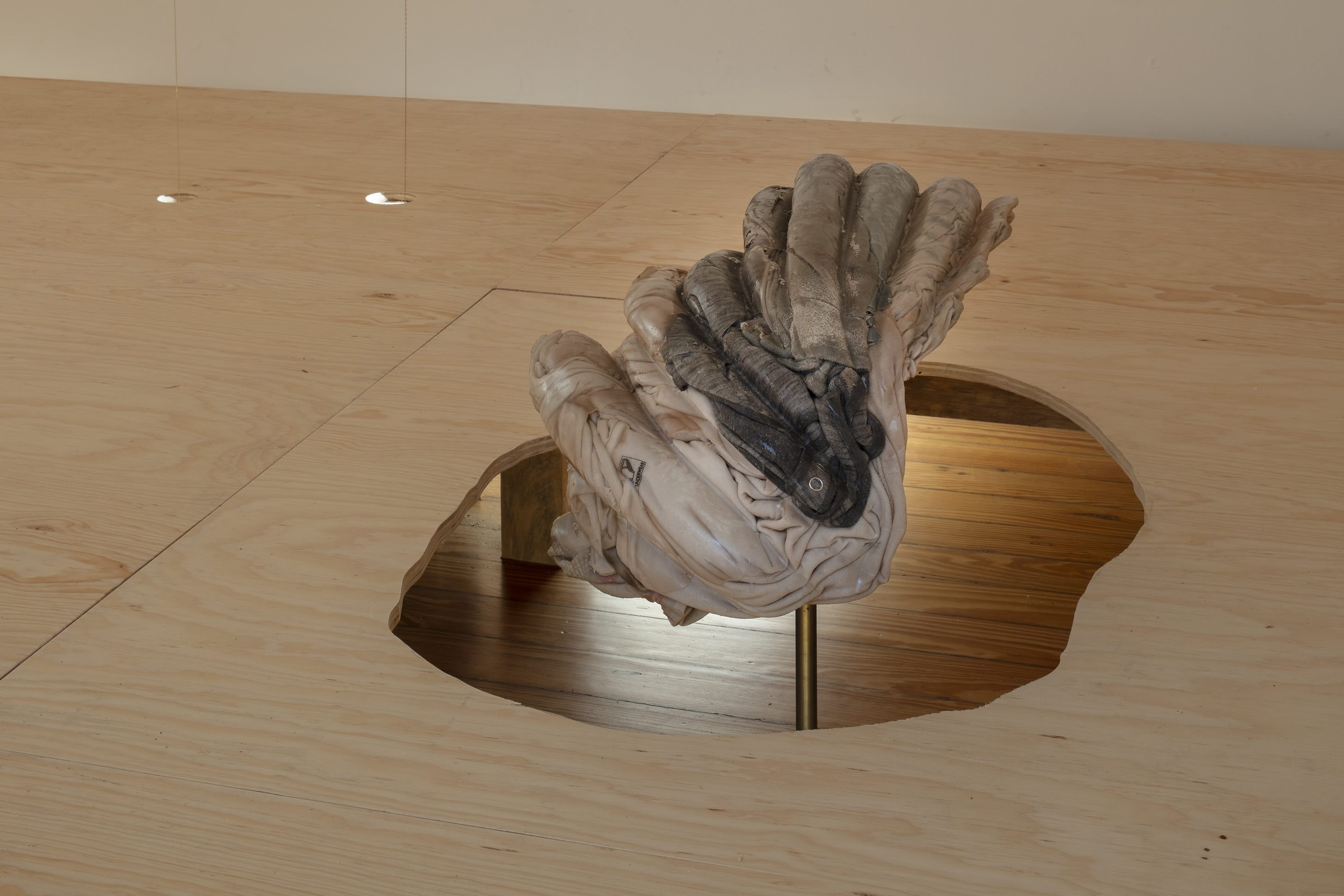
JC: There is a work that caught my attention in particular: El futuro (2025). The title seems to name something that does not yet exist, yet the piece is made from clothes that no longer fit children. Rather than projecting an image of the future, the work seems to gather times that have already occurred. What idea of the future are you exploring here?
TPC: Only one thing is certain: children never stop growing, and that inevitable growth is the future. The clothes that no longer fit them function like fossils of the past; they register a body that was once there but has already changed. Time is inscribed in those objects in the same way a filter accumulates and lets things pass. Growth does not stop, even if we do not know where it leads.
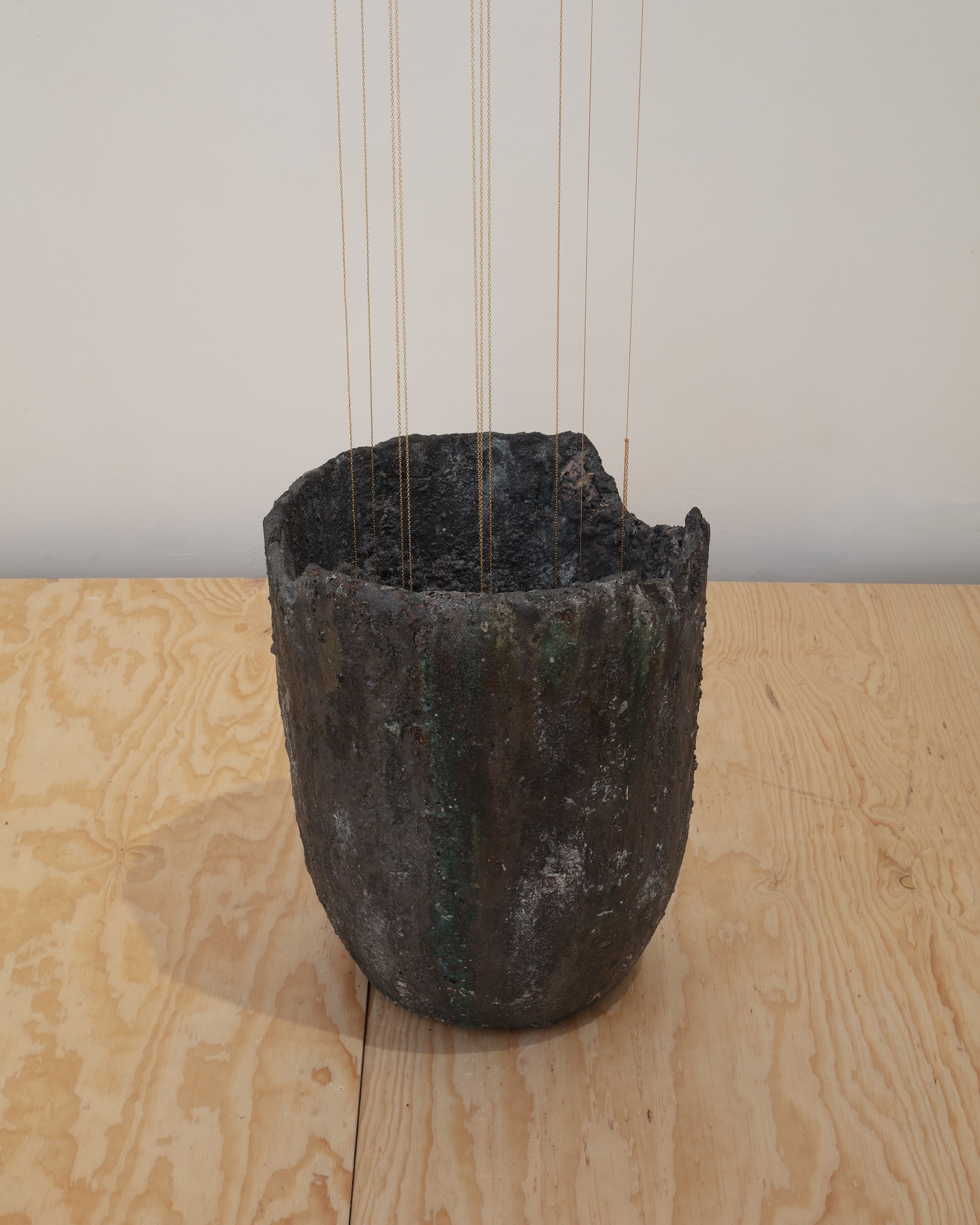
This piece is in dialogue with Lluvia de oro (2025), made with graphite crucibles and gold-plated chains. Crucibles accumulate the residue of many burnings of molten metals; they are saturated with use and make me think of objects from the Iron Age. I imagine a scene: when there is a leak in the roof and you place buckets to collect the water. I once read that on certain planets it rains metals. So I wonder what rain would look like in another solar system. The future is a fiction, a mood crossed by questions.
JC: Finally, considering that you address themes of crisis through materiality rather than representation, how do you understand the political dimension of your works? Does it reside in the sensory experience they produce?
TPC: My interest in art begins when works awaken a kind of resonance and make you feel something. Art as a non-linear language capable of generating that sort of magnetism. For me everything becomes an ingredient: history, time, the space where the work is exhibited–not only formal elements.
Very early on, when I began making things, I felt that an object could not end in an object; it had to reach a situation, a person. I’m interested in thinking about objects from the perspective of their production, their ecological condition, as part of a network of histories, economies, and circulations. That the works reflect outward, rather than remaining closed in on themselves.
This doesn’t only happen when making art; it happens in any gesture of looking beyond–in a relationship with another person, even as a consumer there is a management, a taking of position. For that reason, the effort to think an object beyond the object is a political act. The elements that make up a work are not only materials; they also include the gaze, the time someone spends looking, and the relationship that forms there.
For example, my work Protesta (2025), commissioned by the Wattis Institute for Contemporary Arts, begins with an approach to Federico García Lorca. I don’t usually work from “themes” as such, but here what interested me was exploring the similarity between the political moments we share.
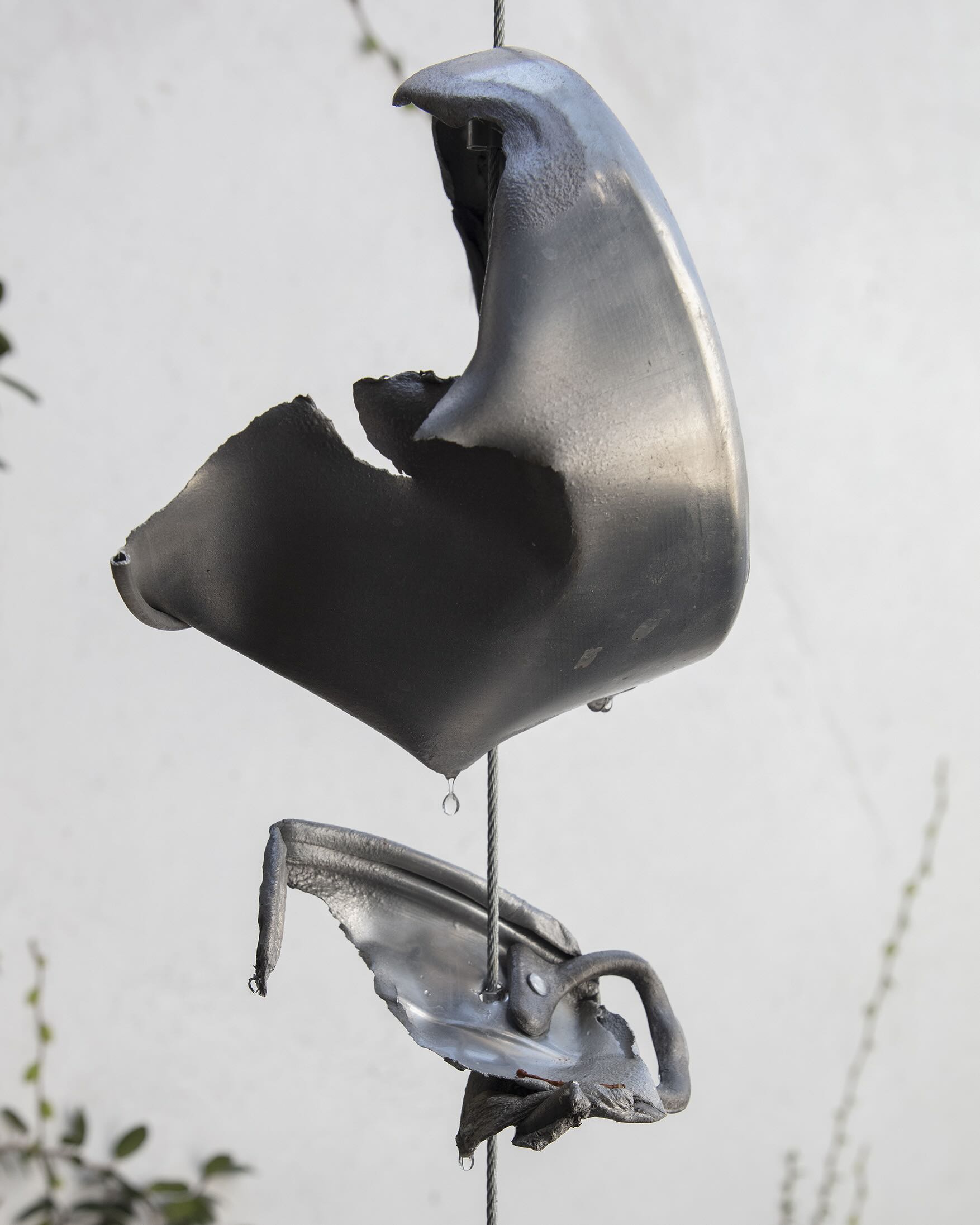
One discovery for me was Japanese rain chains designed to silence rain. I was struck that something could be designed specifically to silence. These chains have small forms that keep water from splashing. I wanted to think about objects that operate in the opposite direction. In the history of protests, pots and pans have been fundamental as devices of noise and collective presence. For this piece I use those same utensils, but melted together with artificial saliva–a substance used to lubricate the mouths of people who speak a lot.
What interests me is that friction between speaking too much and not being able to speak. Protest can also be that: in the silence of saying nothing, at least what remains said is that nothing can be said-and sometimes that says much more.
JC: Thank you very much, Tania, for your clarity and sensitivity. I hope this dialogue brings more people closer to your work and opens new conversations around these ideas.
With affection,
—Translated into English by Luis Sokol
Published on Mar 18 2026