Review
Alloy–Contradiction. On "Withdrawal" by Tomás Díaz Cedeño at PEANA
by Bruno Enciso
Reading time
5 min
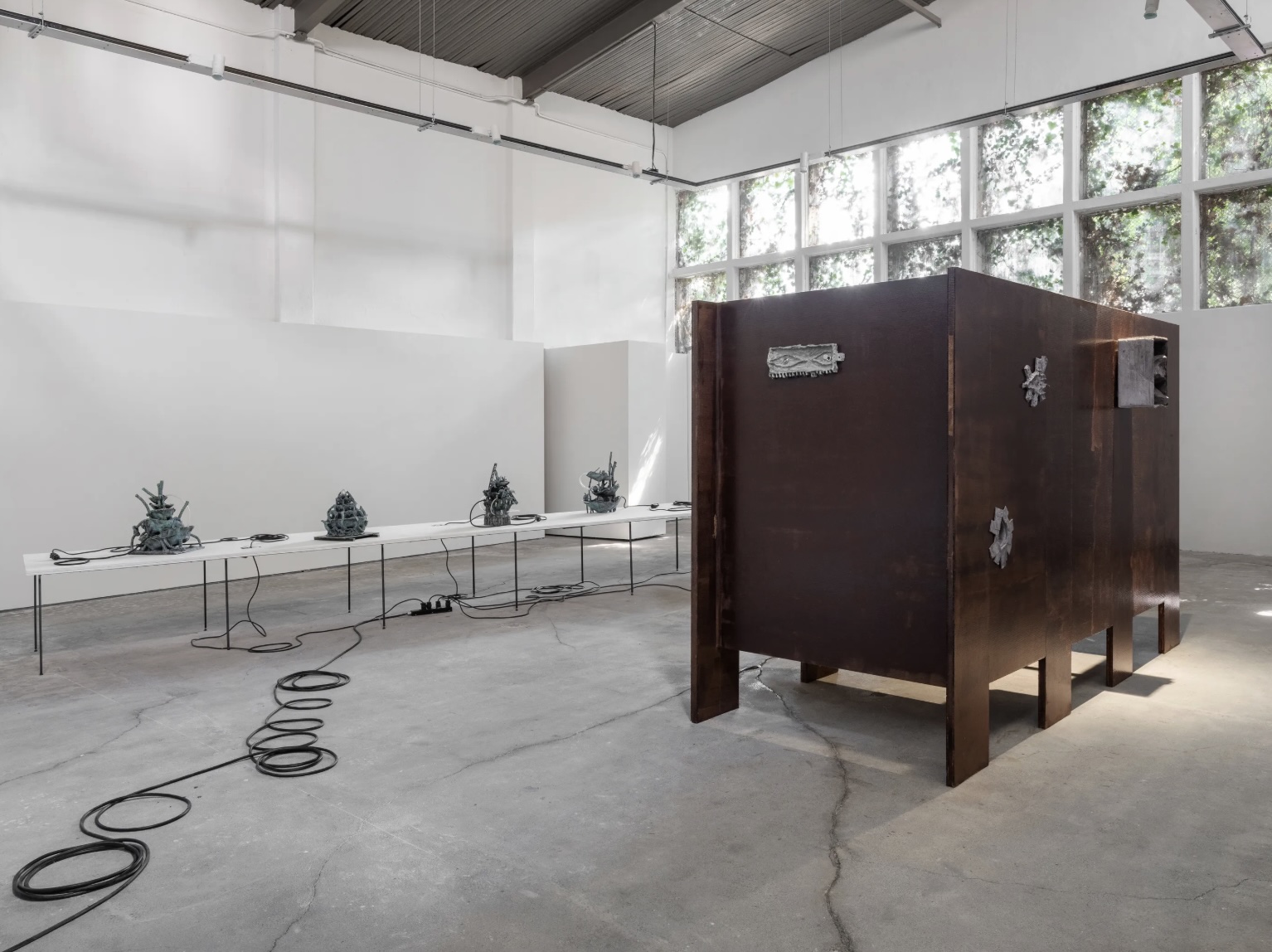
Tomás Díaz Cedeño’s most recent exhibition, curated by Gaby Cepeda, is titled Withdrawal. When I ask myself about the conceptual implications of keeping the title in English, I realize that its translation into Spanish is ambiguous. Depending on context, it could mean retirada (withdrawal), retracción (retraction), or even baja (as a synonym for loss). The artist’s previous projects lead me to expect formally dense works, industrial assemblages, and heavy materials. How might a title that gestures toward loss accompany work with such qualities? After an intuitive walk through the exhibition, I identify a repeated gesture: holes. Some are abrupt, interrupting the surfaces that give them form. Others are placed with great intentionality, fulfilling specific functions. It becomes evident that my initial question about loss—derived from the exhibition’s title—corresponds to this negativity-that-is-always-positivized in the hole. What unfolds here is an essay on desirous forces traversing what is solid.
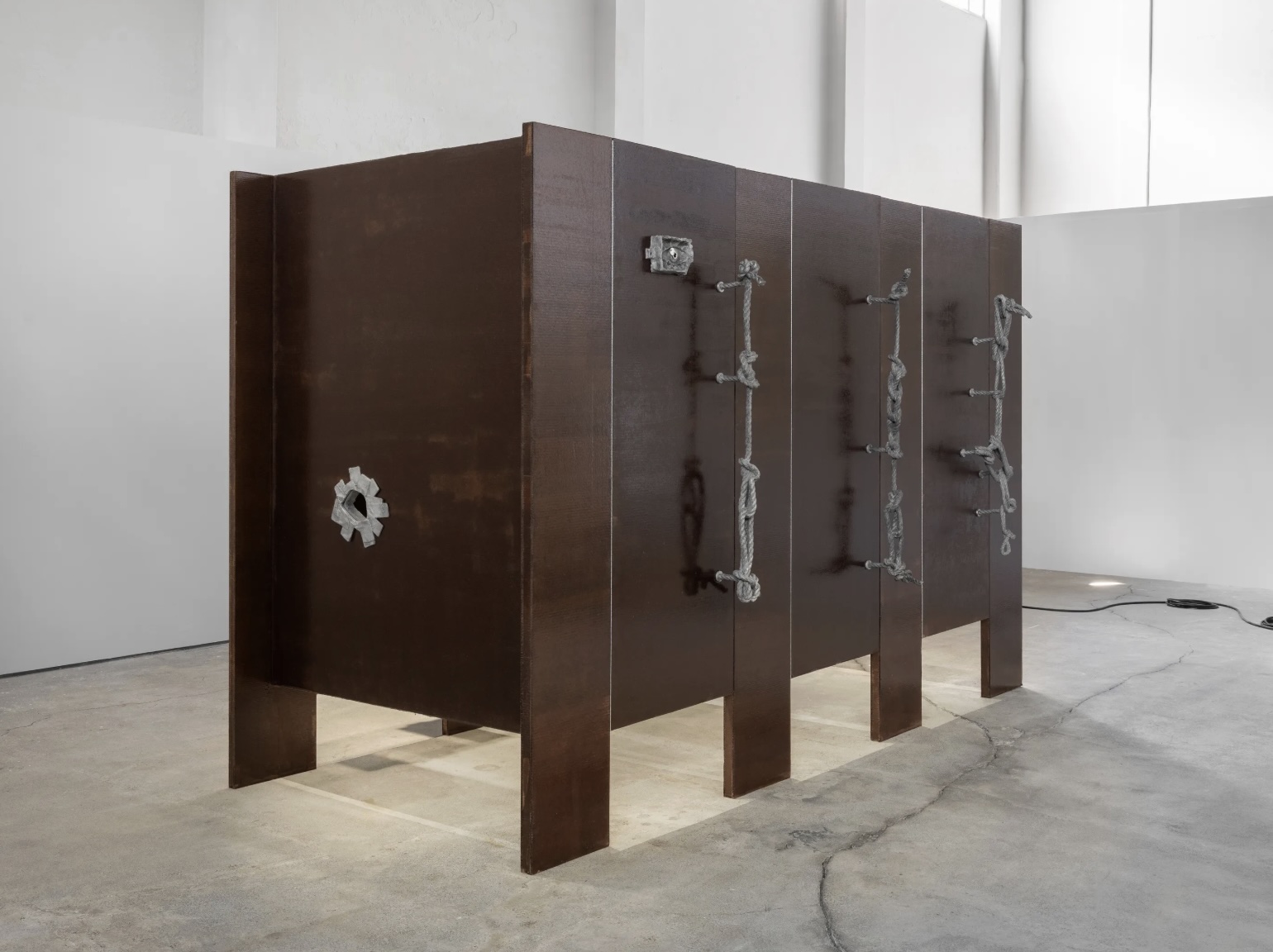
What interests me most is the sculptural ensemble at the center of the room, which functions as a kind of gravitational core. It consists of a triple cubicle resembling an average public restroom, built at real scale. A glossy dark varnish gives a wood-like appearance to the cardboard surface that covers the entire structure. A series of smaller pieces immediately contrasts with this by their metallic look—and I say “look” because there are variations: metal-as-iron, metal-as-graphite, metal-as-duct-tape. In their heterogeneity, they generate a distinctly erotic dynamic of approach. Each piece embodies decisions regarding ergonomics, detail, and possibility, appealing in different ways to curiosity. Through both their placement and their particular modes of operation, these pieces deploy diverse stimuli that seduce the perceptual body: from the gaze that tries to peek through a fish-eye peephole, to the furtive enjoyment of a glory hole, to the modesty involved in opening a door.
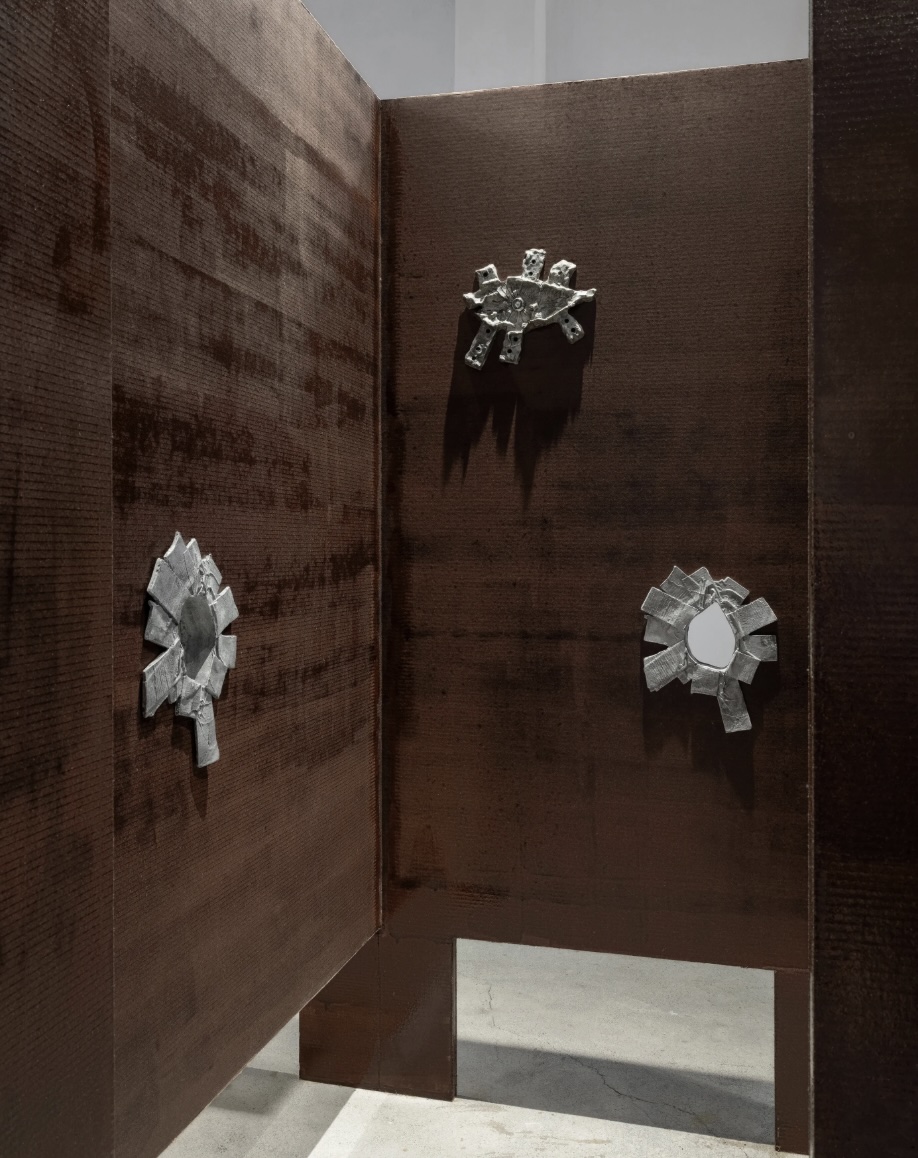
I find the cubicles frankly disconcerting, in the best sense of the word. Their most complex triggers—the metallic inlays—operate simultaneously as mini, single-player games for each viewer and as accessories belonging to a shared referential unit: the public restroom, which carries its own interpretive implications. It would be worth considering this dual performance as an artistic form, both in Tomás’s work and in that of other artists. With imaginaries collapsed by digital oversaturation, might it now be productive to hybridize forms that once seemed autonomous and intrinsic to specific media? Has the plasticity of the art object become indistinguishable from the plasticity of its installation? In this exhibition, material decisions also amalgamate into an anomalous aesthetic sustained by tension between the sophisticated and the makeshift. It is no longer a simple matter of contrasting an expensive material with a cheap one; both are subjected to a cosmetic-formal treatment that distorts their surfaces.
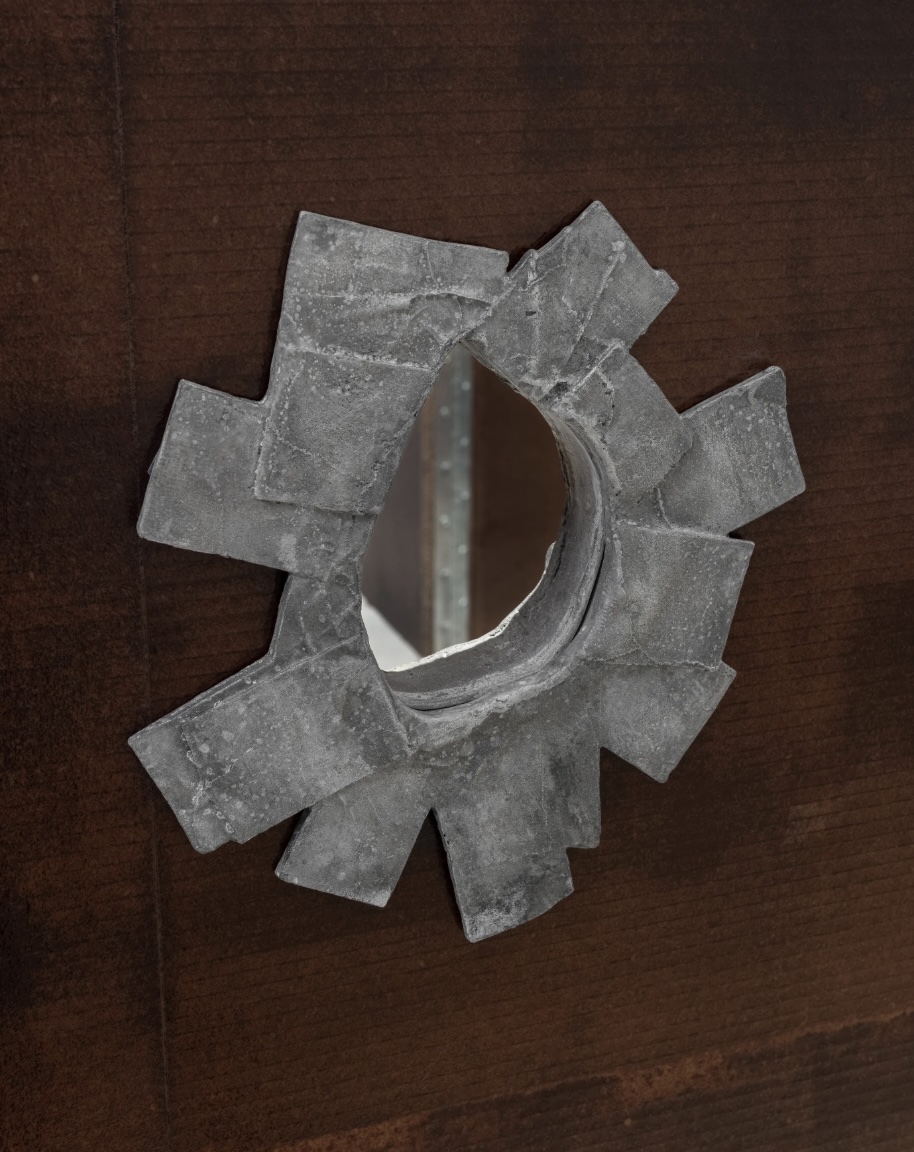
Time spent inside the cubicles carries a sub-tone: the murmur of a rave. It comes from a sound installation produced specifically for the exhibition. The techno music invokes a nocturnal atmosphere that configures a sense of space—not immediately close, but not too far away either. As someone who attends raves with some regularity, I find this evocation of the experience particularly compelling, as it discreetly skirts the intensity of the dance floor. This is how it sounds when you walk toward the restroom—or toward some other fleeting adventure—passing through a shift in lighting and glimpsing the effects of fatigue on the body, still magnetized by the music. The effectiveness of this piece lies less in its ambition to create ambience than in its configuration of a very specific kind of dynamic corporeality: fragile and transitory. This corporeality becomes fully apparent when we discover that the closer you get to the physical source of the sound, the more the volume diminishes until it reaches silence. The intention to approach the music only leads you to look closely at the hole, where you ultimately encounter your own disorientation.
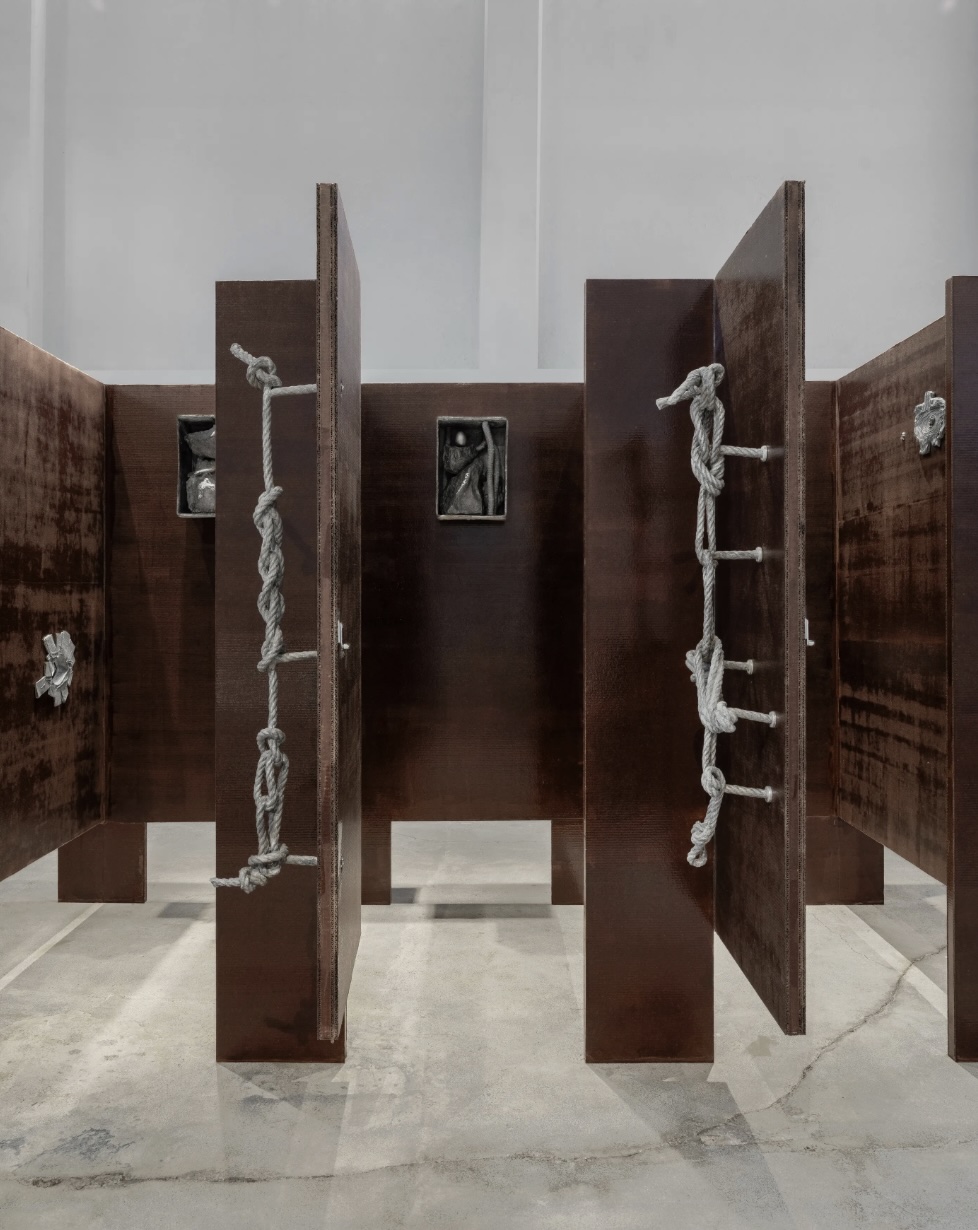
I find both fascinating and fortunate the way these works generate tensions arising from their materiality as well as from their conceptual weave—tensions that, if not contradictory, are at least uncomfortable. The discomfort resides in their crossroads, in the stimuli they trigger as they intersect in opposing directions. It is worth insisting that exhibitions should exceed their shop-window function and instead frame the analytical and perceptual-interfering potentials produced by artworks. In this case, I highlight the extra-verbal quality that envelops the pieces: although they summon human bodies, they avoid a hyper-narrative moment in favor of more intensive situations, belonging to the body and its sentient relation to a confined space. Recognizable, yet still vague; anonymous. At the same time, Withdrawal stands out for its economy of resources, in which an awareness of perception is not addressed through the hyper-profiled accumulation of data, but through the investigation of the different ways a hole can make itself present—something that, in principle, is empty.
The exhibition can be visited until March 21, 2026.
Translated into English by Luis Sokol
Published on Mar 3 2026