Review
Controlled Aggression: On "Good Boy" by Eyibra
by Stefanía Acevedo
Reading time
5 min
During Art Week, Eyibra (1992, USA) presented Good Boy, a performance that reflects on how masculinity forged within patriarchal violence is accompanied by obedience, aggression, and attack. The piece took place in the back area of a parking lot. One had to arrive early to secure a spot, as admission was free. Upon entering, the audience clustered at different points behind two rows of iron barricades, leaving a corridor in the middle where the action would unfold.
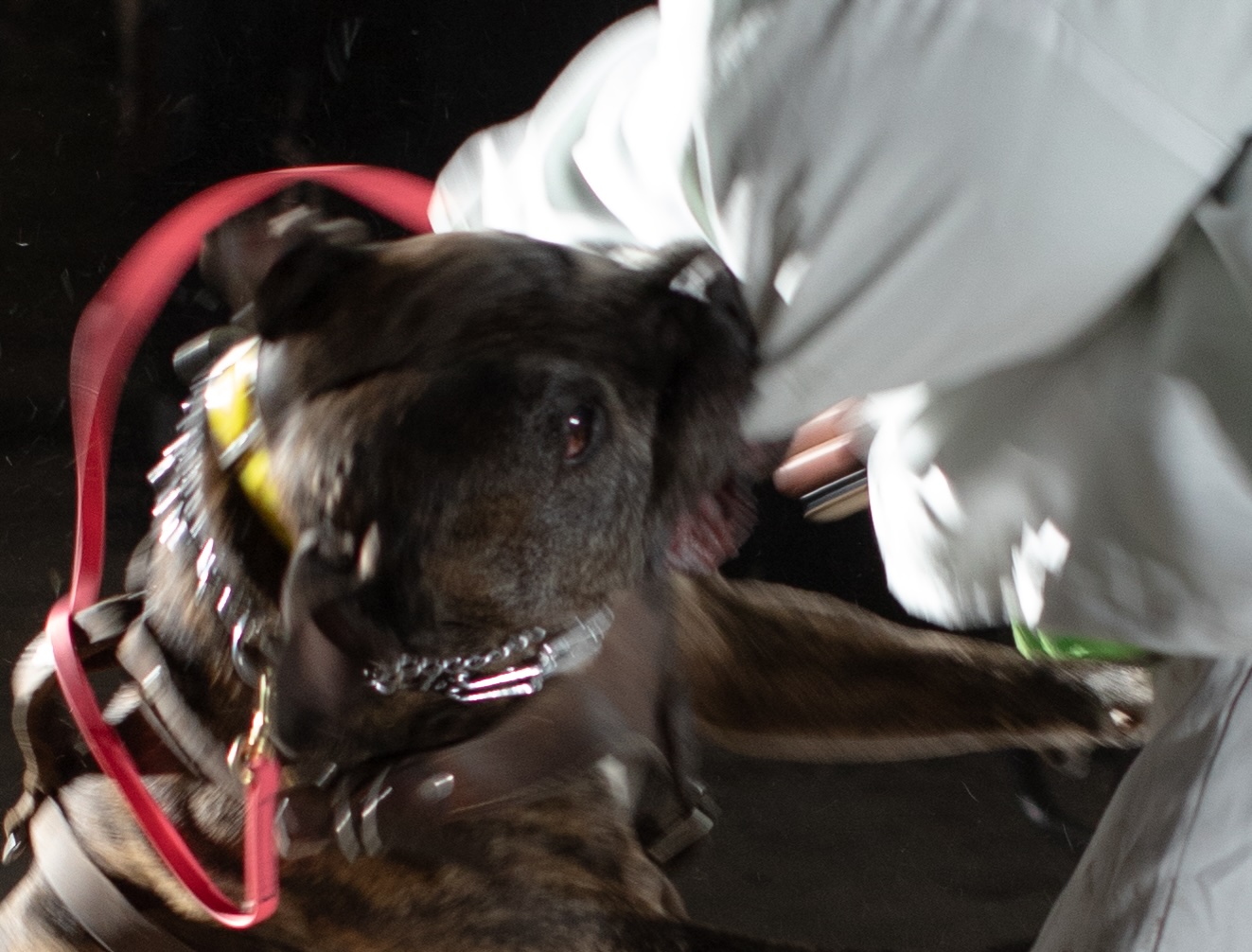
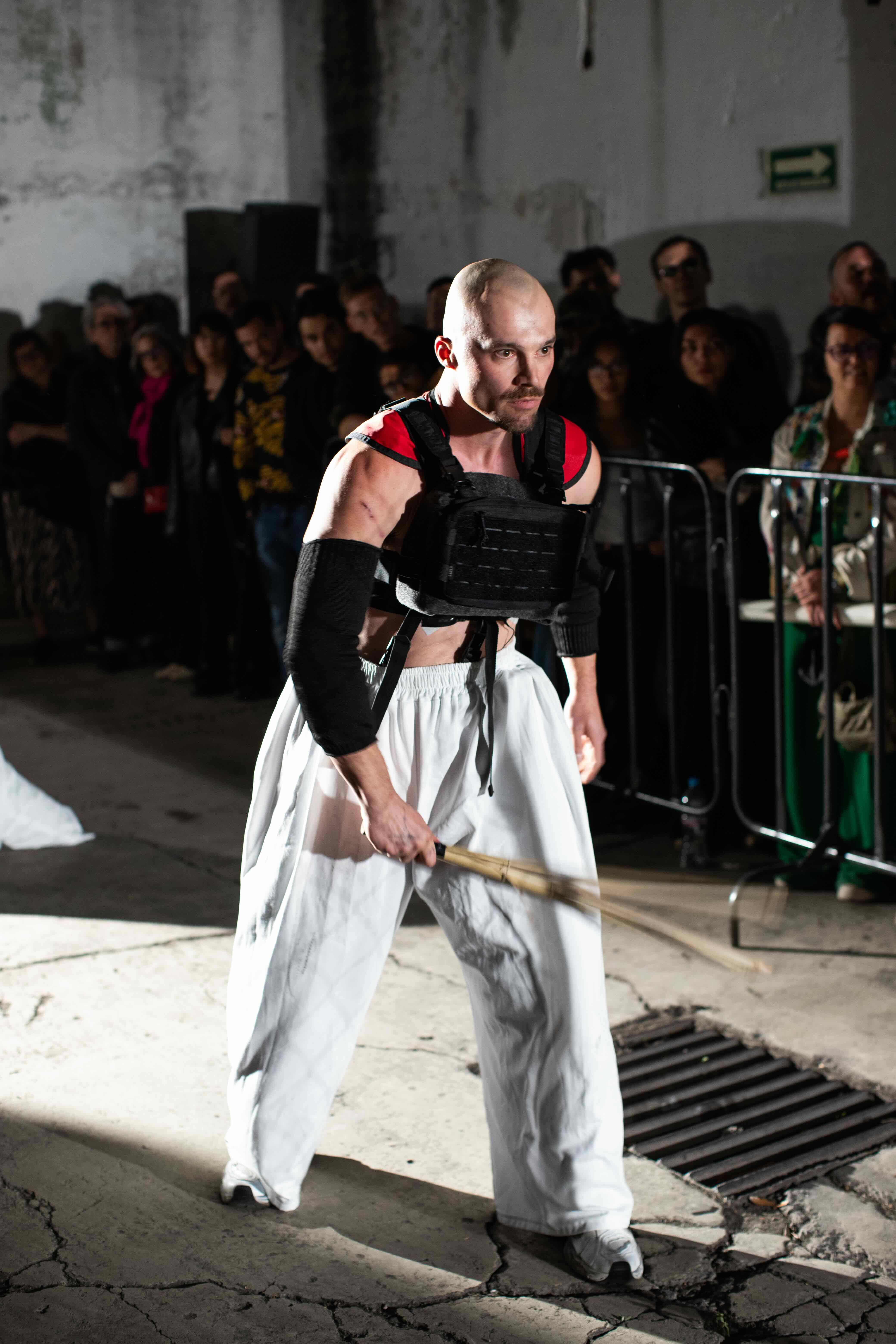
The action: Eyibra, bare-chested, positioned himself behind a metal gate that separated him from Jack, who was being held by his trainer. The artist shook a bamboo agitation stick, which he held throughout the performance. The sound and movement of the stick triggered Jack’s barking. In a second moment, once Jack was ready to attack, Eyibra put on his full protective suit and the gate separating them was removed. From then on, a series of repetitions began: the trainer gave the command to attack and Jack lunged at the artist’s arm or leg. Under another command, Jack released and ran back.
Attack!
Jack was anxious and panting; he barked, whimpered, and drooled. He is a pit bull trained for guard and protection work, so he knows how and when to attack. The piece presents the literalness of violence embedded in the body: the use of force and resistance, the absence of fear in fighting—all of it as evidence of what patriarchal masculinity produces. Eyibra was protected by his suit, in a controlled environment where a dynamic of power was exercised: he held the bamboo agitation stick, split into pieces to create a sharp, dry sound that kept the dog alert. With it, he also provoked Jack to continue biting him. The dog’s trainer was the one who truly held power; his voice commanded the situation, calling a halt or a continuation. This observation was shared with me by the human companion of “Manteca,” a ten-year-old Chihuahua, with whom I spoke after the performance. We both agreed on the sense of repulsion the use of a dog for artistic purposes provoked in us.
Eyibra partially exposed himself to the force of the bite and, despite the protective gear, the marks of the attack inevitably remained on his body—but also on Jack’s, who bit his own tongue and left small drops of blood on the artist’s white suit. The piece does not conceal the inequality of roles; in fact, it heightens them. This is part of the artist’s proposal: to show how all patriarchal violence is produced as a process of domination.
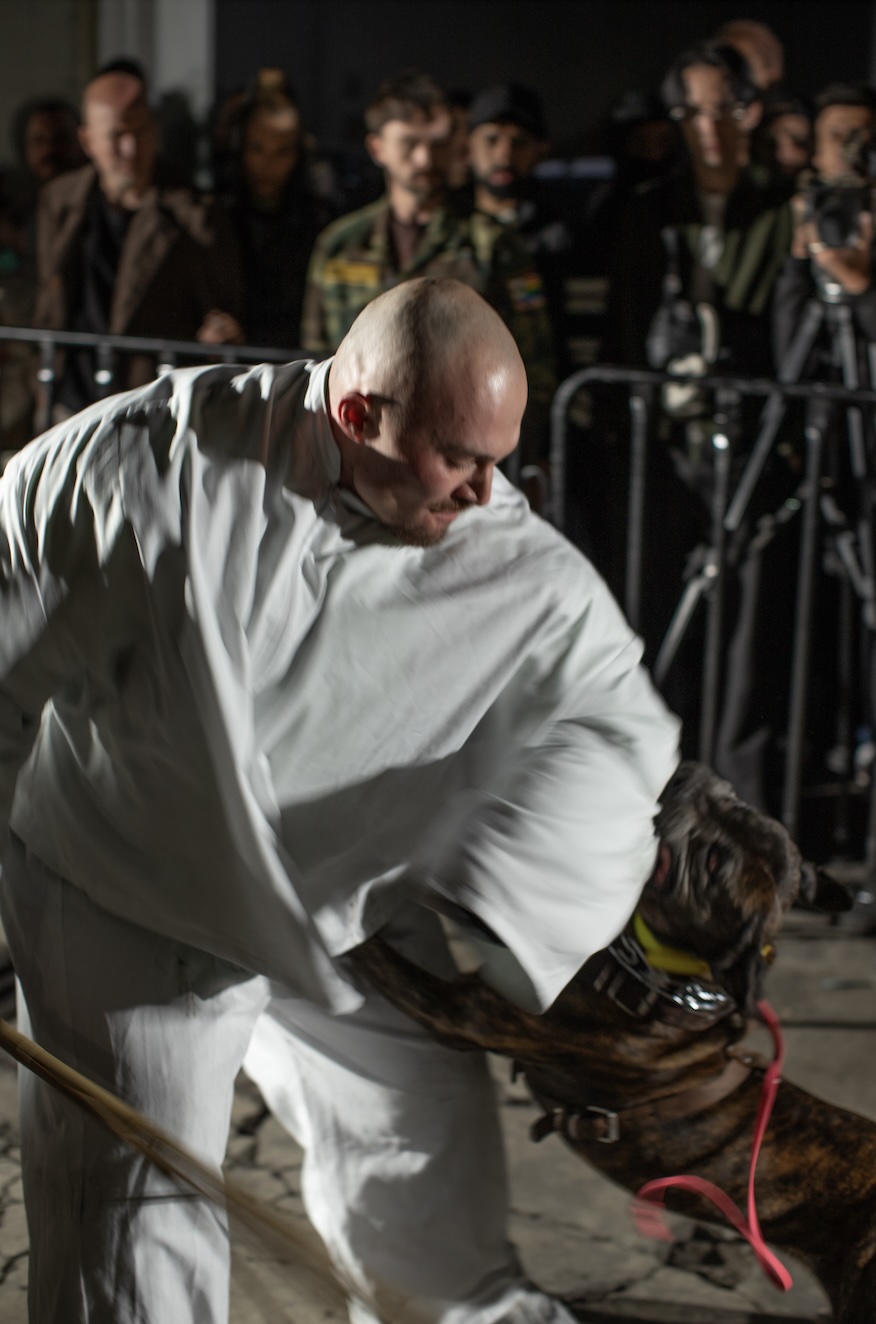
The rehearsals between Jack, the trainer, and Eyibra were evident. Discipline ran through every movement, underscoring the artist’s thesis of patriarchal violence as repetition—as training obeyed without question. The piece functions almost as a conceptual pleonasm: it explores violence through violence, domination through domination; yet this did not prevent it from mobilizing a wide range of affects.
Release!
One could feel the tension, the anxiety, and the morbid expectation among those witnessing the performance. I saw only one woman covering her eyes while a friend narrated what was happening. Some people smiled, excited. At the end of the piece, I heard someone say, disappointed, “I wanted to see blood.” This revealed a sadistic disposition within part of the audience. It is important to note that anyone could have left; nothing prevented them from doing so, and no one did.
Eyibra has previously worked with confrontation, both with his own body and with other humans. The shift here is that he does so with a dog—a risk the artist chose to take and about which he was likely well aware. In that sense, I see a position committed to insisting on the possibility of unsettling his audience.
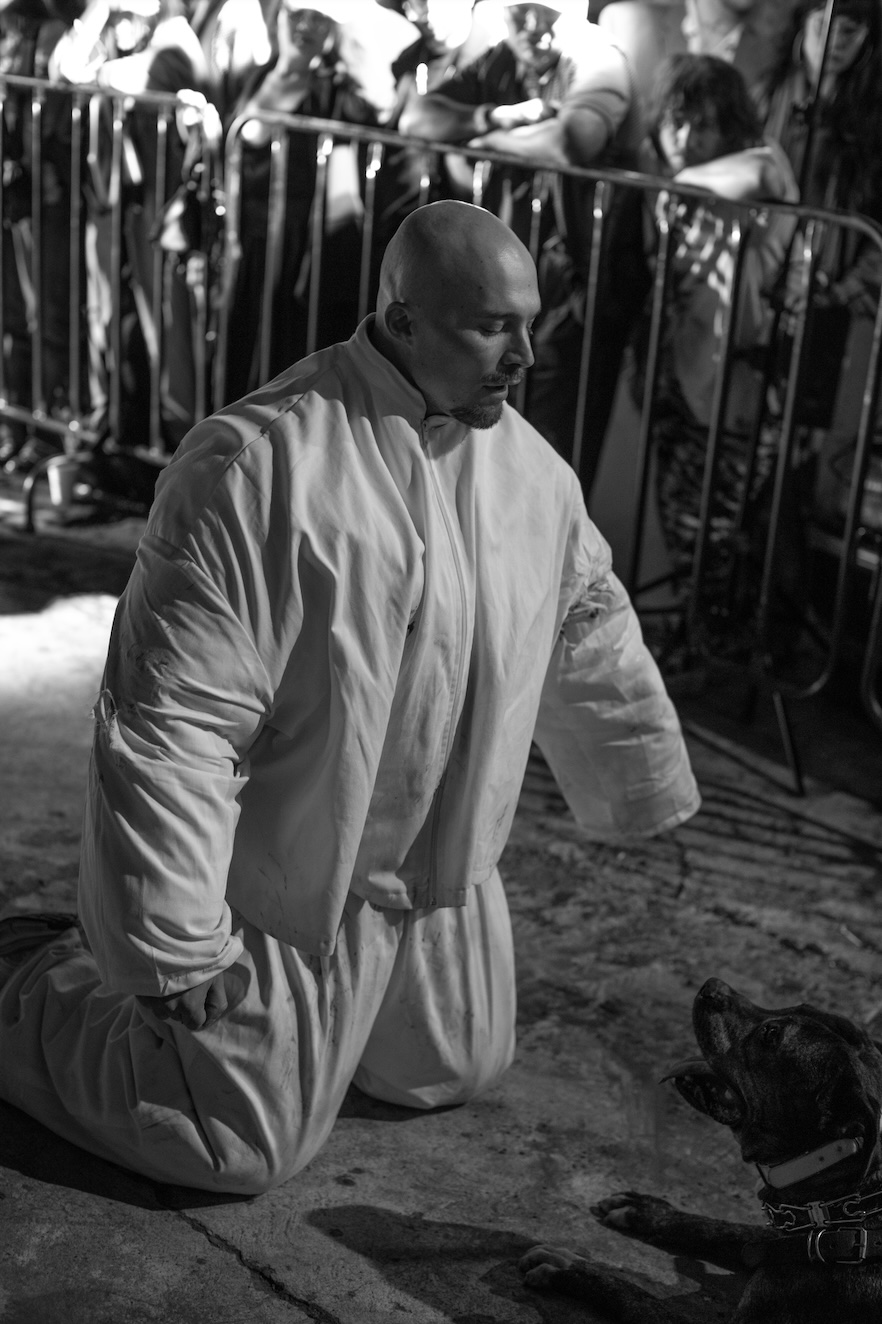
After about fifteen minutes, Eyibra knelt before Jack, and the dog lay down in front of him at the trainer’s command. At that moment, the trainer subtly informed the artist that “something” was not possible. Perhaps the artist wanted to pet Jack. We do not know. Maybe it is my own fantasy of reconciliation that is at play here. Jack returned to his crate. Eyibra received his applause.
Come!
Witnessing this performance affected me personally. I kept thinking about Tristi, the pit bull I care for, who is undergoing training to stop feeling threatened by humans. I recognize that it was difficult for me to adopt a non-judgmental stance toward the piece; at the same time, I wanted to consider how possible it might be to explore other registers of the performance without eclipsing it with my own ethical compass. It is impossible to renounce that compass, but that does not mean it is all that can be said about a work. All this makes me acknowledge an important contradiction in my position toward Good Boy: despite my distance from it, the piece inevitably reflects back to me the times we live in—times in which aggression and cruelty are the first response to any form of questioning.
Jack is not a rabid or uncontrollable dog. He's not violent. On the contrary, his obedience demonstrated the discipline he has learned—discipline that precisely distances him from unrestrained violence, since what he does is bite and release his prey. Patriarchal violence, by contrast, does not know how to release; it consumes everything and is forged as the subjugation of the other as its only mode of self-affirmation.
Translated into English by Luis Sokol
Published on Feb 17 2026