Rini Templeton
Apuntes
Exhibition
-> Aug 30 – Feb 8
Rini Templeton (Buffalo, 1935–Mexico City, 1986) was an artist who dedicated her work to activism and to providing graphic support for social movements. Throughout her life, she traveled across different territories following the organizations she became involved with, mainly throughout the southwestern United States, Mexico, Central America, and the Caribbean. Templeton’s notes, contained in notebooks filled with images and text, reveal her formal and theoretical processes; they are travel diaries, itineraries of struggle, and matrices for the images she would later offer to various political causes for use in pamphlets, magazines, posters, and banners.
From a young age, Templeton showed concern for issues such as war and injustice. She wrote poetry, learned photography, and became involved in several media outlets, both in the press and on the radio. Her artistic training took place in different institutions during the 1950s: she studied sculpture at the Bath Academy in Corsham, England; at the Skowhegan School of Painting and Sculpture in Maine, United States; and printmaking at “La Esmeralda” in Mexico City.
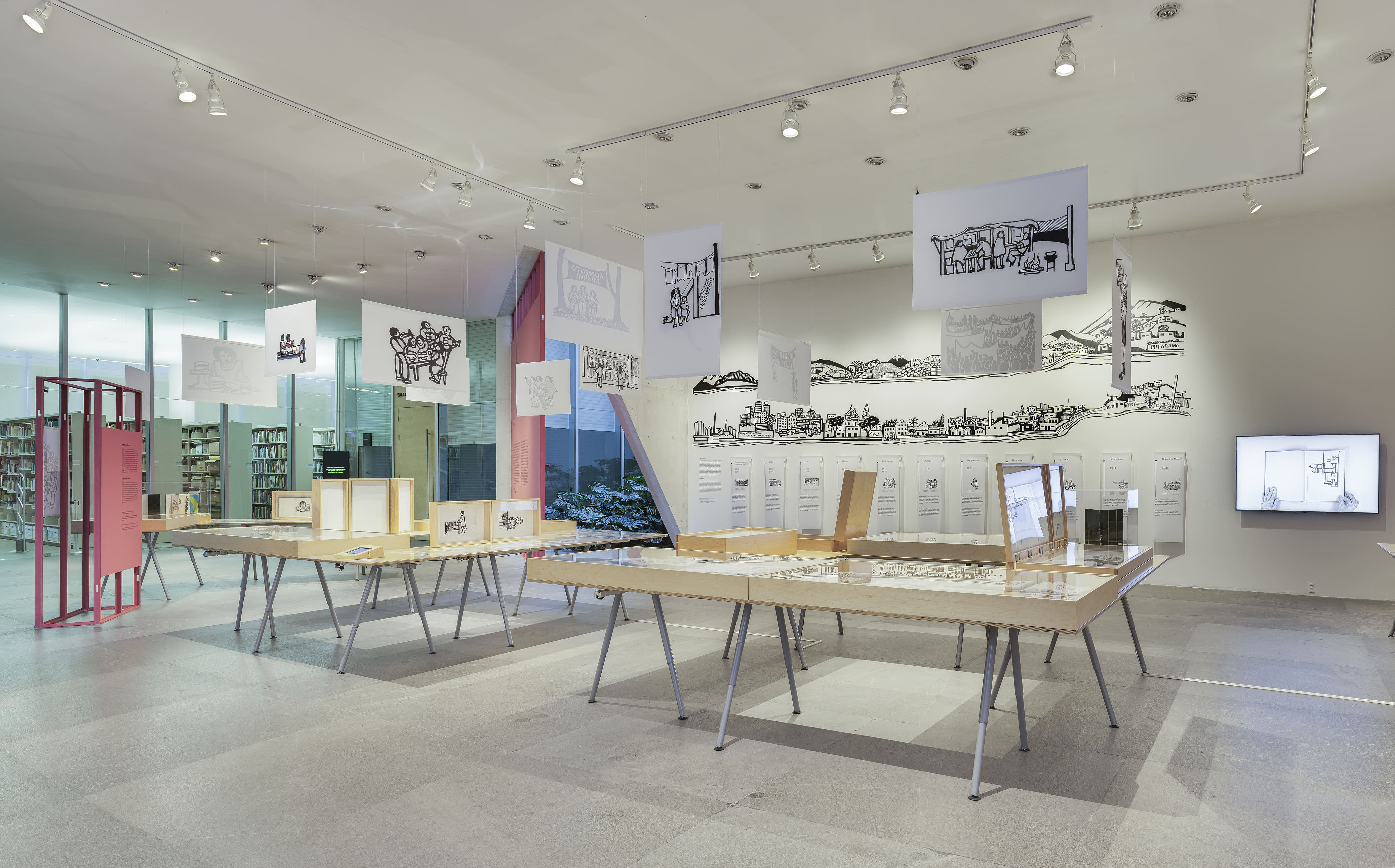
As part of the curatorial framework of the exhibition MUAC Collection: Genealogies and Dissidences, the show Rini Templeton. Notes, opening at the Museo Universitario Arte Contemporáneo on August 30, presents an artistic practice in which images played a central political role. This archival exhibition—curated by Elva Peniche Montfort and Cristine Galindo Adler—seeks to recover her working processes and commitments as a producer of images in service of political and social causes, through an exhaustive review of 76 notebooks. These notebooks comprise the Rini Templeton Collection of MUAC’s Arkheia Documentation Center, donated for safekeeping and research by Templeton’s niece, Corinne Field. In them, the artist recorded the daily life, organization, and surroundings of the mobilizations she was involved with through pencil drawings, watercolor, ink, and marker, which became matrices for reproduction and circulation, mainly through photocopies (a process she referred to as “Xerox-art”) distributed at rallies and marches. They also include written notes taken during assemblies or meetings of militant groups, as well as poems and reading annotations.
Influence on visual culture
Rini Templeton’s work has influenced the visual culture of social movements in the second half of the 20th century in Mexico and the United States. She also engaged in direct dialogue with various visual and political traditions linked to the Left, such as the Taller de Gráfica Popular (of which she was a member), Mexican muralism, and the Frente Mexicano de Grupos Trabajadores de la Cultura, which she joined in the late 1970s.
Some of the processes Templeton accompanied through her graphic work include the Cuban Revolution, the Chicano movement, the Nicaraguan Revolution, the struggles of labor unions in the United States, resistance against the displacement of Native American communities, agricultural workers’ organizations in California, Puebla, Guerrero, and Veracruz, and the labor unions of the Universidad Autónoma Metropolitana and the Universidad Nacional Autónoma de México.
Graphic and political processes
The exhibition Rini Templeton. Notes is organized into four major sections that aim to illuminate the graphic and political processes present in her notebooks. The largest section, titled Accompaniments, presents images of the recurring concerns in her work: labor, political violence, and the everyday life of activism, as well as some of the specific struggles she followed. Templeton’s mode of accompaniment highlights the importance she placed on affective bonds within groups and on camaraderie, as well as on the representation of organizational time—not only the time of struggle, but also the waiting during strikes or rallies, the time for thinking, leisure, or celebration.
In Visual Alphabet, the exhibition presents the evolution of her formal and theoretical processes leading to her Pamphlet of Pamphlets, a graphic production manual that synthesizes Templeton’s life project, centered on the creation of simplified designs meant for widespread reproduction and distribution. This section also emphasizes her participation in the magazine Punto crítico, published from 1972 to 1986, for which she, along with Amelia “Cuqui” Rivaud and others, served as editor and illustrator. This publication was created with the aim of informing and supporting the labor movement during the rise of independent unionism in Mexico.
The section Puente voy. Soy vida takes its name from a phrase found in one of Templeton’s few self-portraits, in which she defines herself as a bridge between people, places, and different struggles against social inequality. Beyond her work with labor unions and peasant organizations, this section includes her collaborations with local artistic groups such as Germinal, CLETA, and her closeness to the Taller Arte e Ideología (TAI), founded by Alberto Híjar, with documents sourced from other collections at the Arkheia Documentation Center.
Finally, Journeys highlights the artist’s extensive geographic itineraries, visible in a variety of landscapes and environments captured in her notes—evidence of her determination to be present in the crucial turning points of the causes she cared most about. From cities, deserts, towns, jungles, ports, and industrial complexes, the section emphasizes key moments of struggle to which she dedicated her life.
Rini Templeton. Notes will be on view in the lobby of the Arkheia Documentation Center (ground floor of MUAC) from August 30 to February 8, 2025.
— MUAC