Review
Labyrinth / Disco Ball. On Manuela Solano’s "Alien Queen/Paraíso Extraño" at the Museo Tamayo
by Bruno Enciso
Reading time
6 min
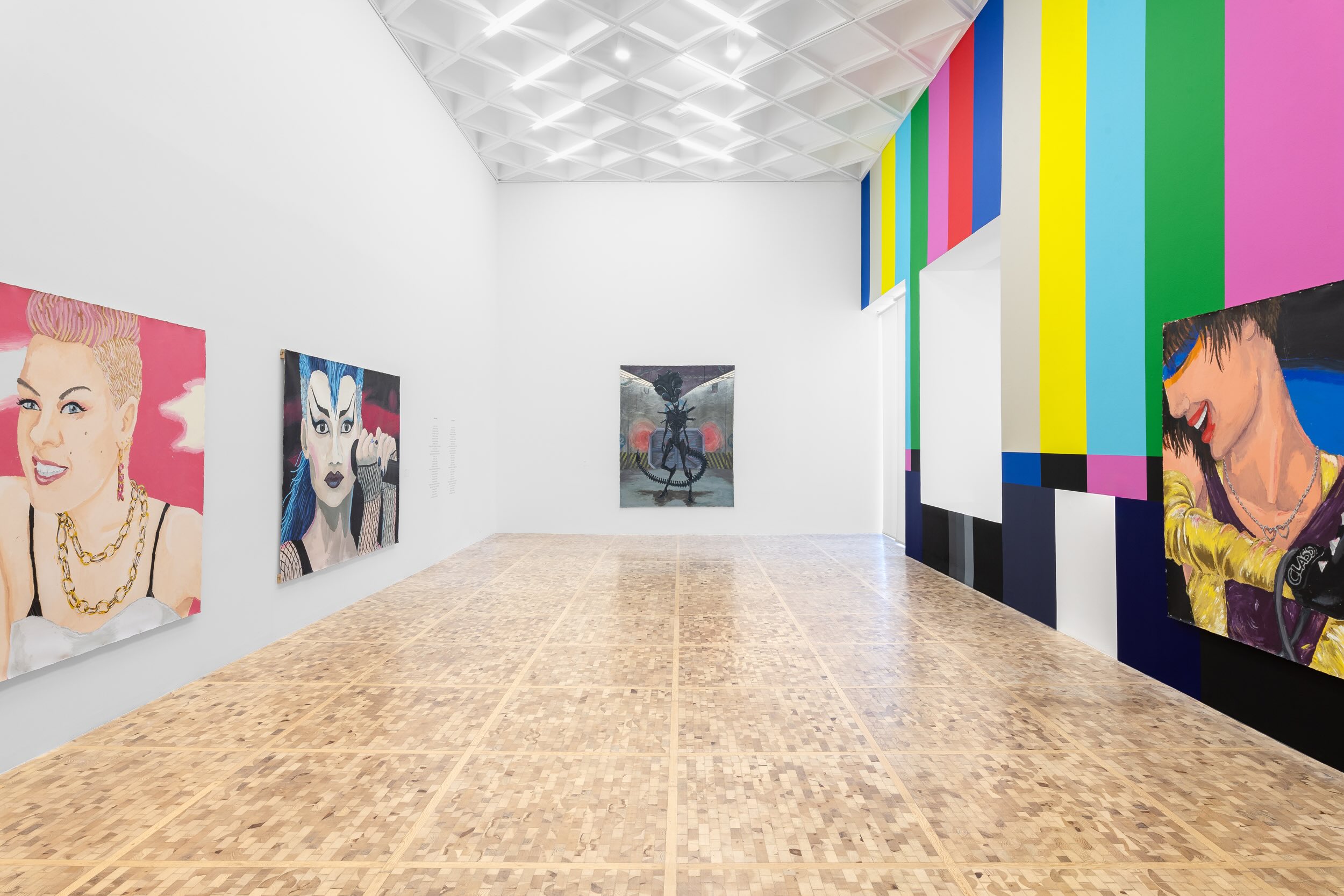
Manuela Solano presents more than 30 large-format paintings in the biggest exhibition of her career thus far: Alien Queen/Paraíso Extraño, at the Museo Tamayo. That seems like a good point of departure for my commentary: the sense that this is a large, expansive show. Many paintings—tall, one after another—many faces and references, and the sheer scale of the building itself, emphasized by the decision to color one of its walls, which I’ll address later. The opening lines of the wall text state that this body of work took seven years to complete. Seven years! How does an exhibition project sustain itself over seven years? What astonishes me first is its vastness placed in the service of multiplicity—a lucid overstimulation that I can scarcely take in fully. The works and their installation bear layers built from the inside out, which I associate with the density of a questioning around identity. They also open pathways that can be followed side-to-side, unfolding another kind of reflection, closer to the implications of pop within visual culture.
These are mostly portraits—paintings whose framing choices allow for a particular way of perceiving someone’s presence. They portray various personalities from the world of entertainment, where real names coexist with fictional characters. A dominant feminine presence is easily recognizable, though not necessarily a human one. Freezer, Jar Jar Binks, Nosferatu, among others, act as nods to universes governed by rules and powers different from ours. Queerness also asserts itself in the way many of these luminaries spill over the natural conventions imposed upon them in their own worlds.
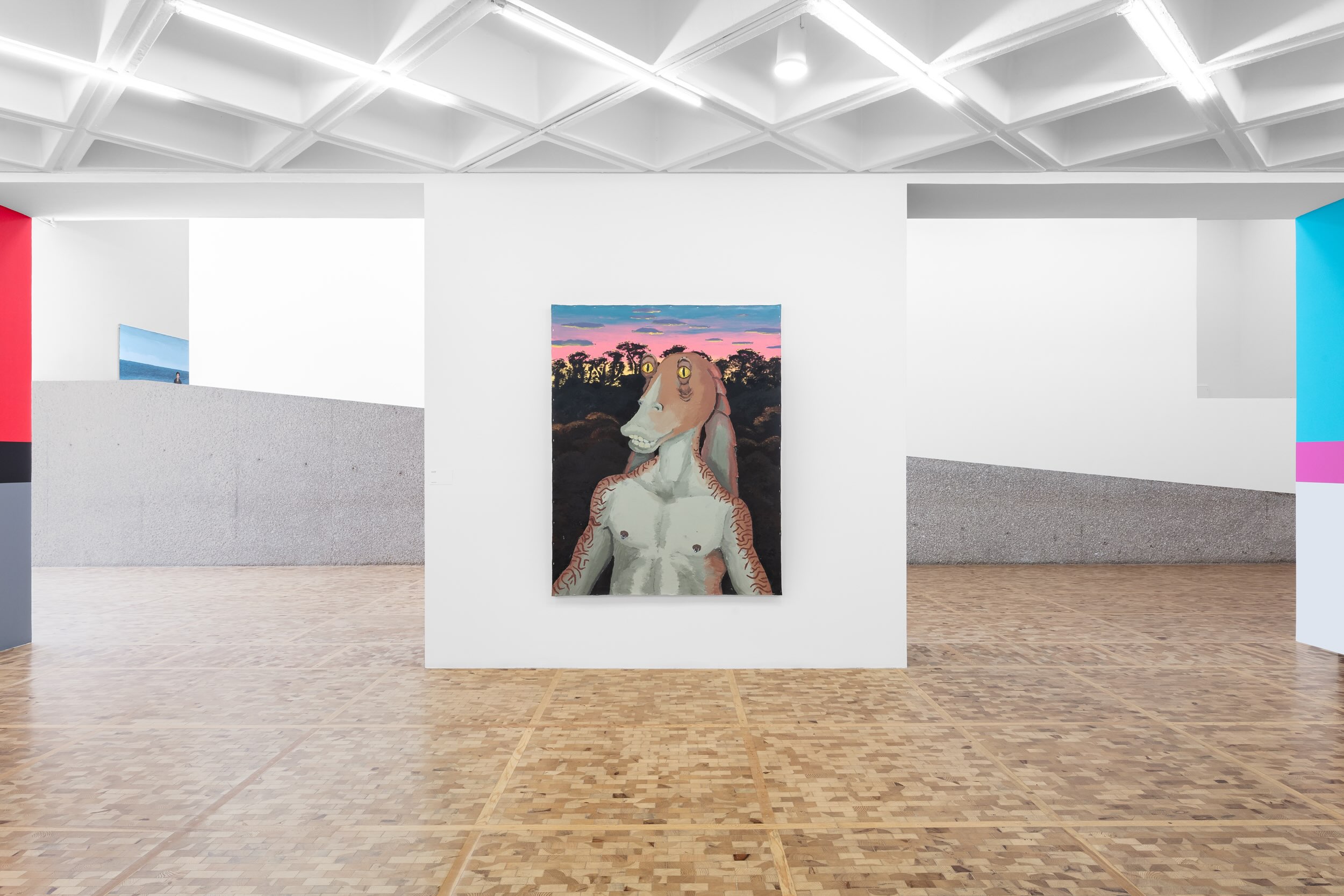
It isn’t necessary to know the references behind each painting, though one could, since the artist has written labels for every piece. These texts can be read as a set of anecdotes as well as a collection of gestures, postures, and moods. Manuela uses varied compositions to experiment with how a portrait can highlight the features that interest her most in each subject—ranging from full-body figures in the foreground to close-ups where the face covers the entire surface. Running in parallel is her personal inquiry into what makes an icon iconic, accompanied by a conscious breakdown of framing, cropping, and their possibilities.
While these characters share an affinity with a specific stretch of the calendar—the nineties and the two-thousands—time is not what calls them forth; the artist’s sensibility is. Even if the flashback quality of the work is clear, it bears repeating that Manuela is neither historicizing an era nor narrating her own biography. It’s worth asking: what else might be happening here? There must be something more. I think of a mirror maze. Before the reflection: scale and movement. Paintings whose format I decipher not only with my gaze but with my steps and my height. Other presences that strain against my own, even when I turn my back on them. After the reflection: the image. Faces whose expressions summon a memory or a longing. Fey inspired me when I was younger. I hope one day to be as much of a diva as Mónica Naranjo. The mirrors in this maze return to the viewer the reflection of a time explained more by desire than by narrative—a rebellious time in which identity no longer recoils at its own artificial nature.
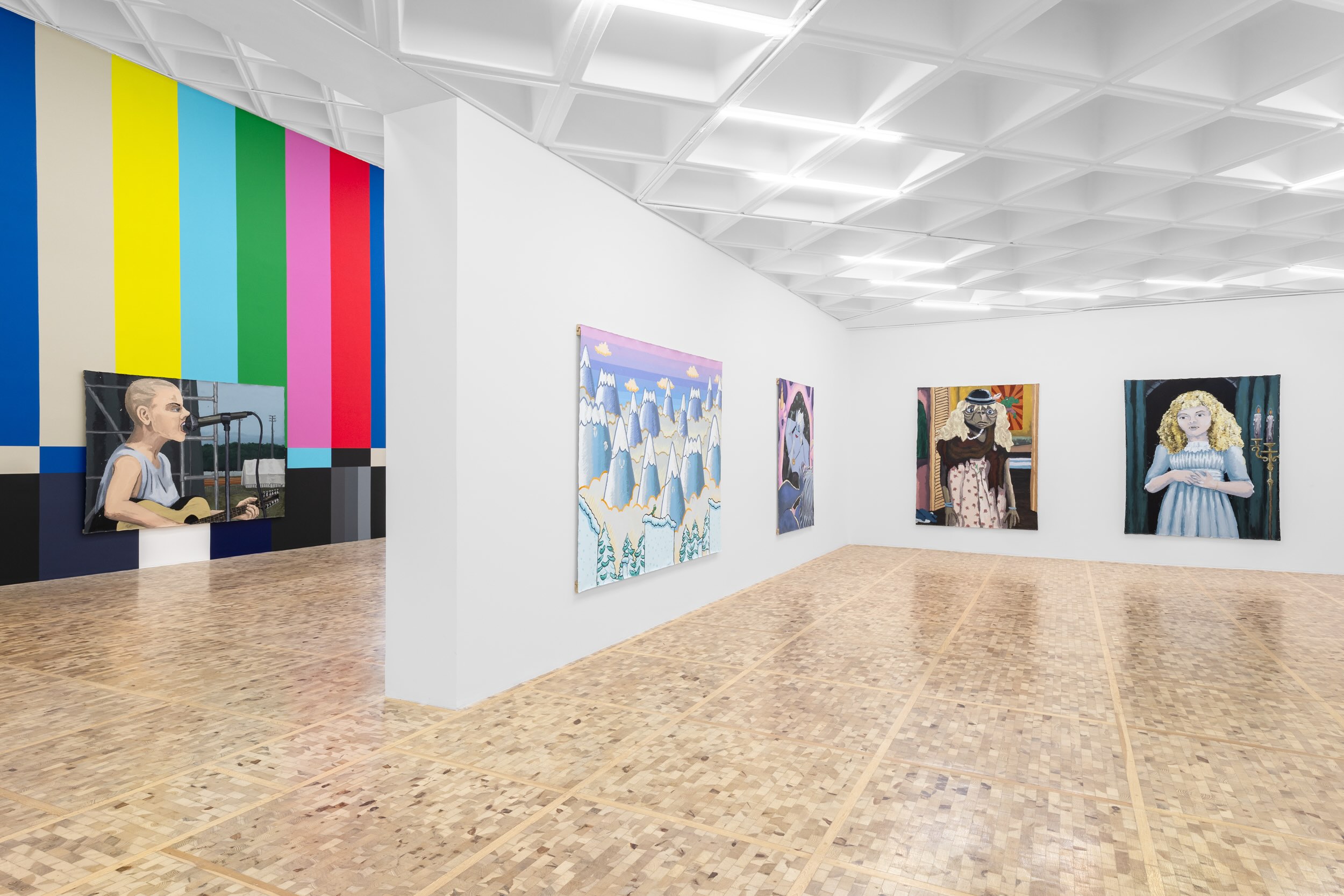
This sequence of mirrors also brings to mind a disco-ball effect. On one hand, the musical factor is strongly present in the selection of references. In fact, the exhibition is accompanied by a playlist curated by Manuela herself (available here). A celebratory feeling also suffuses the show. We celebrate the arrival of the new millennium, queer pride, and the artist’s hard work in finally opening this extensive exhibition. Perhaps the dance floor is the best place to test what we learned from these icons. The disco ball breaks apart and redirects the light, bringing movement to the glow of the screens where we first encountered these presences. That sense of dynamism is crucial—both in this exhibition and in many pop-related matters: what the works produce (paintings, songs) is largely experienced through motion—be it dancing or the rearrangement of affects.
The widest wall in the galleries occupied by the exhibition is painted with vertical bars reminiscent of the video test pattern developed by the Society of Motion Picture and Television Engineers (SMPTE), a technology used in the nineties to test and adjust the chromatic range and illumination of monitors. Besides anchoring these imaginaries in a specific temporal frame, it is fascinating to display a device in which colors appear in their “raw” state, whose modulation produces concrete visual events. This generates a compelling tension given that we are in a painting exhibition, and that the introduction of the digital—among countless effects—profoundly reshaped our relationship to color, its availability, and its reach.
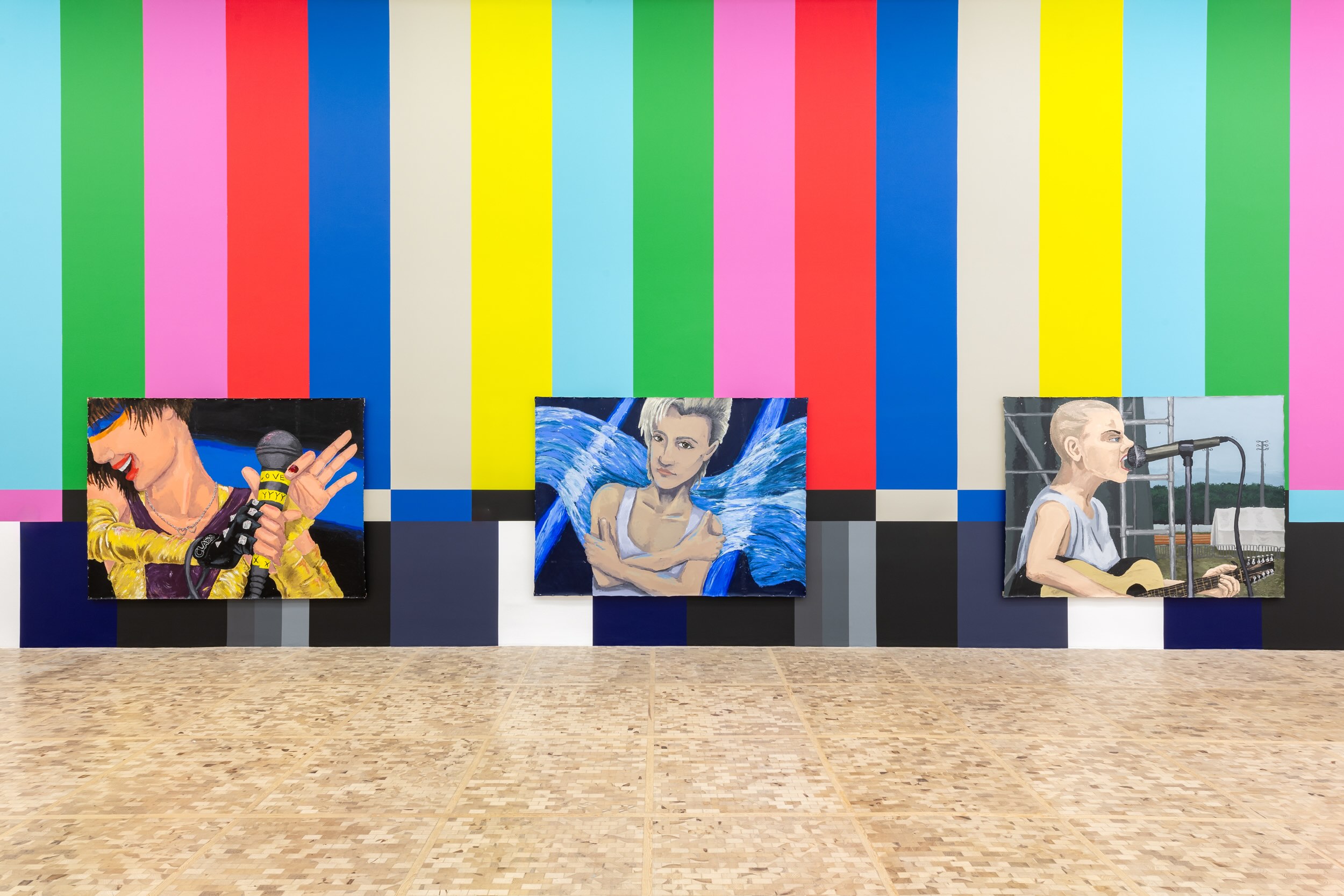
Throughout the exhibition, it is evident that Manuela is a diligent artist who trusts her interests and works intensively to close the distance the world insists on imposing on her, considering her condition as a blind and trans person. She explores these conditions explicitly in the series Blind, transgender and wild, which she has developed since 2014—works on paper in which she paints alone, using her fingers and her memory of color and text. The portraits at the Museo Tamayo operate differently: she has developed a system in which, supported by her team (who not only intervene technically but provide extremely detailed descriptions of each painting), she produces the strokes and contours that allow her to identify the surfaces on which she applies each color. The skills involved—designing and sustaining multiple approaches to solving her paintings, and expanding her imaginaries beyond the conditions that attempt to fix an idea of her identity and abilities—are distinct, fascinating, and admirable.
In conversation with Ixel Rion, as part of the exhibition’s public program, the artist shared a video-performance in which she reenacts Sinéad O’Connor’s iconic 1992 performance on Saturday Night Live, placing herself in the singer’s role. Even though it isn’t painting, I understand why Manuela chose to present it as representative of her work’s character—always tenacious, always confrontational. Like Sinéad at the microphone, when Manuela paints, we pay attention.
The exhibition remains on view through January 4, 2026.
Translated to English by Luis Sokol
Published on December 13 2025